
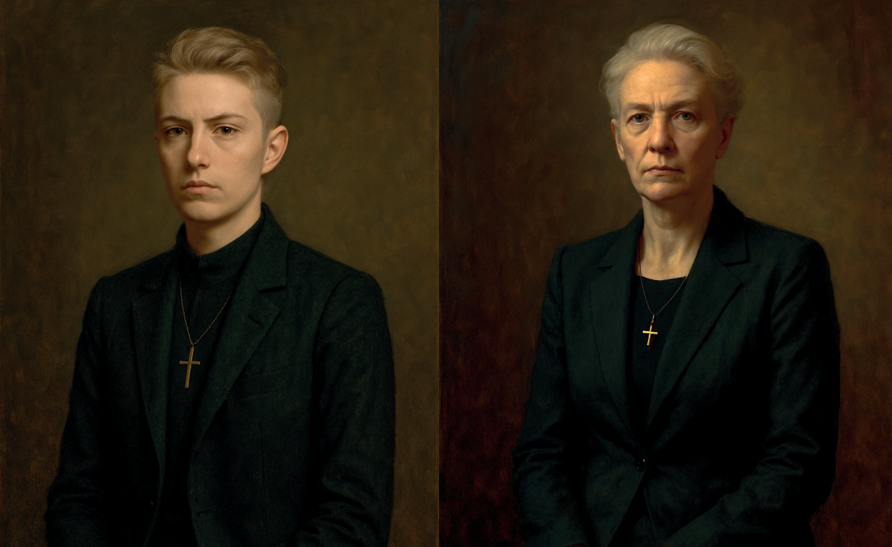
Made with AI; Prompt : “Wie würde Christina von Schweden wohl heutzutage aussehen?”
Historically Queer
In this column, we look back at queer history(ies), both through personal anecdotes and the broader historical context.
If you would like to contribute, please get in touch: info@queer.lu
While searching for a new contribution for this column, I came across a noblewoman from the 17th century: Queen Christina of Sweden. After extensive research and reading two different biographies, I wondered what this woman might have looked like. There are a number of engravings and paintings of her, but they all show a woman who did not seem entirely realistic to me. I asked the AI to create two images for me: Christina in her younger years and Christina as an older woman. This finally enabled me to write about a woman who thought and acted very progressively at a time when Protestants and Catholics were at war with each other (the Thirty Years’ War). She went down in Swedish history as the queen who refused to marry.
Christina was the third child of Gustav II Adolf of Sweden and his wife Maria Eleonora of Brandenburg. After losing two daughters, her parents had wished for a son, and the astrologers had reliably predicted one. At first, the child was thought to be a boy, and the whole palace was filled with jubilation. The disappointment was all the greater when the mistake was discovered. Gustav II quickly composed himself and said: “We want to thank God; I hope that this daughter will amply replace a son for me, and I pray that He will preserve her for me as He has given her to me.”
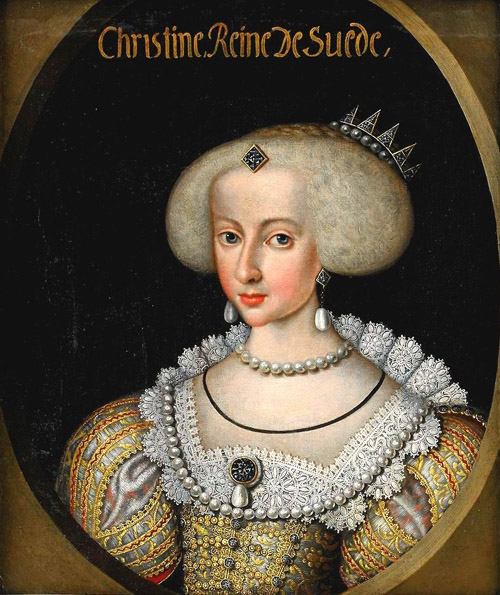
Frühes Porträt von Christina von Schweden um 1640 (Gemälde eines unbekannten Hofmalers); Projekt Gutenberg.
This virtually sealed the fate of little Christina. The king had her educated like a prince and took her regularly on military exercises even as a toddler. When Christina was three and a half years old, Gustav went to war in May 1630 during the Thirty Years’ War. Before his departure, Gustav had settled all the affairs of his country and his family and had his daughter recognised as his sole heir and, in the event of his death, as “King” (!!!) of Sweden. The princess was to learn everything a prince needed to know.
Christina later wrote the following in her memoirs: “The King ordered all my superiors to give me a completely masculine education and to teach me everything a young prince needs to know in order to rule worthily. He expressly stated that [sic] I should not be made to feel my gender in any way, with the sole exception of chastity and modesty. Otherwise, according to his wishes, I was to be a prince and be taught everything befitting a prince. And this is where my inclinations so wonderfully coincided with his intentions, for I had an aversion and an invincible loathing for everything women do and say.” Dressed in men’s clothing, she learned to ride, wield a sword and use weapons.
A year and a half later, when Christina was five years old, Gustav II fell on the battlefield. Axel Oxenstierna, whom Gustav II had appointed as Lord High Chancellor during his absence, remained in his post and continued to manage the affairs of government until Christina was finally old enough to take over herself. She was not raised by her mother Maria Eleonora, but by her aunt, the sister of Gustav II, as he had already noticed during his lifetime that his wife was not suited to the task and would only spoil Christina. After the king’s death, Maria Eleonora demanded that she raise her daughter, but after a short time, all members of the Imperial Chancellery decided against it.
Christina became an inquisitive student. This gave everyone hope that she would one day become an intelligent and wise ruler. At the age of ten, she already knew Swedish, Latin and German. Later, she added French, Spanish and Italian to her repertoire. She devoured all other subjects, such as mathematics, philosophy, astronomy and physics, with equal enthusiasm. She had great affection for all her teachers, but especially for Axel Oxenstierna, whom she described in her memoirs as a surrogate father. The other members of the government were also very fond of her and wanted to put her on the throne at the age of 16, but she refused. It was not until December 16, 1644, the day of her 18th birthday, that she took over the reins of government.
Her affection for Oxenstierna cooled because they disagreed: Christina wanted to withdraw from the Thirty Years’ War and finally bring peace to Sweden, which Oxenstierna did not like. He believed that Sweden had not been adequately compensated for the sacrifices it had made. In addition, he had been trying to pull the strings behind the scenes so that his family could take complete control of Sweden and his son Johann could marry Christina, which would have automatically made him King of Sweden. Christina was to succeed to the throne, but only on condition that she married and thus transferred the royal authority to her husband. As with many other marriage proposals later on, she successfully resisted this one.
As Christina herself announced with brutal candour: “I could not bear it if a man used me as a farmer uses his fields!” In her memoirs, she is also reticent on the subject of marriage: “It is not possible for me to marry, that is how it is. I will not disclose my reasons.” These words shocked the world and sparked wild speculation.
During her reign, Christina transformed Sweden from a barbaric, Nordic society into a cultured country with libraries and museums. She dipped deeply into the state coffers to purchase art treasures, books and paintings, and even had an opera house built. She invited highly respected personalities and intellectuals to Sweden, including the French philosopher René Descartes. But she also ordered a huge art theft and plundered the city of Prague of all its treasures. Overall, she led a free, unconventional life that was considered inappropriate for a woman, even a highly respected one, at that time. She held lavish parties, spent money freely and cared little about finances.
When Christina was 23, the official coronation took place with all the festivities. By that time, however, she had already secretly decided that she would abdicate, as the pressure to finally marry a man and bear offspring was growing.
Five years later, at the age of 28, she announced not only her abdication as queen, but also her religious conversion to Catholicism. Protestant Sweden was thunderstruck. Christina’s father, Gustav Adolf, had fallen for Protestantism in the Thirty Years’ War, and now his own daughter was converting to the Counter-Reformation? This was a bitter blow for the Swedes and the Protestants and a victory for the Catholics and the Pope. The queen’s reputation plummeted. She was branded a heretic and was subjected to abundant abuse and shame from many royal houses across Europe.
“Had she not been a woman born with such [royal] privileges, she would probably have been burned as a witch or heretic.”
She had already chosen her successor. It was to be her cousin Charles X Gustav. Clever and with an iron fist, she negotiated an appanage with the Swedish Imperial Council. As queen (for she retained the noble title of queen), without a country, she intended to continue living a sumptuous life in Rome. She secretly had many luxury goods shipped to Rome in advance.
From her early days in Rome and even before, there are many letters she wrote to her lady-in-waiting and probably lover, Ebba Sparre: “I love you more than anything in the world, and I hope you believe me when I say: my heart belongs entirely to you.”
“I cannot tell you how much I miss you. Every day without you is an eternity. You are my comfort, my light, my joy.”
For political and social reasons, Ebba Sparre was unable to join Christina in Rome. She was married to Jakob Kasimir De la Gardie – against her will, as some sources suggest. The marriage was considered unhappy. However, the marriage was politically advantageous and tied Ebba to the Swedish nobility, making it socially and financially impossible for her to go with Christina. Christina later wrote about Ebba in a distant and disillusioned letter: “I loved her more than she deserved.”
In Rome, Christina was received with all honours by the Pope and lived in the Palazzo Farnese for the first few years. She resided there as a guest of Ranuccio II, Duke of Parma. Here she founded a circle of poets, which later became the Accademia dell’Arcadia, and held a reception every Wednesday so that nobles, clergy and artists had the opportunity to admire the beauties of the palace, which had long been hidden from the public.
She offered her services to the politician and Cardinal Mazarin as a diplomat and mediator in the Spanish-French War of the time. She even wanted to become Queen of Naples and Poland, and all these undertakings were always about money for her. She repeatedly asked her cousin Charles X Gustav to send her more money and increase her allowance, because Christina lived extravagantly and was always short of cash. She remained a patron of the arts and a supporter of young musicians until the end of her life. She even founded a theatre where women were allowed to perform, which was absolutely unique. She never minced her words, which did not always suit the Vatican and other Church representatives.
The French art historian Charles de Brosses described her at the end of her life as follows: “She is now over 60 years old, very small and extremely fat. Her voice and face are masculine, with a strong nose and large blue eyes. She has pleasant facial expressions and an extremely polite manner.”
Christina died in Rome at the age of 62 and is buried in St. Peter’s Basilica.
She became a kind of heroine of the queer movement and feminism. Was she intersex? The initial confusion at her birth and Charles de Brosses’ description certainly suggest this conclusion. Or was she lesbian or even bisexual? The declarations of love in her letters to her lady-in-waiting are an indication. The only thing that can be said with certainty about her today is that she was gender non-conforming and was not raised to be so.
“Between Christina and our time lie thick layers of dust and psychoanalysis”, said Swedish historian Peter Englund about her. Or, in short, after 400 years, the questions about her gender and sexuality can no longer be answered.