
Design: Lloyd Dunn and Editorial Team
Rosa Lëtzebuerg, Luxembourg’s national queer association is a distinctly Luxembourgish story: it’s shaped by inescapable closeness, emotional intensity, and things that take time to unfold. It’s a story of volunteers, of individuals who care deeply, but who often get caught between activism and compromise, commitment and availability, effective advocacy and burnout. Add to this the country’s layered linguistic reality, and the plot thickens quickly. In short, this is a story best told at room temperature.
A quick clarification, for the record. Rosa Lëtzebuerg has nothing to do with the historical “Bloody Rosa.” If anything, the name reads as Pink Luxembourg — obviously in Luxembourgish — though both, in their own ways, were praised and vilified in equal measure.
In 2026, Rosa marks its thirtieth anniversary. Three decades of grassroots work that helped shape queer lives in the Grand Duchy — through pickets and marches, lobbying in front of the Chambre des deputés, come rain or shine, and the slow, frustrating grind of institutional change.
There were moments that must have felt improbable at the time, like stepping out into Place d’Armes to hold the first Pride march, when visibility was a daring act, or the pictures of Jean-Paul and Henri tying the knot at the mairie de Differdange, making headlines news on January 1, 2015, as the first same-sex couple to receive formal legal recognition.
And yet, a glaring absence cuts through the picture. Full trans and intersex rights, equal access to employment, protection against poverty, and the enduring gap between legal achievements and lived reality remain among the most pressing concerns for Luxembourg’s queers.
What follows are six interviews with former presidents of Rosa Lëtzebuerg asbl, retracing key moments in the organization’s history. This is neither an exhaustive account nor a linear read, but a set of perspectives on visibility, compromise, rupture, burnout, and what it actually means to lead under pressure.
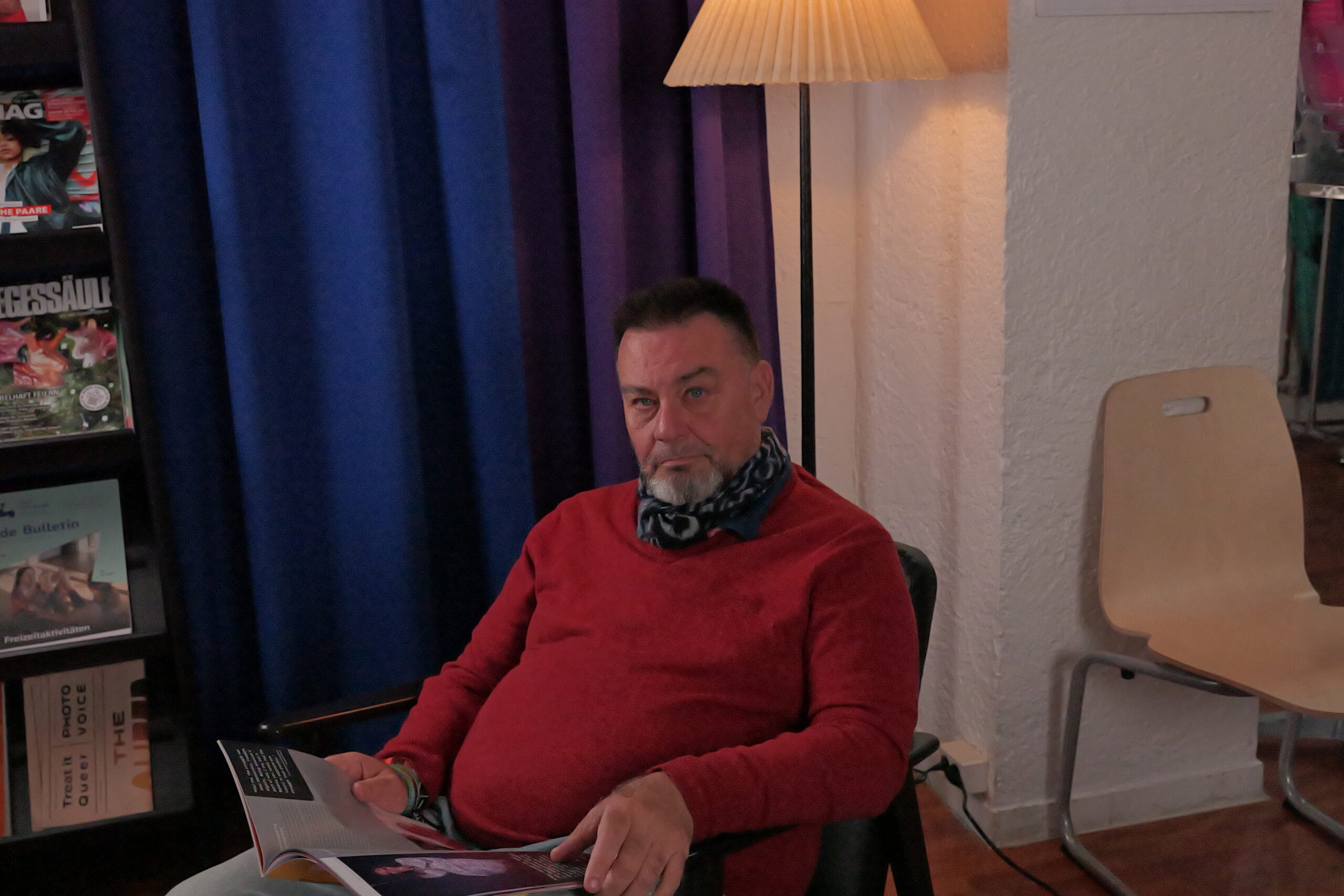
Patrick Weber, Photo by Kusaï Kedri
Patrick Weber — Visibility
Coming out into public space when silence was still the norm
Patrick Weber’s presidency belongs to a moment when visibility itself was political – when speaking publicly about homosexuality in Luxembourg was neither assumed nor safe, but necessary.
queer.lu: When and why did you join Rosa Lëtzebuerg?
Patrick Weber: This was around late 1996 or early 1997. What really pushed me into action was my first Gay Pride in Brussels. I remember turning around during the march and seeing the crowd behind me. It made me cry. I came back to Luxembourg thinking: I have to get involved. At the time, Luxembourg was beginning to debate legal recognition for same-sex couples. There were two proposals: one on opening marriage and another on civil
union — what would later become the PACS. I wrote to several newspaper editors, describing what Pride had meant to me and arguing that things needed to move here. I didn’t sign the letter publicly. Some newspapers published it, others didn’t. Luxemburger Wort didn’t — back then, it simply didn’t deal with these topics. The letter was discussed on Radio ARA by Marc Grond, without naming me. That was my first real step into activism.
What triggered you to join the organization more formally?
I was frustrated by how little visibility there was in Luxembourg. A film night had been announced and then cancelled, but almost nobody even knew it had existed. There were a few posters in gay bars, nothing in the press.
Later, I saw a poster announcing a Rosa meeting. I went — not as a member, but because I wanted to say: you need visibility, you need media, you need public relations. At that time, Rosa was preparing a public conference on homosexuality but didn’t yet know how to structure it. I got involved immediately: shaping the concept, helping define the program, finding speakers, and handling press relations.
At the time, Rosa worked closely with Rosa Lila asbl, which was then the lesbian association in Luxembourg. Rosa Lila existed as a separate organization because many of its members felt uncomfortable associating politically or socially with men — other times, other interactions and dynamics.
How did your first meetings with the board go?
I got involved quickly, and they understood I could be useful — especially because I quickly sense who I might clash with in life, but overall the connection was there.
Did you fear public backlash at the time?
No – because society barely noticed. Even the first conference mostly reached people who were already open. When I later did my first TV interview, I wasn’t afraid. What surprised me was how few negative reactions there were. That conference was a turning point. We expected twenty or thirty people. Instead around 115 showed up. For Luxembourg in the late 1990s, that was significant.
It showed there was a real need to talk openly about homosexuality.
You became president without a formal election. How did that happen?
Marc Grond, Rosa’s first president, was getting seriously ill and could no longer continue. The committee asked me to take over because I was the most involved. I agreed, but on one condition: the association had to function collectively. I couldn’t – and wouldn’t – run it alone. At the next general assembly, there were committee elections, but at that time only a handful of people were willing to take responsibility.
What were your priorities as president?
Making homosexuality visible in Luxembourg — notably through the first “GayMat” in 1999, a small-scale event with information stands that would later evolve into the country’s first official Pride march — and using that visibility to demand rights. Civil union mattered, but marriage equality was always the ultimate goal. The second priority was creating a space where young people — what later became the Centre LGBTIQ+ CIGALE — could find support and safety. Visibility mattered because public awareness was extremely limited. Drag shows existed, but many people still believed gay people were “elsewhere,” not among them. People need faces. They fear what they can’t name.
That idea of visibility still matters to you today.
Absolutely. Coming out isn’t about provocation or attention-seeking — it’s about living in daylight. What worries me today is that some gays and lesbians want to quiet down, to retreat into respectability. That, in my view, plays into the hands of homophobes. It becomes even more dangerous when some queer people claim that trans or non-binary struggles are none of their concern. Every minority struggle should be our own.
How would you describe the political climate of the late 1990s?
We gained access to political parties relatively quickly, but not with open arms. I wouldn’t call the landscape hostile, but there was a lack of urgency when it came to LGBTIQ+ rights. We had to explain why change mattered: couples together for decades without legal recognition, binational couples facing obstacles, older couples needing protection while time was running out.
What hasn’t changed since then?
Visibility. Even today, when someone comes out publicly, people still say, “Why make it public?” — as if heterosexuality weren’t constantly on display without being named. Visibility remains necessary: for young people, for those who are afraid, and for those who come after us. My main fight was — and still is — about representation. Trans people, non-binary people, people of colour remain underrepresented. But representation doesn’t happen by itself. People have to show up, take responsibility, and shape organizations from within.
Many younger queer voices in Luxembourg say their distance from Rosa has to do with what they view as lack of diversity on the board, and the dominance of older cis gay men. What would you say to them?
I understand the frustration. But boycotting won’t change anything. If you want to transform a structure, you have to enter it and work from within. Generational conflict exists everywhere. The only way through it is participation.
Where do you see the queer movement heading?
I’m worried — not because of who we are, but because of the political climate: authoritarianism, disinformation, the rise of the far right. History shows that queer people are among the first to pay the price. If trans rights are rolled back, gays and lesbians are next. Many still think that warning is exaggerated. I don’t think reality will take long to prove otherwise.
François Diderrich, photo by Kusäi Kedri
François Diderrich — Consensus
Change through compromise
François Diderrich’s presidency focused on turning long-standing queer demands into law. It was a slow, uneven process marked by the adoption of civil partnerships and the long road toward marriage equality, and the creation of support structures such as the Centre CIGALE, which emerged to address concrete needs that Rosa’s volunteer structure could no longer absorb: counseling, legal guidance, group support, education, and a permanent community space.
queer.lu: When did Rosa Lëtzebuerg first enter your life?
François Diderrich: In 1999. A friend told me about Rosa’s General Assembly in Bettendorf. There were around twenty people. I was 39, and I remember being genuinely surprised that such an organization even existed in Luxembourg.
What motivated you to get involved?
A mix of community and politics. Luxembourg can feel very small when you’re looking for people who share your values. And politically, the inequality was obvious: we couldn’t marry, and even financially same-sex couples were disadvantaged. That sense of injustice had been with me for a long time.
You took on responsibility very quickly.
Rosa needed people. The treasurer position was vacant, so I stepped in. It was practical, largely invisible work — bookkeeping, handling cash at events, membership fees — but it kept the organization running.
How did that lead to the presidency?
I became secretary in 2000 and 2001, dealing with correspondence, subsidy applications, and press texts. Then, in 2002, Patrick Weber left rather suddenly. We were in the middle of setting up CIGALE, and there were no candidates. We couldn’t afford a leadership vacuum. I accepted out of a sense of responsibility, not ambition.
What defined your presidency politically?
Two milestones above all. First, civil partnership, which came into force in 2004. Then marriage equality, with the draft law emerging in 2010 and its adoption following in 2014. Everything we did revolved around those goals — public discussions, roundtables, press work, sustained visibility.
How receptive were media and political actors at the time?
We had access to media like RTL and 100,7, sometimes Radio ARA. Politically, the Greens were the most open, followed by the Socialists. The CSV was slower, but not monolithic — there were individuals who were genuinely receptive.
Rosa was rarely confrontational during your tenure. Was that deliberate?
Yes. I tend toward consensus. Some activists wanted stronger tactics, and we did experiment — for example with street petitions — but our instinct was to convince rather than provoke. That approach also reflected Luxembourg’s political culture at the time.
Do you have any regrets about that strategy?
No major ones. Different moments call for different methods. At that point, persuasion felt more effective than escalation.
What was the most demanding period for you personally?
The late 2000s, when trans issues became more central. Early Rosa focused mainly on sexual orientation. Gender identity wasn’t yet fully integrated. We were never hostile, but it required new language, new frameworks, and more time than a volunteer structure could realistically provide.
How did you view the later creation of ITGL?
As necessary. Trans advocacy is complex and deserves its own dedicated structure. Unity matters — but it also has to be realistic. We were stretched thin.
CIGALE was created during your presidency. Why was it needed?
Because people were already coming to Rosa with concrete personal problems — legal questions, family situations, mental health concerns. CIGALE emerged around 2002–2003 to provide structured support: one-to-one counselling, group work, education. At first, Rosa even carried the legal responsibility.
Rosa didn’t have its own premises for a long time.
That’s true. Meetings were held in cafés, later in shared spaces with CIGALE. Volunteers built the organization before it had a roof. It really was grassroots.
What did leadership teach you?
That volunteer organizations are fragile. Often, an entire project depends on one person. When that person leaves, everything can wobble.
Why did you not apply for a new tenure?
I was exhausted. The work had intensified, especially toward the end, and it felt right to pass the baton.
Today, some younger activists say Rosa doesn’t represent them. How do you respond?
I understand the impulse to create new structures. They can be clearer, faster, more focused. The risk is fragmentation. Specialization is fine — but disconnection weakens everyone.
How do you see Rosa’s evolution today?
As growth. Like a plant developing branches. People find where they belong — but the branches still need to belong to the same tree. Unity still matters.
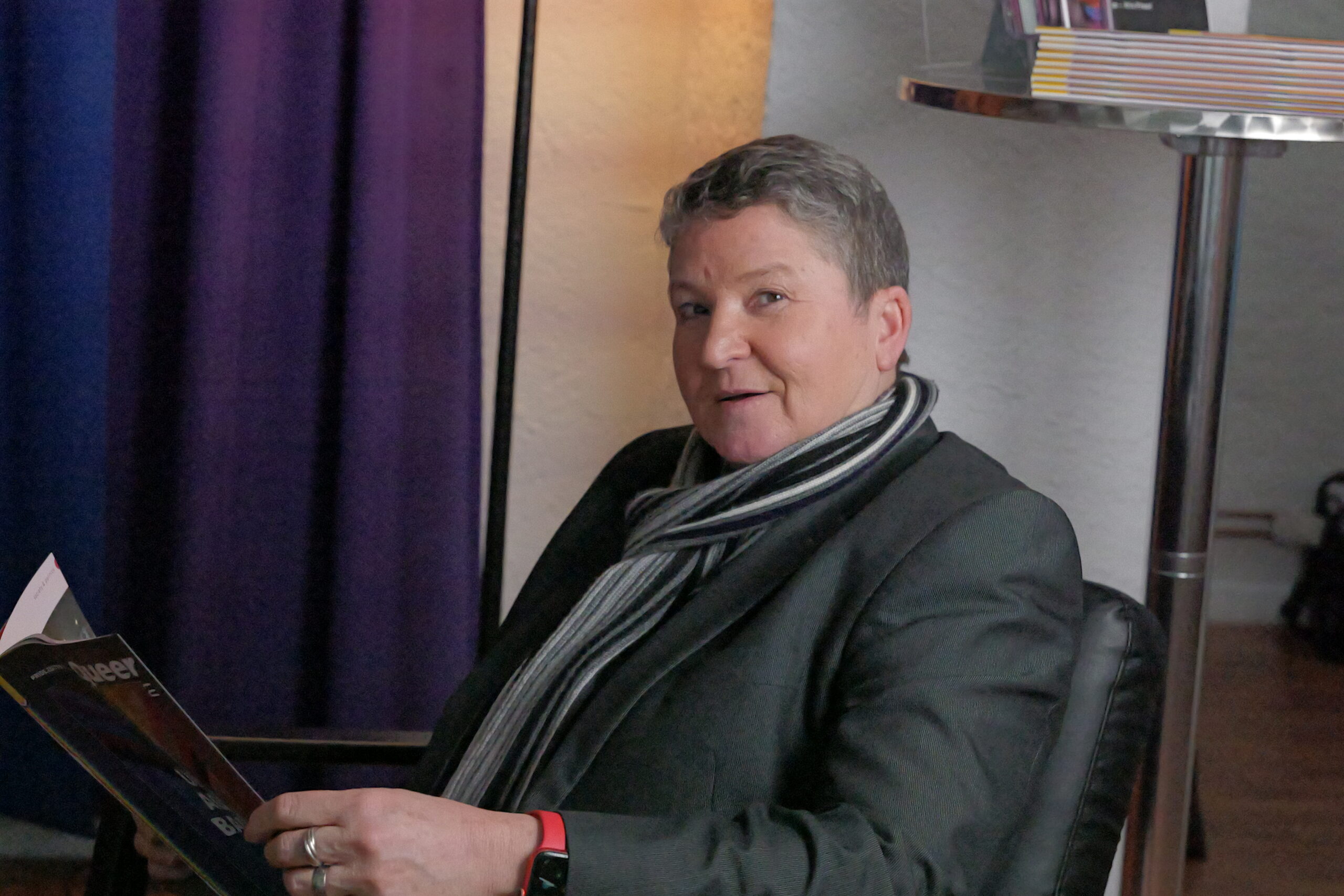
Gabriele Schneider, photo by Kusäi Kedri
Gabriele Schneider — Belonging
Making space where visibility was no longer enough
Gabriele Schneider became the first woman to serve as president of Rosa Lëtzebuerg at a moment when visibility and activism alone no longer answered the organization’s internal questions. Her presidency shifted attention toward space, safety, and who actually felt able to belong — especially women and trans people — inside a growing, but still fragile structure.
queer.lu: How did Luxembourg’s queer community first become part of your life?
Gabriele Schneider: I came to Luxembourg in 1986. At the time, the community was very small and centered almost entirely around nightlife — parties, drag shows, discos, informal meeting places. There was a social scene, but very little structure.
When did politics enter the picture?
Slowly. Rosa Lëtzebuerg was founded in 1996, but initially it focused on visibility for gays, and to a lesser degree for lesbians. Other identities existed, but they were not yet central. Above all, there were no dedicated spaces — especially not for women. The Centre CIGALE brought a fresh perspective to the community, through school outreach and awareness-raising activities. As president, one of my central missions was to strengthen the visibility of CIGALE’s services and to deepen its relationship with government institutions, with the aim of advancing a first national action plan for LGBTIQ+ rights.
How was your interaction with the board members of Rosa?
I met François Diderrich and other founding members around the time of the first GayMat, in 1999 or 2000. We talked a lot about what was missing — particularly the absence of women within Rosa’s structures.
What did that absence mean concretely?
A lack of comfort and safety. As a lesbian, there was no place where you could simply exist, talk, come out, exchange experiences. That absence made it clear that something had to be created.
You became involved in GayMat early on.
Yes — in 2000, I joined the organising team for the first time. GayMat — the Luxembourg Pride event, which later became Luxembourg Pride — was the key public moment of visibility. A small march took place during the very first GayMat in Luxembourg City, but in the years that followed, marches were no longer permitted. Despite these restrictions, the event continued to grow and became increasingly political, combining panel discussions, cultural programming, and public visibility. Organising GayMat was challenging — with limited funds, administrative obstacles, and open resistance — but it mattered deeply.
Before becoming president of Rosa, you led a women’s organization.
From 2004 to 2009, I served as president of the lesbian association Rosa Lila, which later became the Rainbow Girls. The work was essential in building visibility for lesbian and queer women, but the structure struggled to renew itself over time. It was during this period that I realised Rosa Lëtzebuerg was the only organisation with real political weight in Luxembourg — and the one where the interests of the entire community ultimately needed to be represented.
When did you join Rosa’s board?
Around 2009-2010. At that point, discussions were intensifying around women’s visibility, the further development of CIGALE, and the lack of safe, accessible spaces — particularly as CIGALE was then located underground, a setting many women and trans people experienced as unsafe.
That led to the creation of the women’s section.
Yes. At the end of 2008 and beginning of 2009, the Pink Ladies were founded. They began organising meetings and events dedicated to women and rainbow families under the umbrella of Rosa. For a time, we met in CIGALE’s offices, but many women expressed the need for a space closer to the city centre. We were then welcomed into a discreet, protected location within the Chocolate House — a setting that offered both visibility and a sense of safety.
What impact did that have?
It changed everything. Women came — young, older, mothers, retirees. Thirty or forty people at a time. People who had been invisible finally felt they belonged somewhere.
You became president shortly after.
Yes, in 2010, after François Diderrich prepared to step back. I became the first woman to lead Rosa. The support from the community — especially from women — was very strong.
How would you describe your presidency?
Intense and demanding. Leadership meant being present — listening to the community, but also engaging with wider society. It meant being at the heart of the action: defending the rights of the community, offering support, and raising awareness — at meetings, at Pride, with volunteers, in dialogue with institutions, and within international networks such as ILGA, the Fundamental Rights Agency, and other human-rights platforms. In a volunteer organisation, you simply cannot lead from a distance.
Trans inclusion became a major issue during that time.
Yes. Trans women joined the women’s section because they identified as women. That triggered debates within the lesbian community. Some were open, others resistant. For me, inclusion was not negotiable. If you identify as a woman, you belong.
But this also led to structural tensions.
Exactly. Trans and intersex advocacy requires expertise, time, and professional capacity. Volunteers alone cannot carry everything. That’s why independent structures like ITGL eventually made sense — not as fragmentation, but as necessity.
Another major moment was moving Pride to Esch.
After years of obstacles in Luxembourg City — restricted space, administrative resistance — we reached a breaking point. Esch welcomed us. The city offered funding, visibility, and political backing. Pride was able to grow.
How do you feel about the idea of Pride returning to the capital?
I understand the symbolic importance of the capital. But Esch must not be erased. It stood with the community when others did not. Ideally, Pride should expand — not rewrite its own history.
Why did you eventually step down?
Exhaustion. Pride relied too heavily on a small number of people, as did the day-to-day management and supervision of CIGALE. Without real delegation, it became unsustainable. Stepping down was painful, but it was the only responsible choice — for me and for my spouse, who was serving as Rosa’s treasurer at the time. Nearly all of our free time had come to be absorbed by the association.
What remains Rosa’s main challenge today?
Being a true umbrella organization. Inclusion requires presence, listening, and work — not just declarations. Board members need to be visible in the community.
What advice would you give to a woman considering the presidency?
Bring your strength — and share it. Defend your vision, make it heard, and stand up for the whole community. Show up, speak out, and don’t carry the role alone. You need the support of your board — don’t be afraid to ask for it, and to insist that responsibility is shared.
And to trans people who may feel sidelined?
You belong. Representation starts when voices enter the room — even when it’s difficult.
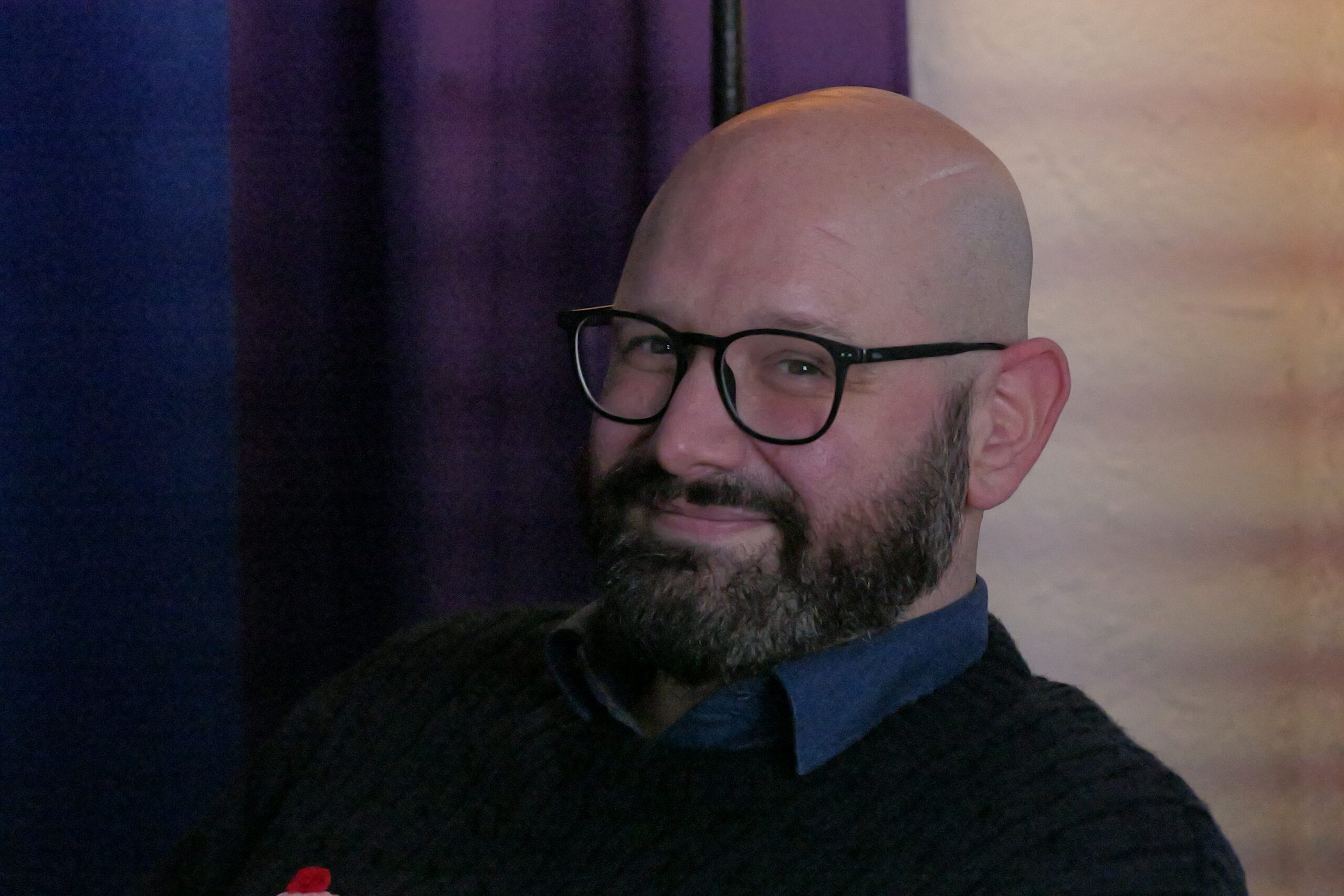
Romain Mancinelli, photo by Kusäi Kedri
Romain Mancinelli — A Crack in the Pot
When commitment became a breaking point.
Romain Mancinelli’s presidency was brief and turbulent. It unfolded at a moment when Rosa was struggling with participation, structure, and uneven commitment — and it exposed how fragile a volunteer-run organization can become when expectations collide. His tenure did not fall quietly. It broke, publicly and painfully, forcing questions about responsibility, power, and what leadership can realistically demand.
queer.lu: How did you first come into contact with Rosa Lëtzebuerg?
Romain Mancinelli: Through my coming out. I was around 19 when I first went to a gay bar in Luxembourg. That’s where I met people connected to Rosa and CIGALE. For me, CIGALE — which was then housed in the basement of a building in Bonnevoie — felt safe.
What did Rosa represent to you then?
Rosa was the militant arm. I never really identified as militant myself. I was more drawn to the social side: meeting people, building community.
How did you become more involved?
I helped where I could — magazine work, helping out around GayMat, which was the original name for Luxembourg’s annual Pride. Later, I joined the board during Gabriele Schneider’s presidency. I admired her. She was fully invested, often carrying things almost alone. I wanted to support that and move things forward.
Tell us about your vision for Rosa?
To make it a real umbrella organization — visible, structured, financially stable. I believed members should commit: pay fees, participate, work. Without that, you can’t build anything sustainable.
How did the board members react to that?
Many people didn’t want to invest time or energy. They wanted symbolic presence, not operational responsibility. That created deep frustration.
What led you to take on the role of president?
Gabriele wanted to step down. There were no other candidates, so I agreed to take over as interim president. It wasn’t ambition. It was fear that Rosa would stagnate or fall apart.
What was your tenure like?
Lonely. I tried to meet more people, plan ahead, and be present externally — institutions, conferences, embassies. Instead of more engagement, there was less. Board members stopped showing up. You can’t lead alone in a structure that requires collective decisions.
You’ve mentioned that you were quite “pushy” in your approach.
I was pushy about finishing what we started. About showing up. I was very clear: if being on the board isn’t your priority, then you shouldn’t be on the board.
That led to a rupture.
During a meeting, I said: either people commit, or I’m the wrong person for the job. A decision was made. I walked out, knowing I wouldn’t return.
How did that feel?
Brutal. Rosa had been my safe space. Losing it overnight hurt deeply. But I couldn’t keep pretending everything was fine.
You were president when CIGALE formally separated from Rosa.
Yes. I signed the papers. It had been discussed before. At that point, keeping everything together was no longer functional.
How did you stay connected to the community afterward?
Through Pink Gents, a monthly gay get-together. It’s a simple concept: friends sitting down for dinner, sharing a meal, talking. Community starts with presence.
What did this teach you about leadership?
That leadership requires honesty — and honesty has a cost. Without people who share your level of commitment, you burn out.
How do you see the community today?
Fragmented — by language, culture, generation. That worries me, especially with politics shifting in Europe. I fear we’ll only come together when we’re under attack — and I hope we won’t be too divided to fight back.
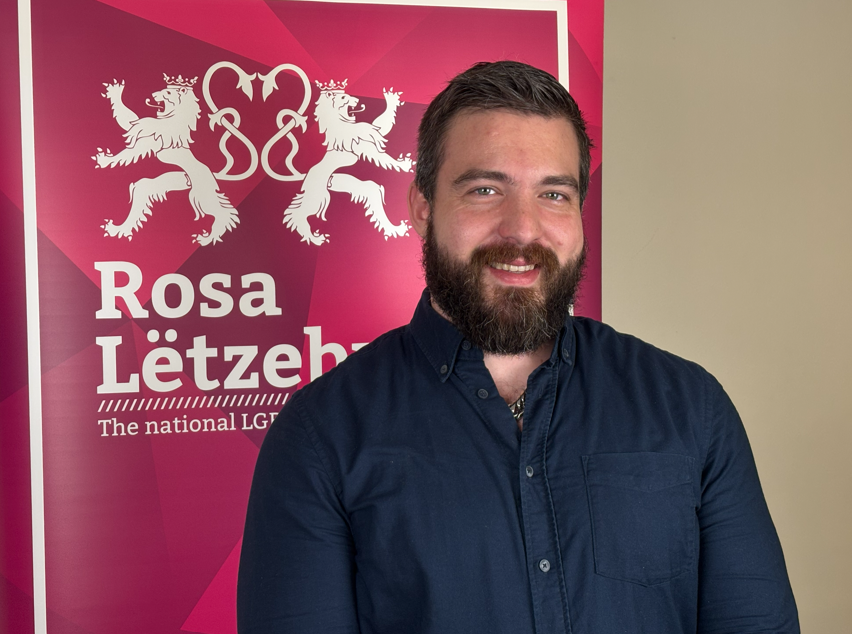
Nicolas Van Elusé, photo by Kusäi Kedri
Nicolas Van Elsué — Navigating Challenges
When keeping afloat becomes the job
Nicolas Van Elsué’s presidency lays bare the emotional and structural cost of holding an organization together when volunteer energy runs thin and pressure intensifies.
queer.lu: When you became president, what was the hardest thing to accept?
Nicolas Van Elsué: That not everyone has the same energy, time or motivation. I tried to balance asking people to act, reminding them, and at the same time I tried to balance asking people to act, reminding them, and at the same time respecting their limits. That’s where frustration started. Even after several reminders, some things simply weren’t done. It’s difficult because these are also your friends — people with jobs, partners, private lives. At some point, association work becomes semi-professional. You still treat people as friends, but they are also members with responsibilities. Managing that tension wasn’t easy. During events, I felt supported. But during preparation — all the invisible work — I often felt alone. Not because of bad intentions, but because everyone was already close to their limits.
Did you underestimate what volunteering really means?
Partly, yes. I entered through Pride, which has a very specific rhythm — deadlines, pressure, urgency. Outside Pride, what frustrated me most was the habit of endless discussion. We talk and talk, but when it’s time to decide and act, progress is often slower than expected. Even after long debates with valid arguments, implementation just doesn’t happen that easily. That was the most difficult part for me.
What were your priorities when you took on the role?
At the beginning, I didn’t know specifically where to start, so the initial goal was simple: keep everything running and expand on things later. However, two things were of importance to me. First, volunteers and community. The board hasn’t welcomed new permanent members in recent years. That’s not a failure — but the current people cannot keep up this work forever. We need new energy, new people, new ideas. When newcomers arrive with motivation, they are immediately confronted with unexpected complexity and rigidity in the processes. The second pillar was structure. Not bureaucracy for its own sake — but clarity.
Volunteer structure became your main battle — it eventually hit against the wall. Why?
We organised meetings and events to discuss the future, and then … almost nothing happened. Adjustments in this area are very labour-intensive, but volunteering is the heart of an association. People need to feel valued and recognised. There was an opportunity to obtain official volunteer recognition, which could have brought visibility and new members. But this requires basic structure — documentation, follow-up and coordination. What I experienced was a lack of collective buy-in. Some felt it was “too procedural.” Others said they’d do it — but weren’t able to put words into action. In the end, I felt like I was the only person who was taking responsibility for volunteer coordination, and this on top of all the other work. However, volunteer management can’t be a one-person job. However, volunteer management can’t be a one-person job. We need more people on the board so that the tasks can be distributed more fairly among more people.
When did you realise the role wasn’t sustainable?
During the petition targeting LGBTIQ+ topics in schools. That was the breaking point. It was summer 2024. I tried to bring people together — not just the board, but the wider community. Rosa is seen as a representative voice. But I felt we were not able to fulfill that role as I wanted to. Coordination failed. Stakeholders acted separately. Old conflicts resurfaced — during a direct attack on the community when unity was required.
I’d been close to quitting before, but this time I was frustrated with myself. I
realised I couldn’t keep going like this without burning out completely.
Rosa’s Annual Gala event seems to have exacerbated that exhaustion. Is that fair to say?
Yes. I had clearly said I couldn’t take responsibility for it — I was already at my limit. But no one else stepped in, and I ended up leading an event I didn’t believe was a priority at that moment. The hardest part wasn’t the work itself. It was that after months of asking for help, comments appeared on the day of the event from different directions. I had to keep things together, show the united front. But when it ended, I felt empty — not proud, not happy. Just done. The next morning, I sat on my couch and cried. Everything I had been holding back came out at once.
Did you feel supported?
I had raised my concerns several times and signaled I needed more help. I didn’t feel truly seen. Even when there was understanding, it wasn’t at the level I needed. Then my private life started to get more and more intertwined with the association work, which blurred everything further. Sometimes you don’t even know whether your exhaustion comes from work, the association, or your private life. Everything piles up.
Why did you stay as long as you did?
Stubbornness and loyalty. Rosa has given me a lot: it helped me discover skills and parts of myself. Even in difficult moments, there was still a sense of team. And there’s that voice saying: you don’t abandon people when things get hard. But responsibility can turn into self-destruction if you’re not careful.
In hindsight, do you see your presidency as a failure?
I try not to think like that. I hope I contributed something.
What do you consider achievements from your tenure?
Continuity. Building on what previous presidents did — especially in diplomatic and institutional relationships. Rosa wasn’t forgotten. Ministers and ambassadors remained openly supportive. And despite everything, the Rainbow Center grew — structurally and in activity. An organization that steadily grew in both visibility and responsibility did not collapse under its own weight. That matters.
You’re still a Rosa member today, why is that?
Because community work still matters to me. Rosa changed my life. It forced me to confront my own limits and privileges. It pushed me to listen more. I just know now that I need boundaries. I can help — but not without limits.
What warning would you give to the next president?
Protect your private life. Motivation alone will not save you. And remember: being president doesn’t mean deciding everything. Leadership is knowing when to speak — and when to let others speak. If you forget that, you’ll burn out. Or you’ll burn bridges.
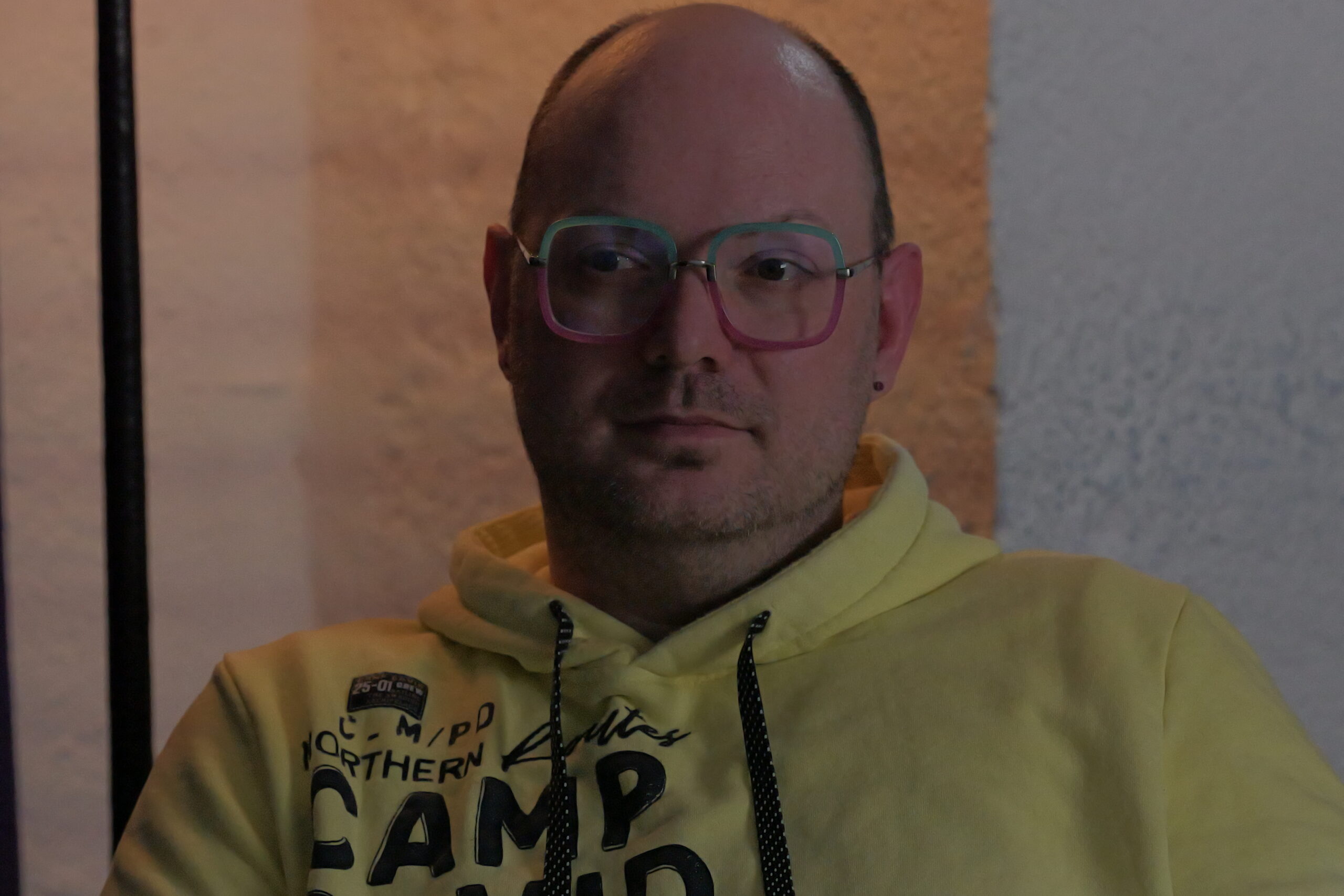
Tom Hecler, photo by Kusäi Kedri
Tom Hecker — Staying the Course
Exposure, Endurance and Care
Tom Hecker is the current president of Rosa Lëtzebuerg. His presidency unfolded in two stages, interrupted briefly by a short-lived leadership transition, before he returned to the role. Over the years, his public visibility has grown significantly – as Tom, as drag performer Séraphine Mirage, and as storyteller Tatta Tom, reading stories to children.
queer.lu: How did you first hear about Rosa Lëtzebuerg?
Tom Hecker: I was very young — around 18. My first contact was actually through an event: a speed-dating in the north. My parents and my sister drove me there. Later, I got more involved through Pride. I had started doing drag in Liège, and when I came back to Luxembourg for the summer, I joined a Pride fashion walk. That was when I really became aware of Rosa.
What was the organization like then?
Much more Luxembourgish. No social media. Flyers, La Pie qui Chante, and CIGALE — like the Rainbow Center today — as a place to get information and meet people. Language shaped groups naturally, but I never experienced that as a real problem.
You joined the board during Gabriele Schneider’s presidency. What was that like for you?
Positive — but tense. More people doesn’t automatically mean things get easier. There were always tensions on the board. Honestly, sometimes I didn’t understand why — and I still don’t. I tend to look forward rather than dwell on conflict.
At one point, you left the board. Why?
I felt useless. Not because it wasn’t enjoyable — but because I couldn’t find my place. I didn’t feel I was changing anything for society.
And yet you returned — and eventually became president.
People asked me to come back because the board needed stability. I thought maybe I could help calm things down. That didn’t really happen. But I stayed because the community needs an organization that functions — otherwise, nothing moves.
You’ve spoken openly about a situation you now regret involving Romain Mancinelli’s departure from the board.
The separation of Romain from the board was carried out for statutory reasons. Whether this was the appropriate course of action can be debated from today’s perspective. At the time, however, it was considered the only viable solution in the interest of the association.
When you look back on your tenure, what emotion dominates?
Not anger. Never anger. I don’t regret my actions — because in the moment, they felt right. I look back with a smile. Things changed. Things were built. I was part of that process.
Talk about your happiest moment as president.
One Pride — after the Equality March. I was on stage and people just kept coming. It didn’t stop. I had tears in my eyes. That feeling of being together, of proving the bad people wrong — it stays with you.
And your lowest point?
When internal communication became challenging and the gap between public responsibility and internal processes grew too wide. That’s when I had doubts about continuing.
Your public visibility goes beyond the presidency. How do Sérafine and Tatta Tom fit into this story?
Drag gave me confidence. A lot of drag artists will tell you the same. Through Rosa, I was able to do awareness work — sometimes in unexpected places. Tatta Tom came after the library asked me to adapt a Pride reading for children. And yes, visibility has a cost. After the Tatta Tom controversy, you become more cautious. You don’t immediately know whether someone approaching you is friendly or hostile.
If you had to define the role of president in one word?
Communication.
What advice would you give your successor?
Grow a thick skin. And if you ever develop an ego, get rid of it. This role isn’t about you — it’s about the community. And take care of your inner child. Keep it alive. If it’s happy, you’re happy — and less likely to turn into an asshole.
