
A year ago this month, the world witnessed the inauguration of Donald Trump as president of the United States for a second term. From the moment he came into power, on January 24, 2025, the State Department issued a directive halting all US foreign assistance for 90 days, and shutting down the funded programs of the U.S. Agency for International Development (USAID). The move paused all new funding obligations, allegedly to align foreign aid with the administration’s “America First” agenda.
As a result, hundreds of organizations in dozens of countries were forced to suspend or scale back critical services — including legal aid, mental-health support, HIV treatment, community services, and decriminalization advocacy. In parallel, some governments increasingly relied on “foreign-funded NGO” rhetoric and legislation to delegitimize LGBTI+ organizations, restrict pride marches, and muzzle activism — part of a broader global rollback of fundamental human rights.
What followed was a political domino effect. Several governments, emboldened by Washington’s shift, leaned more aggressively into the “foreign-agent” narrative, using them to undermine civil society. Across Europe, activists describe a sense of déjà-vu, an old playbook returning with renewed force.
European Context: Coordinated Anti-Rights Movements & the Funding Freeze
“Across Europe, we’re seeing a deliberate and well-coordinated push from far-right and anti-rights actors,” Katrin Hugendubel, Advocacy Director at ILGA-Europe, told queer.lu. ILGA-Europe is the International Lesbian, Gay, Bisexual, Trans and Intersex Association, advocating for LGBTI+ people across Europe and Central Asia. “They want to restrict fundamental rights, question international and European human rights standards and institutions, and undermine democracy”.
These movements aren’t new. Their roots stretch back to the early 2000s. But as Hugendubel explained, the scale has widened dramatically. “This is no longer limited to a handful of countries. It’s a regional trend, from Central and Eastern Europe through parts of Western Europe — and we see it globally as well”.
The tactics are familiar: limits on freedom of expression, attacks on civil society, orchestrated disinformation campaigns, and the steady spread of foreign agent laws. Legislation framed as targeting LGBTI+ “propaganda” often functions as a broader authoritarian tool, shrinking democratic space and criminalising dissent.
“LGBTI+ rights are being used as a gateway, an entry point”, Hugendubel emphasised. “What starts with censorship of queer lives often expands into systematic suppression of the press, opposition movements, and human rights defenders”.
As anti-rights narratives sharpen, the resources available to fight them are shrinking. ILGA-Europe confirmed to queer.lu what many organisations have been warning for months: a real and escalating funding freeze. Major donors have shifted priorities amid global crises; foreign aid budgets are tightening; and political pressure from anti-rights groups within donor countries is shaping where money can safely flow. When big donors step back, smaller institutions and governments follow — triggering a chain reaction that leaves LGBTI+ organisations dangerously underfunded.
Compounding the problem, foreign-agent laws modeled on Russia’s legislation have surged. In the last year alone, Bulgaria, Georgia, Hungary, Kyrgyzstan, and Montenegro have proposed or adopted such measures. Their message is clear: NGOs receiving international support are portrayed as suspect, disloyal, or illegitimate.
ILGA-Europe itself has been affected. The organisation has had to reorganise programs, tighten priorities, and concentrate resources where impact is most immediate. “Movement building, safety, and resilience remain central”, Hugendubel said.
Three countries — Hungary, Moldova and Türkiye — illustrate how these trends collide on the ground.
HUNGARY
“We knew this was about freedom of assembly”.
In Hungary, the erosion of LGBTI+ rights has unfolded over more than a decade — slow at first, then accelerating with authoritarian precision. Victoria Radvani (she/they), president of Budapest Pride, recounted this trajectory in an interview with queer.lu.
“Since Viktor Orbán came to power in 2010, he’s been building a systematic crackdown on LGBTI+ rights”, she said. It began with a 2012 constitutional ban on equal marriage and intensified during the COVID-19 pandemic, when protests were banned and public life was frozen.
During that period, the government:
- banned legal gender recognition for trans and intersex people;
- dismantled the Equal Treatment Authority;
- restricted adoption rights, by placing final decisions in ministerial hands;
- passed a Russian-style propaganda law in 2021, censoring LGBTQ+ topics in education and media.
2025: Orbán’s Pride Ban — and its Collapse
The decisive blow came on February 22, 2025, when Orbán used a State of the Union–style speech to promise his supporters that Pride organisers “would no longer need to trouble themselves”. Hours later, Parliament passed a law criminalising any demonstrations that “mention or promote homosexuality or gender change”. Organisers now face up to one year in prison, participants risk fines of up to €500.
Budapest Pride was not unfazed.
“We knew this was about freedom of assembly”, Radvani said. “If we don’t stop this, other movements and minorities will be next”.
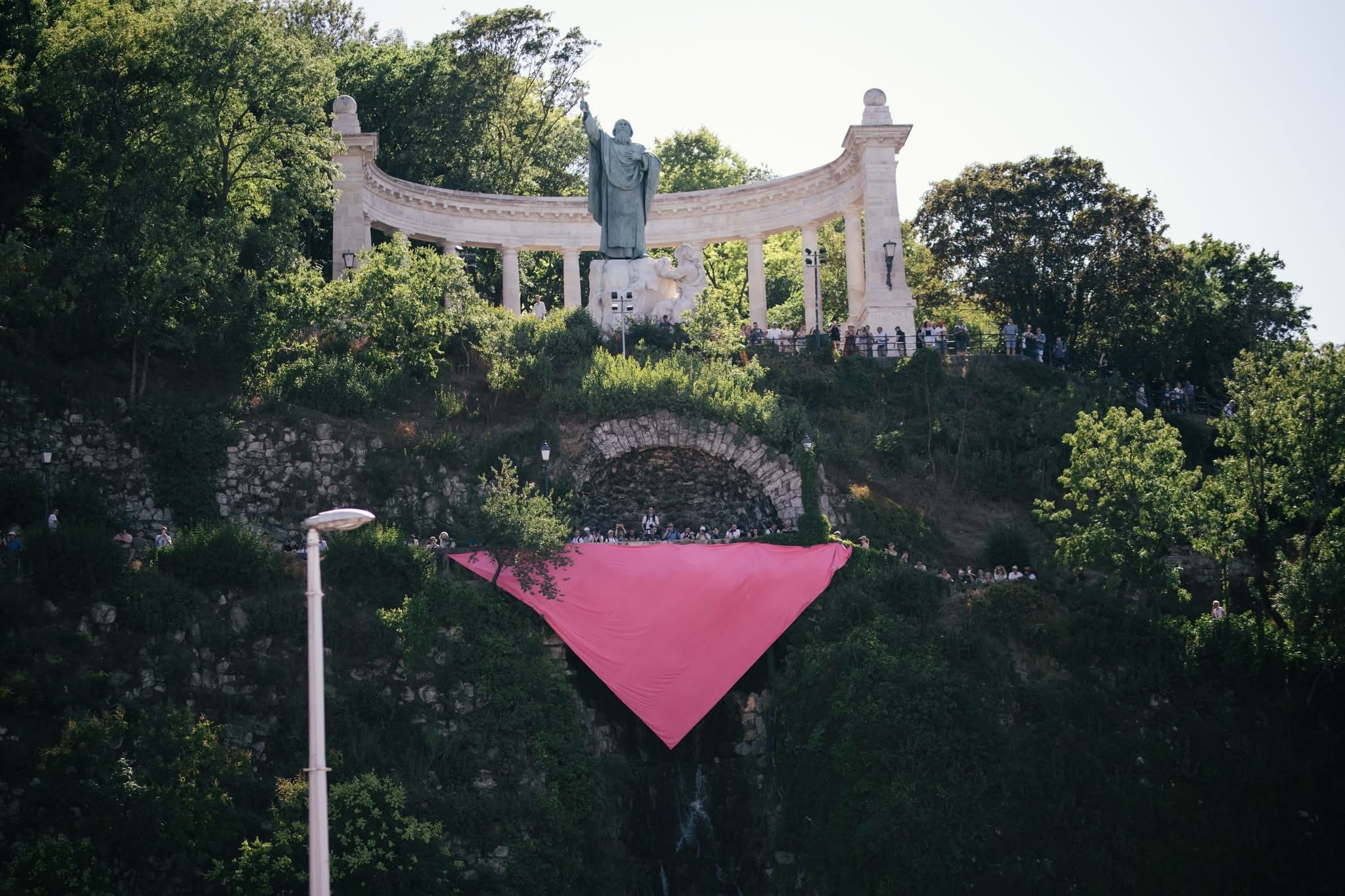
Pride organisers teamed up with the Municipality of Budapest, reclassifying the march as a city event. That simple legal shift changed everything — enabling the largest protest in Hungarian history, with an estimated 300,000 and 500,000 participants.
Delegated Violence & Corporate Anxiety
While anti-pride groups have long attempted to disrupt marches — “often with quiet coordination from the governing party”, Radvani notes — 2025 brought a new challenge: funding collapse.
“When Orbán announced the Pride ban, 95% of our corporate sponsors dropped out”, she told queer.lu. No law required them to do so. But fear did. Radvani calls it early compliance — corporations choosing to anticipate repression rather than resist it.
“It’s dangerous for human rights movements to rely on corporate sponsorship. Most actors change their operations instantly when the political landscape shifts”.
Budapest Pride now turns to crowdfunding, community donations, and local businesses to survive — yet long-term sustainability remains precarious.
What Europe Must Learn from Hungary
Many international donors stopped funding within EU member states years ago, believing governments would safeguard human rights infrastructure. But, Radvani warns, the assumption no longer holds.
“What we need is capacity. The actors who deliver effective projects are easy to find — donors just need to come back to the table”.
More than anything, she told queer.lu, movements must invest in alliances: across sectors, across borders, across identity lines. “When a crisis hits, those networks are your lifeline”.
MOLDOVA
“We hope to protect our community before narratives turn into laws”.
Unlike Hungary, Moldova has not seen a dramatic rise in far-right extremism — a rare exception in today’s Europe. But that doesn’t mean the country is free from threats.
Leo Zbancă (he/they), Organisational Development Program coordinator at GENDERDOC-M, described a more subtle but increasingly volatile landscape.
GENDERDOC-M, founded in 1998, is Moldova’s oldest LGBTI+ organisation and provides legal, psychological, and social services through four major programs, while also leading national advocacy and awareness campaigns.
The Funding Freeze Hits Home
The organisation is entirely donor-funded, making it acutely vulnerable to global shifts. The U.S. funding freeze alone caused a 12% annual funding loss, and far fewer funding calls are available than in previous years.
“This threatens our financial sustainability, especially as of 2026”, Zbancă told queer.lu. The group has launched a Patreon, but it can only cover secondary needs. International donors and embassies remain essential.
Populism, Not the Far Right — But Still Dangerous
Moldova’s threat comes not from the far right but from left-wing populist parties — the Socialists and Communists — historically aligned with Russia.
“They use the same anti-LGBTI+ narratives, contaminating the public information space and polarising society”, Zbancă explained.
This rhetoric intensified dramatically during Moldova’s election cycle from 2023 to 2025. During the 2024 presidential election and the referendum on the EU accession path, anti-queer messaging became a central tool used to court conservative voters.
“This created a high level of anxiety within the community”, Zbancă recalled. “Many feared what might happen if pro-Russian forces came to power.”
The pro-European party’s victory in September 2025 brought relief — but the threat remains latent.
With a democratic government in place, GENDERDOC-M is pushing for:
- equal marriage or civil partnership legislation;
- a legal gender recognition law;
- and public education efforts to immunise society against anti-LGBTI+ political manipulation.
“We want to see Moldova in the European Union”, Zbancă told queer.lu, “with stronger protection for the diverse groups that make up the LGBTI+ spectrum”.
Türkiye
“The iron that is used does not rust — but my back hurts”.
In an interview with queer.lu, Janset Kalan (she/her), a 38-year-old trans human rights defender, described herself with a smile: “I’m a single mother of four — my cats”. But the joke is also a political statement. “When you think of how Turkish society sexualizes single mothers, how they’re treated as incomplete without a man, how they face harassment and discrimination in every public institution — it mirrors the experiences of trans women”, she told queer.lu. “The neighbors think you’re hypersexual. Men think you have universal consent. The state thinks you’re immoral and obscene.”
Kalan is the general coordinator of the Rainbow Association Against Discrimination (ARC) — a network of 13 LGBTI+ organisations across Türkiye. ARC provides mentorship, capacity-building, and subgrants, ensuring its members can keep offices open, pay staff, and offer essential psychosocial and legal support.
Its role has become nothing short of existential.
A Community Under Siege
“The queer community in Türkiye today is highly oppressed, in poverty, and targeted”, Kalan told queer.lu. “But it is also very strong, resilient, and knowledgeable.”
According to counsellors across queer organisations, young LGBTI+ people face soaring levels of anxiety, depression, and self-harm risk. The crisis worsened sharply after November 2024, when the government restricted access to hormone replacement medication. The number of trans people seeking psycho-social and legal aid has skyrocketed ever since.
The threats are multiple and overlapping:
- Access to gender-affirming healthcare is collapsing;
- Trans women and sex workers face obscenity charges;
- LGBTI+ content is censored across media platforms;
- Pride marches and gatherings are routinely banned;
- Poverty and unemployment disproportionately hit queer people;
-
Hate speech and violent attacks continue to rise.
Yet despite the pressure, Kalan emphasises that the community has also become more organised and connected. “Every new restriction pushes us to build new mechanisms of solidarity”, she said.
The Funding Crisis: “Sudden withdrawals broke our ecosystem.”
Like Moldova and Hungary, Türkiye has been hit hard by the global funding freeze — but here, the consequences have been devastating.
“Individual donations are rare in Türkiye”, Kalan explained in her interview with queer.lu. “Most associations simply cannot operate without international funding”.
The past two years have been brutal:
1. UN Withdrawals
- Local LGBTI+ organisation Red Umbrella Association was forced to close its service units after the United Nations for Population Fund (UNFPA) abruptly terminated funding it in March 2024 — ending access to Sexual and Reproductive Health and Rights (SRHR) and psychosocial support;
- Kaos GL Association will lose its refugee program funding next year due to a sudden UNHCR withdrawal;
- Local LGBTI+ organisation Hevi LGBTI+ saw its long-term refugee project derailed midway.
2. Staffing Cuts & Overwork
- SPoD Association had to lay off staff members,
- Pembe Hayat Organisation cannot hire enough staff to expedite administrative work.
- Due to cuts at Kaos GL, Hevi will become the only remaining organisation supporting LGBTI+ refugees — with no additional resources.
3. Financial & Related Crises
- second office,
- Lambda Istanbul is struggling to keep its doors open as rent and utilities become untenable.
This collapse is happening as anti-LGBTI+ rhetoric intensifies — leaving communities exposed and unsupported.
The danger begins before the law passes.
The global rise of anti-gender movements is deeply felt in Türkiye. Local authorities behave as if they already exist.
“Hormone Restrictions pushed a few trans people to the black market”, Kalan said. Pink Life’s field research found that:
- Nearly 90% of trans participants cannot access hormones;
- 70% report serious health deterioration;
- LGBTQ+ refugees are increasingly denied healthcare in hospitals.
For trans prisoners, the situation is worse: solitary confinement, lack of hygiene supplies, disciplinary threats, and total isolation from family or friends.
And Yet — Signs of Hope
Despite relentless state pressure, social attitudes in Türkiye are gradually shifting. A 2024 public survey by Kaos GL and May 17 showed:
- Nearly 70% of society is not opposed to LGBTI+ rights;
- Around 39% openly support LGBTI+ people living freely and equally;
- About 40% support trans people’s right to access gender-affirming healthcare.
More than 170 civil society organisations signed statements opposing anti-LGBTI+ draft laws — a sign, Kalan said, “that solidarity is still alive.”
A Message to Activists Everywhere
When asked what she wishes to say to queer people worldwide facing similar battles, Kalan paused for a while.
“When I feel down, I visit my trans mothers”, she said. “I listen to their stories — how they survived with dignity and pride. That memory gives me courage. I pass their knowledge to the next generation”.
Then she shared a sentence she first spoke at the 2025 ILGA-Europe Annual Conference — a sentence that sums up both exhaustion and resilience:
“The iron that is used does not rust — but my back hurts.”
A reminder that activism is forged in endurance, but has its own human limitations.
ILGA-Europe’s warning resonates across all interviews: attacks on LGBTI+ people are inseparable from attacks on democracy itself.
And yet, from record-breaking protests in Hungary and trans resilience in Türkyie to cautious optimism in Moldova, one thing is clear: Europe’s queer movement is not stepping back. Not now. Not ever.
