
Historically Queer
In this column, we look back at queer histories — both personal anecdotes and the broader historical context of their time.
If you would like to contribute, please feel free to contact us at: info@queer.lu
.
He was a co-founder and the first president of “Rosa Lëtzebuerg”. He would have turned 70 this year. 2024 was the 25th anniversary of his death. What remains of a man who left us so long ago? Who was Marc Grond really?
In search of his traces.
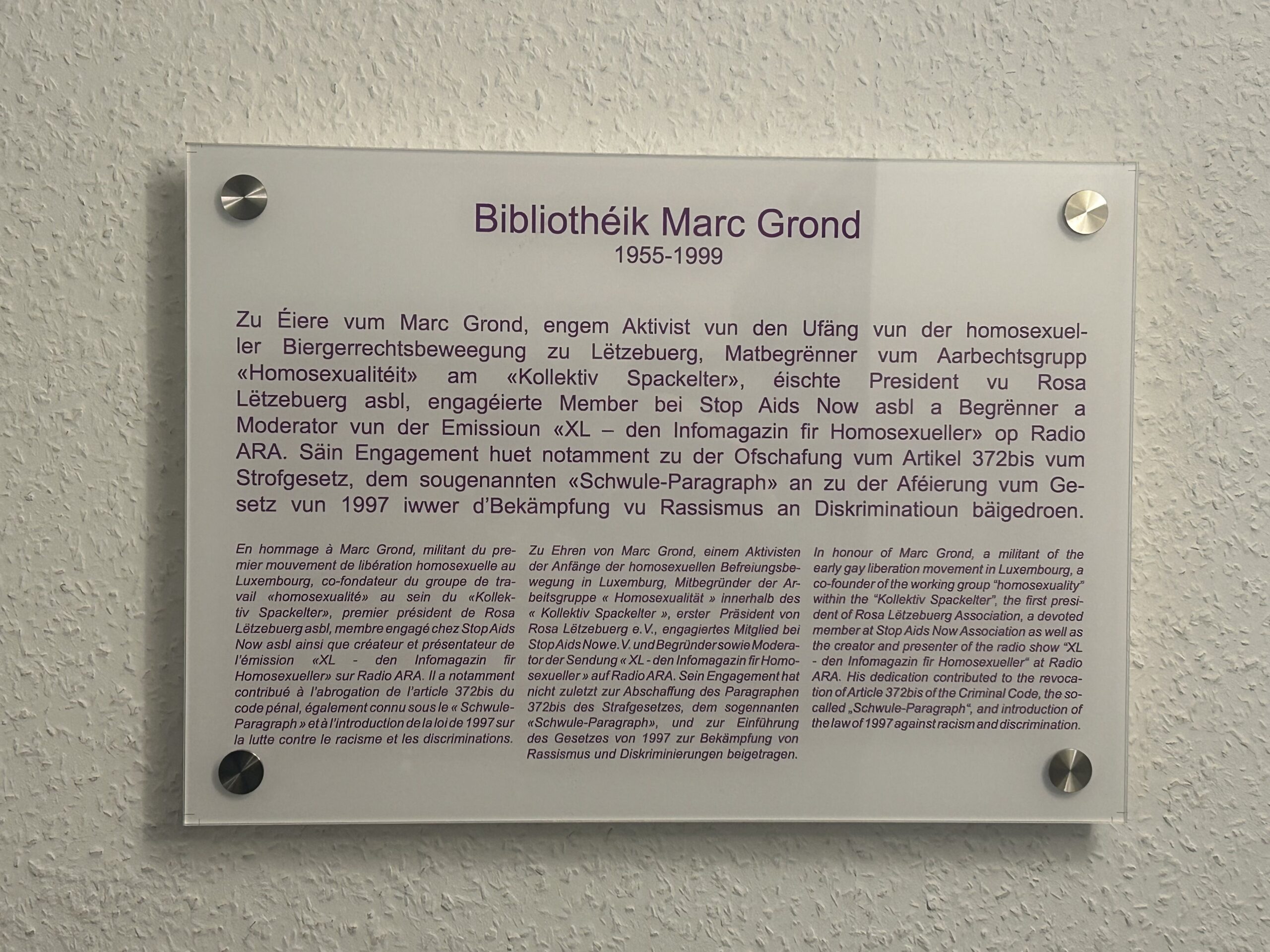
The first trail leads to the Centre LGBTIQ+ CIGALE, which hosts a library bearing his name. In his will, he stipulated that “Rosa Lëtzebuerg” should inherit all his books. There is also a memorial plaque there:
Marc Grond 1955 – 1999
In honor of Marc Grond, an activist of the beginnings of the homosexual liberation movement in Luxembourg, co-founder of the working group “Homosexuality” within the “Kollektiv Spackelter”, first president of Rosa Lëtzebuerg asbl, committed member of Stop Aids Now asbl, and founder and presenter of the program “XL- den Infomagazin fir Homosexueller” on Radio ARA. His commitment led not least to the abolition of Section 372bis of the Criminal Code, the so-called gay section, and contributed to the introduction of the 1997 Act to Combat Racism and Discrimination.
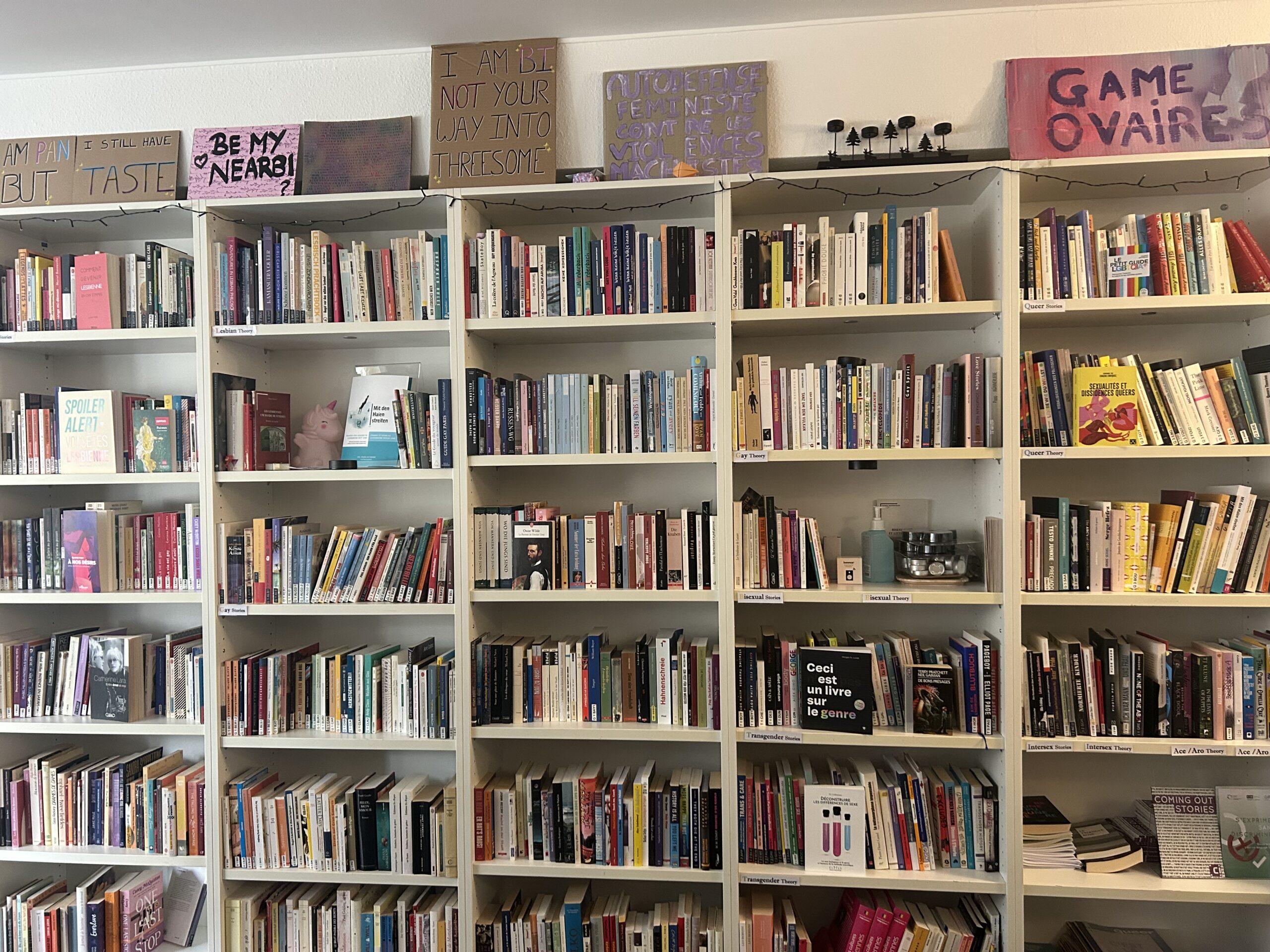
The books are available to the public and will also be available in the register of the Bibliothèque Nationale de Luxembourg (BnL) in the near future once they have all been cataloged.
Article 372bis was enshrined in the Luxembourg Criminal Code for 21 years and referred to a law that had already been introduced in Belgium in 1965. It prohibited same-sex sexual acts between people over the age of 18 and people under the age of 18. For heterosexual people, however, the age limit was 14. The article introduced in 1971 was welcomed by all political parties. There was no organized homosexual movement that could have opposed this law; it was not until 1979 that the activist “Kollektiv Spackelter” founded the “Homosexuality” working group, of which Marc Grond was a member. The aim was to campaign for equal rights for lesbians and gays and to eliminate discrimination. The fight against Article 372bis was seen as the main task. This was to last until 1992.
In our search for people who knew Marc personally, one name keeps coming up. We arrange a meeting with him. Henri Goedertz was a companion of Marc’s. He is still active today for ‘Stop Aids Now’ (SAN). SAN is an organization that used to be on everyone’s lips in Luxembourg, but you hardly hear anything about it anymore. It still exists, but it has shifted its activities to West Africa, where it actively supports regional organizations, including queer organizations on the ground. All this must be done with the greatest possible discretion, as in some countries the repressive laws described above still exist and are subject to far more drastic penalties. Henri tells us that Marc only really became active with SAN in 1994 when he knew that he himself was affected by HIV.
Henri gives us a few photos that were taken at an exhibition at the Cercle Cité in December 1994. This exhibition, entitled “Exposition Solidarité”, was a collaboration between SAN and the Croix Rouge.
Henri Goedertz is the first person to tell us something about Marc’s private background: Marc was an educator by profession and worked with disabled people, among others. As a child, he contracted poliomyelitis, also known as polio. This was his undoing, as his immune system was weakened for the rest of his life. His relationship with his family was poor and there was little to no contact. Henri describes him as a rather quiet person. But when he went to clubs in the evening, he was unstoppable. He could dance all night to techno music, and with his size and rather remarkable dancing style, he needed a lot of space on the dance floor.
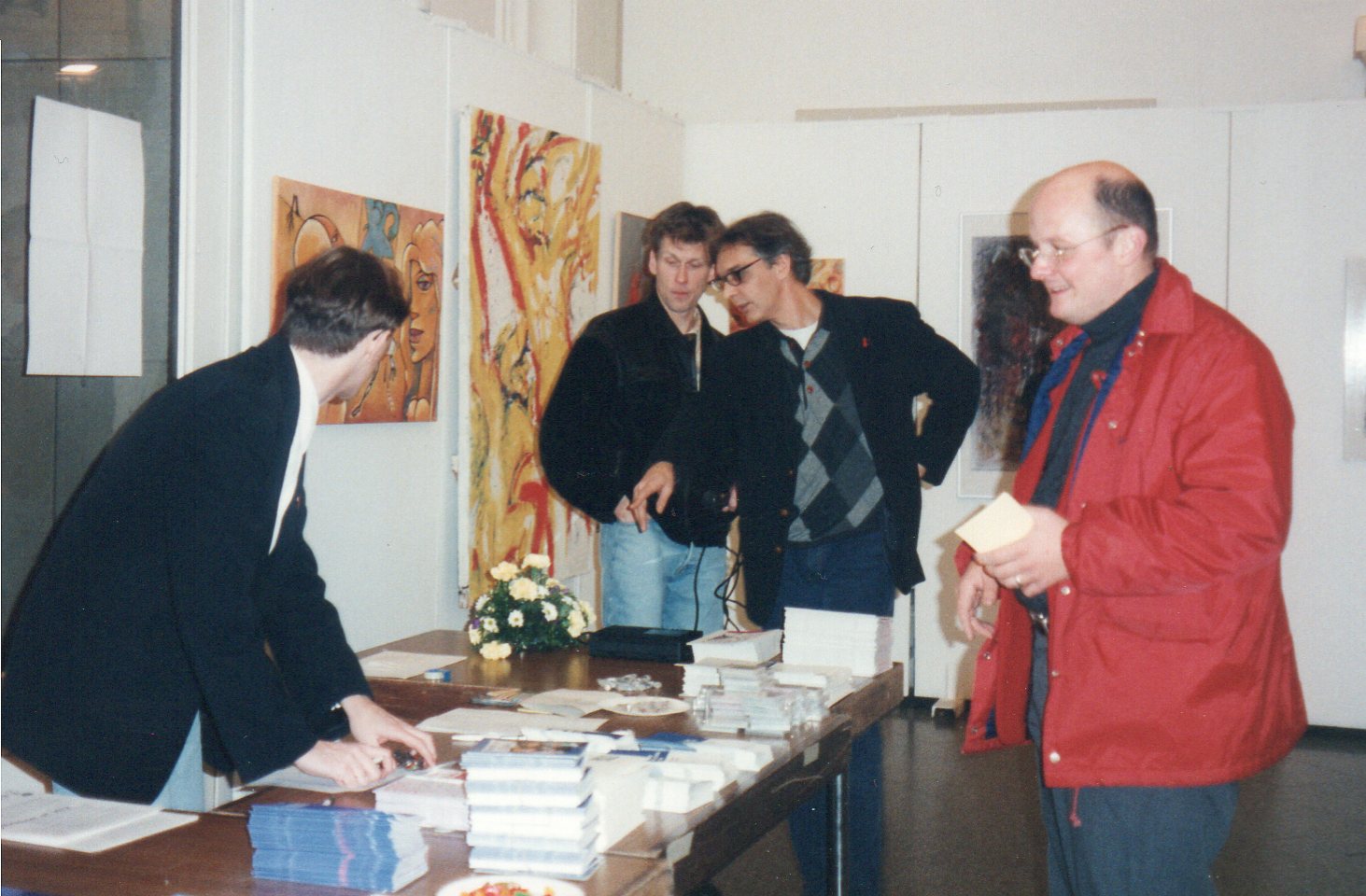
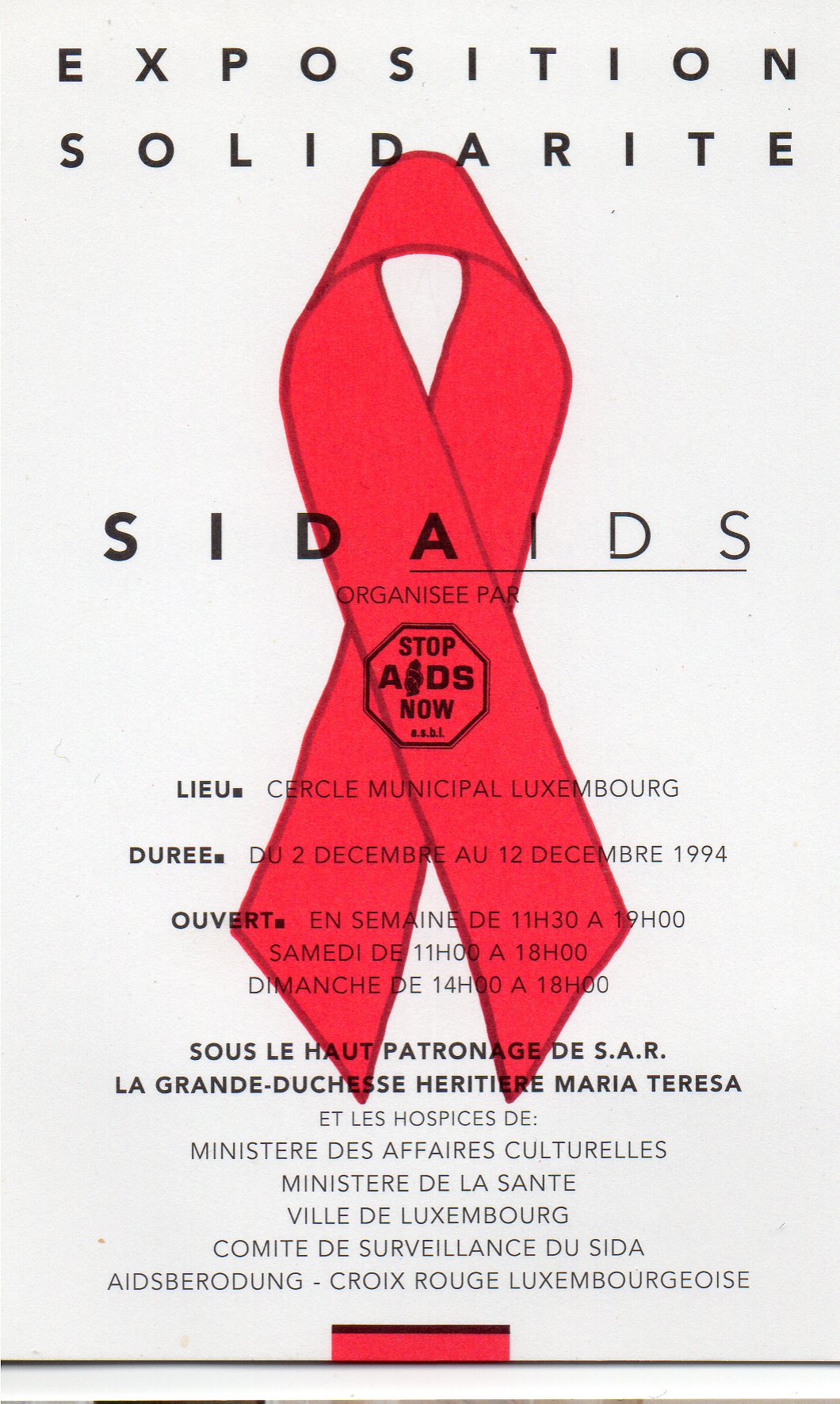
Exhibition “Exposition Solidarité”: Claude Neu, Marc Grond, Henri Goedertz, Marc Angel
Henri was also one of the co-founders of ‘Rosa Lëtzebuerg’ and remembers that Marc was against the name ‘Rosa Lëtzebuerg’ when the association was being named because he thought it was too political. It was undeniable that the Berlin activist Rosa Luxemburg was also on people’s minds. But he was outvoted.
Henri also knew that Marc had already founded an association called ‘Initiativgrupp Homosexualitéit Lëtzebuerg’, or IGHL for short, in 1987, which operated the first hotline for homosexuals. Coming out, oppression and hate speech, but also HIV and AIDS were just some of the topics on which you could get anonymous advice – an absolute novelty in Luxembourg in the 1980s.
And what was the radio program ‘XL- den Infomagazin fir Homosexueller’, which is mentioned on the memorial plaque? It was a weekly program that was broadcast live every Saturday evening from the studios of Radio ARA, then still located in the old town on Rue de la Boucherie. It began on Radio Radau in 1987 and then moved to Radio ARA under new legal regulations. The archives of ‘Rosa Lëtzebuerg’ contain a bulging folder with Grond’s handwritten notes on each program. The journalist Jutta Hopfgartner described XL and Marc’s role in the program in ‘Lëtzebuerger Land’ as follows:
Marc Grond (also) sees his role as helping homosexuals and those who are just discovering their sexual orientation – not necessarily just young people – wherever possible. The name “XL” – extra large – stands for this. As broad as possible, as comprehensive as necessary. And that covers a whole spectrum. Information about events in the greater region that particularly appeal to a homosexual audience is just one aspect of this. It is far more important for him to fill the space that other media do not want to give to gays and lesbians with concrete help for their lives and to provide information about the still rather “weak” legal situation in Luxembourg
Lëtzebuerger Land Nr.42 from 20 October 1995
The XL radio program and the IGHL hotline thus complemented each other perfectly. But that wasn’t enough for him: if he really wanted to make a difference, he had to get involved in politics. An article by Claude Kohnen contained the following sentence:
Within the homosexuality working group of “Déi Gréng”, he (Marc) also became increasingly involved at party political level in the 1990s. His efforts were primarily directed towards the introduction of a registered partnership for same-sex couples in order to eliminate the legal and fiscal discrimination against homosexual partnerships.
Lëtzebuerger Land Nr.19 from 7 May 1999
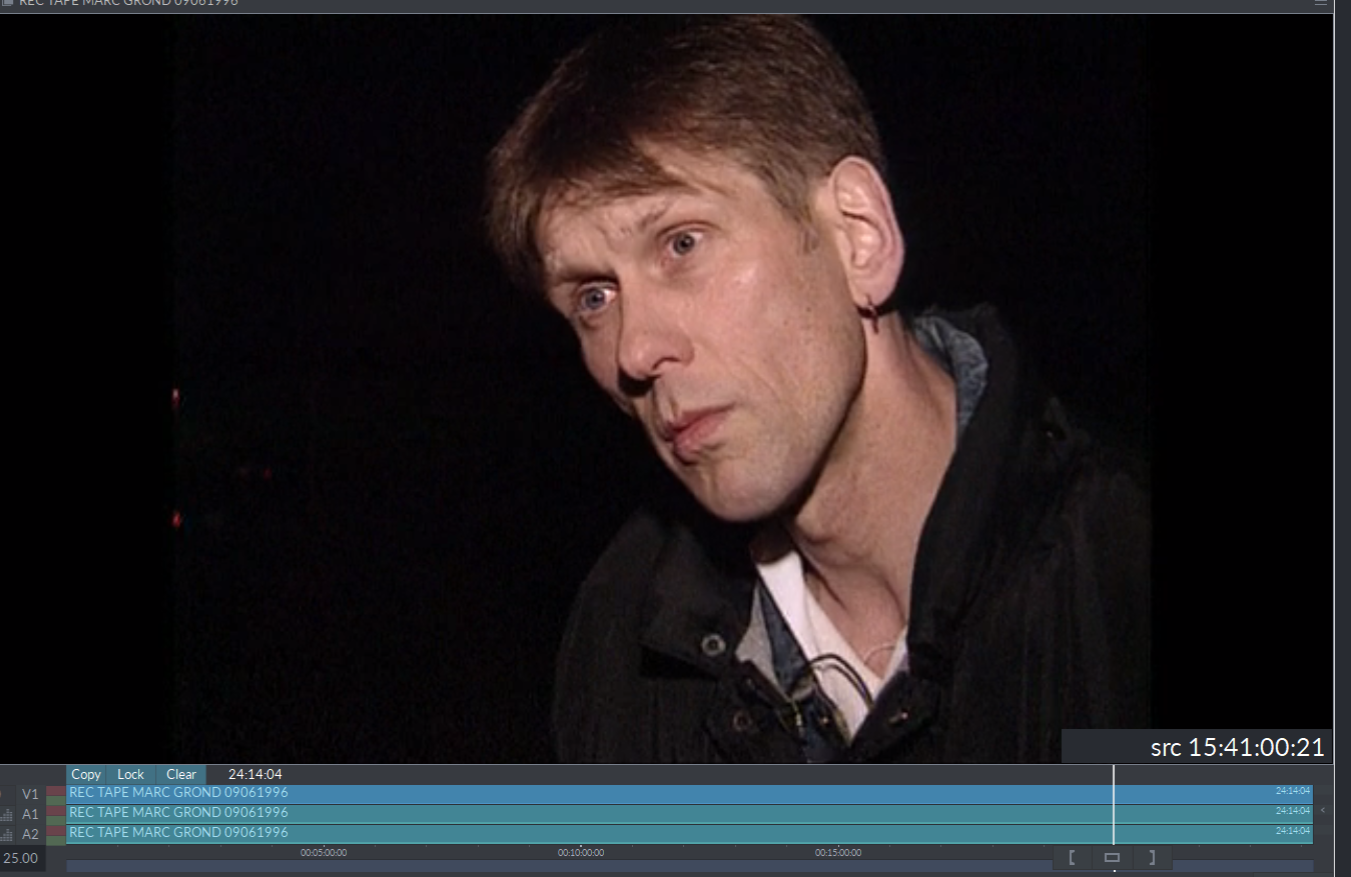
Marc’s last years are quite well documented, as there are several interviews with and a longer report about him in the RTL/CNA television archives.
On 14 February 1996, Valentine’s Day, Rosa Lëtzebuerg organized a rally, the “Marche de l’Amour”, to draw attention to the issue of AIDS. This rally was picked up by the media and RTL made it the main topic in the news. They invited Marc Grond for an interview.
“Today on Valentine’s Day we have an HIV-positive guest in the studio, good evening Marc Grond,” said the reporter at the beginning of the interview. Marc was the first Luxembourger to come out as gay and HIV-positive live on television. He was outraged that HIV-positive people were always made unrecognizable in reporting and that their voices were distorted, even though he understood these people. “If these people are treated like this, then something is wrong in our society. The disease is being misinterpreted and unnecessary fears are being stirred up.”
Another question was: “You are a very committed and certainly well-informed person and yet you still got infected. How is that possible? Or does that mean that all prevention campaigns are doomed to failure?” Grond’s answer: “I’m not convinced that prevention is doomed to failure. What happened to me can be explained by ‘safer sex en panne’. At the time, I wasn’t in a relationship, I’m not an angel and I don’t come from a monastery. I live out my sexuality, use condoms and am careful, but it’s sex and there’s always a residual risk.”
This statement was later often misinterpreted, although it was absolutely correct. In the 1990s, it would have been unthinkable to explicitly explain queer sexual practices, safe fellatio, anal intercourse and cunnilingus on prime-time television, and that sometimes the head and the mind go blank.
This was followed in May of the same year by a long-term report by journalist Sandy Lahure, who accompanied Marc with her camera for two months. He talked a lot about his state of health and the various medications. How they helped him and made him feel better, but how they failed after a while and he started using new, sometimes experimental therapies. His polio at a young age unfortunately hindered the hoped-for success. People close to him also had the opportunity to speak: his partner at the time as well as some acquaintances and friends. His cleaning lady reported how she was approached after the first interview and had to listen to very inappropriate remarks. Here too, Marc spoke openly and unsparingly about his fate, about not being able to marry and not being able to leave anything to his partner without the state demanding the maximum rate of inheritance tax. A very touching sentence to his partner: “If I get sicker and sicker and you can’t take it anymore and leave me, then I would understand.”
We know from Henri Goedertz that his partner did not leave him and stayed with him until the bitter end. Marc married his best friend so that at least one person could visit him in hospital. According to strict regulations for seriously ill patients, only family members and relatives were – and still are – allowed to visit. The marriage also prevented his biological family, with whom he no longer had any contact, from inheriting his estate.
A final report was broadcast on February 1, 1999. It is close to the limit of what is bearable: Marc looks very emaciated and weak. He is lying on a bed in the CHL and has a catheter for an infusion. He is in a very bad condition. He is now more susceptible than ever to even the most harmless viruses, and everyone around him who has even the slightest cold has to wear a face mask. He is not struggling with his fate, at least he doesn’t let on in the interview. He speaks calmly and composedly. He explains that he is tired, that he has to undergo an operation to avoid going blind, but he has decided not to do it. “What do you have left?” asks the journalist. “ There’s not much more I can do, but I still have a few projects and I’m working on them now.” The projects in question were not mentioned.
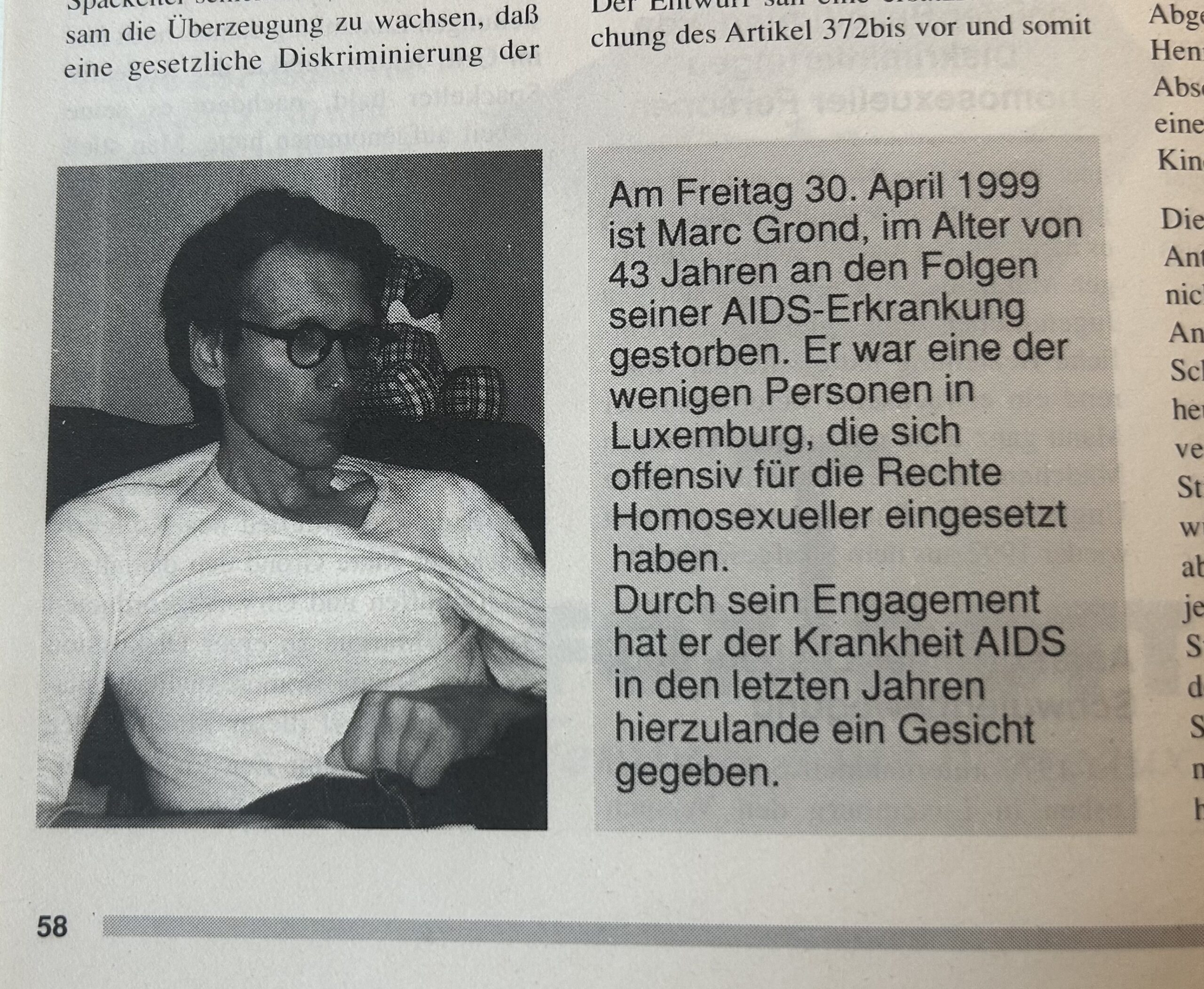
Forum Nr.193 from june 1999
Marc Grond died on April 30, 1999 at the age of 43 from the consequences of his AIDS infection. He was an activist with heart and soul. He passionately fought his battles for the rights and concerns of gays and lesbians in the 80s and 90s. He used all possible channels such as television, press and radio. He was never discouraged by the fierce headwind from the conservative ranks of politics and the church. On the contrary, one has the feeling that this made him even more committed to the cause.
But there were also dissenting voices, even from within his own ranks. He was accused of going too far, that lesbians and gays were largely accepted in society and that it was time to give it a rest. Today we know that he was way ahead of his time. In our age of social media, he would certainly have been one of the most radical and unsparing voices online. He would certainly have been pleased that his commitment to legal and recognized same-sex partnerships and marriage was not in vain.
What can we learn from him? You should never let yourself be beaten down, and when it comes to human rights, ‘giving it a rest’ is not an option!
Call for Contributions
In one of our upcoming editions, we will feature Julia in the “Historically Queer” section. She was one of the first trans women in Luxembourg who was not forced to work as a sex worker or in strip clubs. Julia worked as a hairdresser and ran a salon in the city center during the 1980s. Although no written records of her life exist, she was a well-known and vibrant personality in the city’s daytime and nightlife scene. Her family name, Silva, was hardly known to the public. If you knew Julia personally or were a regular client at her salon, we warmly invite you to get in touch with us at: info@queer.lu All conversations will be treated with strict confidentiality.
