Since the work of Daniel Kahneman and Amos Tversky on decision-making and cognitive biases, we know that the idea of a rational individual in economics and psychology has been called into question. Contrary to the classical theory of expected utility, Kahneman and Tversky show that individuals do not always make rational decisions.
As a result, some of our behaviour and decision-making can appear paradoxical. Is it not common to come across people from working-class backgrounds voting for a political programme at odds with their economic and psychological interests? Or racialised people joining ultra-nationalist and xenophobic groups? Or LGBTIQ+ people joining transphobic, ableist or racist exclusionary movements? The aim of this article is to explore some of the mechanisms underlying these seemingly irrational behaviours that can be observed among members of stigmatised groups.
Understanding stigmatisation: a process of social disqualification
Sociologist Erving Goffman defines stigmatisation as a process by which an individual is socially discredited because of a characteristic perceived as deviant or inferior (sexual orientation, gender, origin, social class, disability, etc.). This social stigma leads to disqualification in social interactions and an often negative image.
In the case of LGBTQIA+ minorities, racialised people and migrants, stigmatisation takes several forms:
- Rejection and social exclusion (family, work, institutions).
- Structural discrimination (access to health, housing, rights).
- Physical and symbolic violence (insults, aggression, invisibilisation).
According to Abdelmalek Sayad, the stigmatisation of immigrants and their descendants produces a double exclusion: they are both excluded from the country of origin and marginalised in the host society. This phenomenon is similar to what many LGBTQIA+ people experience, caught between family or cultural rejection and societal discrimination.
The psychological impact of stigmatisation: an invisible trauma
Prolonged exposure to stigmatisation has psychological consequences:
Minority stress and hypervigilance:
- Stigmatised people experience repeated states of anxiety due to fear of rejection or discrimination (Meyer, 2003).
- This results in over-adaptation: modulating behaviour, voice and gender expression to avoid violence or rejection. For example, some LGBTQIA+ people adopt a “discreet” behaviour in public spaces to avoid being attacked.
Depression and isolation:
- Numerous studies show that stigmatisation increases the risk of depression, anxiety and low self-esteem.
- Abdelmalek Sayad points out that individuals in situations of domination often internalise their condition as an inevitability, reinforcing their isolation and suffering.
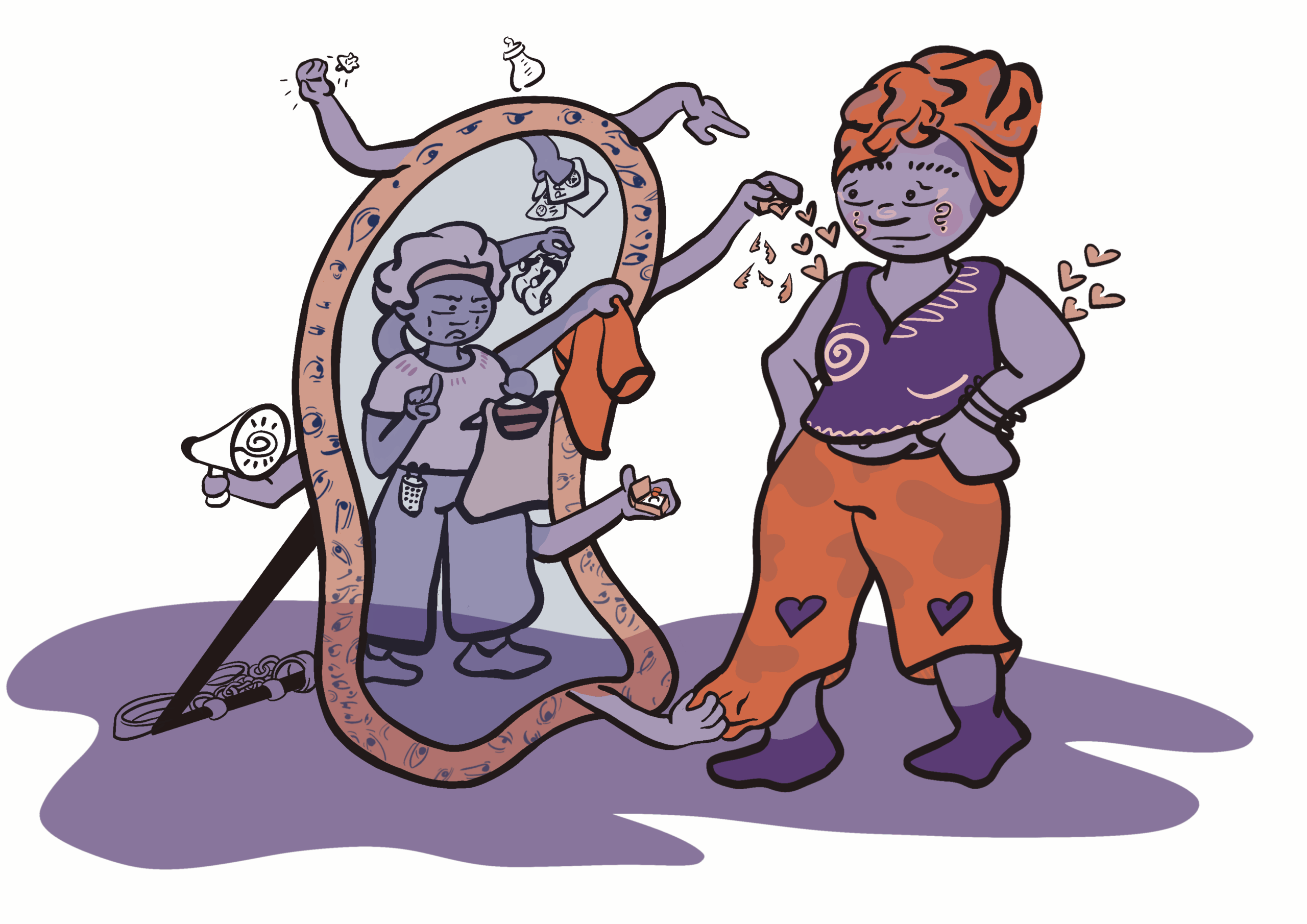
When stigma becomes an inner prison
The internalisation of stigma is based on a process of identity alienation: the individual absorbs the judgements made about them and transforms them into a feeling of shame and inferiority. Goffman analysed the way in which stigma becomes a “moral disadvantage” internalised by stigmatised individuals.
Ali Shariati, in his critique of Westernisation, highlights a phenomenon whereby dominated peoples end up internalising a devaluing vision of their own culture and adopt the norms imposed by the oppressor. This process of cultural alienation can be likened to certain dynamics within minority groups, where individuals tend to reproduce the dominant hierarchies and discriminations in order to better integrate or distinguish themselves from the most marginalised members of their own community. A significant example of this mechanism can be seen in the way in which some gay cisgender men who conform to normative standards of masculinity express contempt for or discriminate against more effeminate gay cisgender men. This phenomenon is similar to the rejection of minority identities by members of these communities themselves. Example: Some members of the LGBTQIA+ community reject non-binary or transgender identities in order to fit in better with the hetero-cispatriarchal norm.
Internalization of shame and stigma
- The stigmatised person gradually adopts the negative way in which society looks at them.
- This process can lead to self-rejection, internalised hatred (homophobia or internalised racism) and a quest for “normality” through conformity.
- Ali Shariati speaks of cultural alienation, where the oppressed internalise the values and norms of the dominant to the point of disassociating themselves from their own group.
An emblematic social psychology experiment conducted by Kenneth and Mamie Clark in the 1940s explores the effects of the internalisation of stigma through racial segregation on the self-esteem of African-American children.
Details of the experiment:
The researchers presented two dolls that were identical except for their skin colour:
- A white doll (light skin, blond hair).
- A black doll (dark skin, black hair).
They asked African-American children aged between 3 and 7 to choose the doll they preferred and to associate qualities with the dolls (nice, mean, beautiful, ugly, etc.).
Main results:
- A majority of African-American children preferred the white doll, and attributed positive qualities to it (kindness, beauty).
- Conversely, they associated negative traits with the black doll (meanness, ugliness).
- When asked “Which doll looks like you?”, many hesitated, and some pointed to the white doll before correcting their answers.
Interpretation and impact:
The study shows that black children carry internalized racism and the norms of segregated society, which affects their self-esteem. These results were used as psychological evidence of the damage caused by racial segregation during the Brown v. Board of Education case (1954), which led to the banning of school segregation in the United States.
Links with the internalisation of stigma
The Clark & Clark experiment illustrates the phenomenon whereby a minority internalises dominant norms that devalue it. This mechanism is similar to the processes of internalised homophobia, internalised transphobia, or the cultural alienation described by Ali Shariati and Abdelmalek Sayad.
This type of experiment has inspired other research into the effects of systemic discrimination on the identity and psychology of minority groups.
Imposter syndrome and the need for validation
- Stigmatisation sometimes leads to an excessive quest for recognition by the dominant group.
- For example, an individual from a minority group may over-invest in their career, social image or respect for norms in order to be accepted.
- Ali Shariati speaks of the ‘westernised man’ (gharbzadegi), who adopts the codes of the dominant group to prove his worth, at the cost of his deeper identity.
The Queen Bee Effect: a dynamic of alienation?
According to Klea Faniko, the Queen Bee Effect describes the behaviour of certain women in professional environments dominated by men. These women, seeking recognition and acceptance in a patriarchal system, may adopt attitudes or practices that reproduce or reinforce gender inequalities, instead of challenging them. They align themselves with male norms, and are even critical of subordinate women, in order to maintain their privileged position in a system that remains discriminatory overall. This phenomenon reflects a form of structural alienation, where the individual, in order to conform to the dominant power, paradoxically contributes to their own collective marginalisation.
Bourdieu describes symbolic violence as a mechanism whereby the dominated incorporate the structures of power and reproduce them. Klea Faniko’s study of the Queen Bee Effect shows that certain minorities adopt exclusionary attitudes in order to draw closer to the dominant group.
This phenomenon reflects a form of structural alienation in which the individual, in order to conform to the dominant power, paradoxically contributes to their own collective marginalization.
Another example: homonationalism (Puar) illustrates how some LGBTQIA+ people position themselves as defenders of the national order by excluding migrants or aligning themselves with Islamophobic discourse. The instrumentalisation of LGBTQ+ rights by Western states to justify nationalist, securitarian or racist policies, particularly towards Muslim and immigrant populations. From this angle, the acceptance of LGBTQ+ rights becomes a marker of civilisational superiority, pitting a progressive and tolerant ‘us’ against a supposedly homophobic and backward ‘them’. This mechanism is similar to the internal tensions in minority movements: cisgender lesbians vs. trans lesbians, white queers vs. racialised queers, and so on. These internal divisions weaken the collective struggle and benefit the dominant structures.
Shariati's Westernisation: cultural alienation
Ali Shariati identifies Westernisation as a dynamic in which the elites of colonised or post-colonial societies adopt the values, norms and behaviours of Western powers, often to the detriment of their own culture and identity. These elites, fascinated by the West, try to conform to its standards (modernity, lifestyles, institutions), while at the same time devaluing their own cultural roots. This process results in a double alienation: on the one hand, the elites distance themselves from their own community and, on the other, they remain marginalised in the Western system, which never considers them to be fully equal. The elites thus play a paradoxical role: although they aspire to modernity, they participate in reproducing patterns of domination and oppression.
The search for acceptance in a dominant system
In all these theories, there is a search for validation by a dominant entity:
- Queen Bee Effect: Women in a patriarchal environment adopt the behaviours valued by men in order to climb the ladder.
- Occidentalisation: Colonised or post-colonial elites seek to integrate into the structures imposed by the West.
- Homonationalism: Some LGBTIQ+ individuals adopt the values and discourses of homonationalism, even when they reinforce oppressive logics. This may take the form of assimilation into the national norm, rejection of marginalised identities, or alignment with securitarian discourse.
In this type of context, the alienated individual or group internalises the norms of the dominant power and conforms to its expectations, even if this means giving up their identity or solidarity with their group of origin.
The role of dominant discourse in alienation
Shariati and Faniko highlight how dominant discourse shapes behaviour:
- Shariati shows that the norms and ideals of the colonising West are disseminated through institutions, the media and education systems, encouraging the elites of colonised countries to adopt them.
- Faniko observes that the dominant male norms in professional environments shape the behaviour of women, who align themselves with these standards in order to succeed.
The dominant system acts as a force for internalising norms, making the alienated unwilling accomplices in their own marginalisation.
Coping and survival strategies
Alienation does not always translate into passive shame, but sometimes into active coping strategies. In social psychology, this is known as ‘passing’, the attempt to conform to the dominant norms in order to avoid discrimination.
In the context of immigration, Abdelmalek Sayad analyses how immigrants integrate the imposed social hierarchy and adopt behaviour aimed at distinguishing themselves from new arrivals, thereby perpetuating the dynamics of internal rejection. This same mechanism can be observed in LGBTQIA+ communities, where certain racialised people or people from working-class backgrounds can be marginalised by more privileged circles.
Alienation does not always manifest as passive shame; at times, it takes the form of active strategies of adaptation. In social psychology, this is referred to as “passing,” meaning the attempt to conform to dominant norms in order to avoid discrimination.
Reclaiming one's identity and breaking out of the vicious circle
The internalisation of stigma is a powerful tool of domination, but it is not inevitable. Through critical awareness and solidarity actions, it is possible to extricate ourselves from this alienation and fight against oppressive logics. As Ali Shariati said: “The worst kind of slavery is that which makes people love their chains”. The challenge, then, is to break these chains to build communities with greater solidarity and freedom from imposed norms.
Regaining collective power
Die Verinnerlichung des Stigmas ist ein mächtiges Werkzeug der Herrschaft, aber sie ist kein unabwendbares Schicksal. Durch kritisches Bewusstsein und solidarisches Handeln ist es möglich, sich dieser Entfremdung zu entziehen und gegen die unterdrückerische Logik zu kämpfen. Wie Ali Shariati sagte: “Die schlimmste Sklaverei ist die, die dazu führt, dass man seine Ketten liebt“. Die Herausforderung besteht also darin, diese Ketten zu sprengen, um solidarischere Communities, die frei von auferlegten Normen sind, aufzubauen.
Further reading:
– Jasbir Puar, Terrorist Assemblages: Homonationalism in Queer Times
– Frantz Fanon, Peau noire, masques blancs
– Ali Shariati, L’Homme et l’Islam
– Abdelmalek Sayad, La Double Absence
– Klea Faniko, recherches sur le “Queen Bee Effect” (2021)
– Sara Ahmed, Queer Phenomenology (2006)