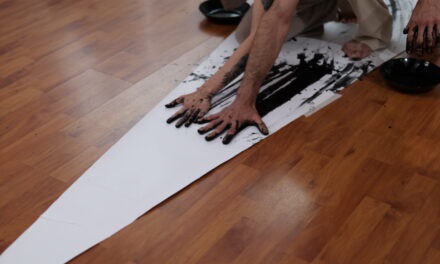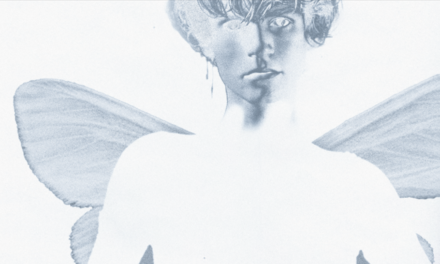
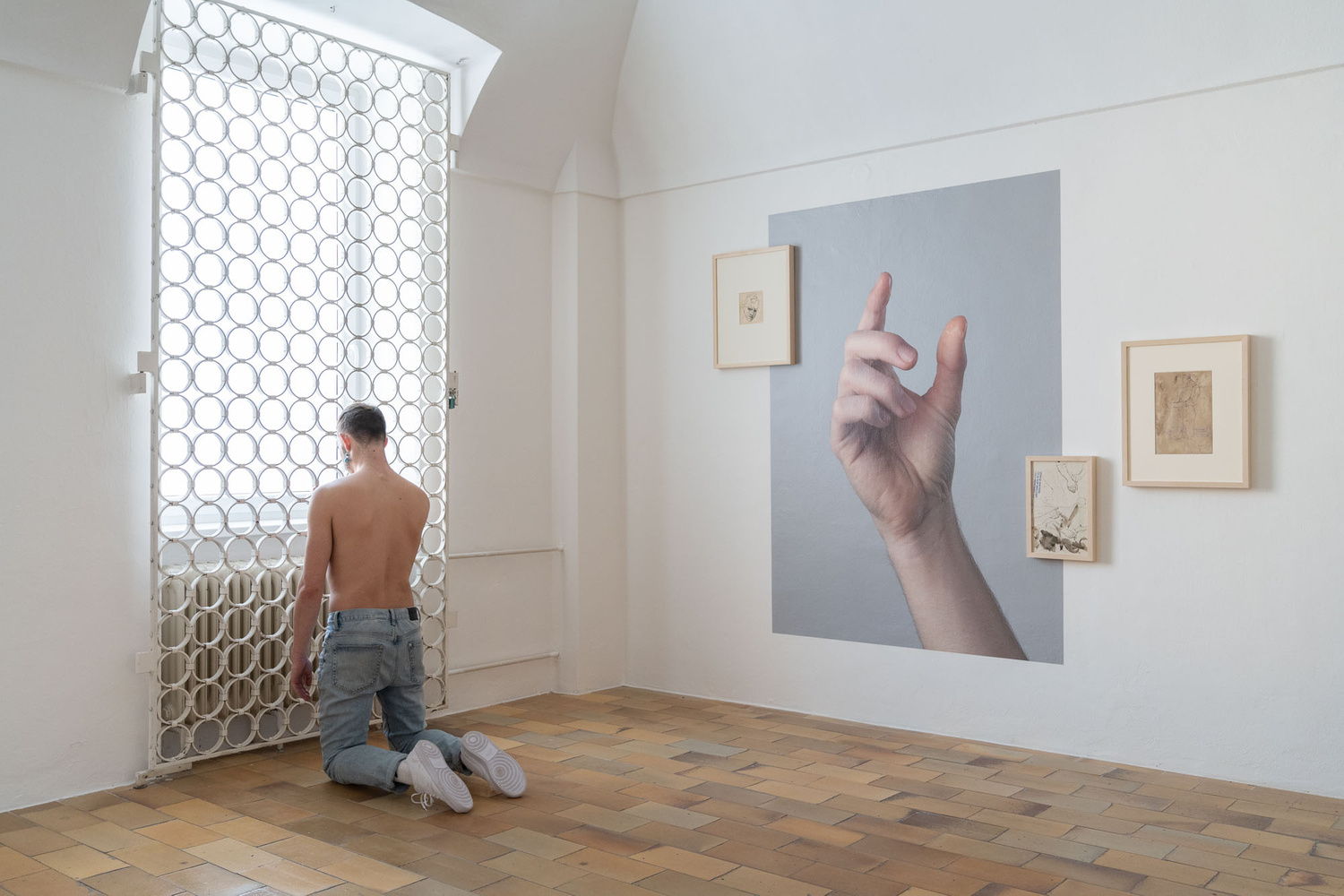
left: Slza (Memoriál Juraja a Matúša). Photo Adam Šakový – left inset: Photo Kvet Nguyen above: Prayer for a Better future. Photo Adam Šakový
Kristián Németh (1983), a Slovak artist living and working in Brussels, has built a body of work that is both deeply personal and insistently political. From early confessional works that placed his voice and body in confrontation with the Catholic Church, to more recent meditations on fragility and impermanence, his practice holds a mirror to the uneasy intersection of queer life, religion, and social change in Central Europe. His installations, videos, and performances never shout, but they never retreat either. They create space for dialogue, for reckoning, and for imagining futures that are not yet here but urgently needed.
At the Slovak National Gallery in 2023, his exhibition The Time is Now asked a simple but piercing question: if not now, when? One work wrapped a public sculpture in creeping vines, making visible the neglect and marginalization of queer citizens. Another transformed a gallery space with colored light, at once recalling stained-glass windows and offering sanctuary. A third was a quiet, devastating memorial to Juraj and Matúš, two young queer men murdered in a hate crime in Bratislava. A single symbolic tear on a windowpane was enough. Németh evades the spectacle; instead, he condenses grief, anger, and hope into gestures that are at once minimal and monumental.
This gesture of condensation has been present throughout his career. His long-running project Fragile arranges crystal glasses, bowls, and vases in precarious formations—objects inherited from his mother and friends, fragile architectures of memory and risk. Visitors move carefully, aware that the smallest vibration could bring collapse. It is a metaphor that needs little explanation. In many countries, queer life is exactly this: a delicate balance, beautiful but vulnerable, resilient yet breakable. In more recent works like Herbarium of Time, Németh preserves flowers in resin just at the edge of wilting. They seem eternal, yet beneath the glassy surface, they continue to fade. It is a meditation on temporality, but also a queer refusal to let beauty be erased too soon.
When I spoke with Németh, our conversation circled around the themes of migration, queerness, and faith, threads that run consistently through his work.
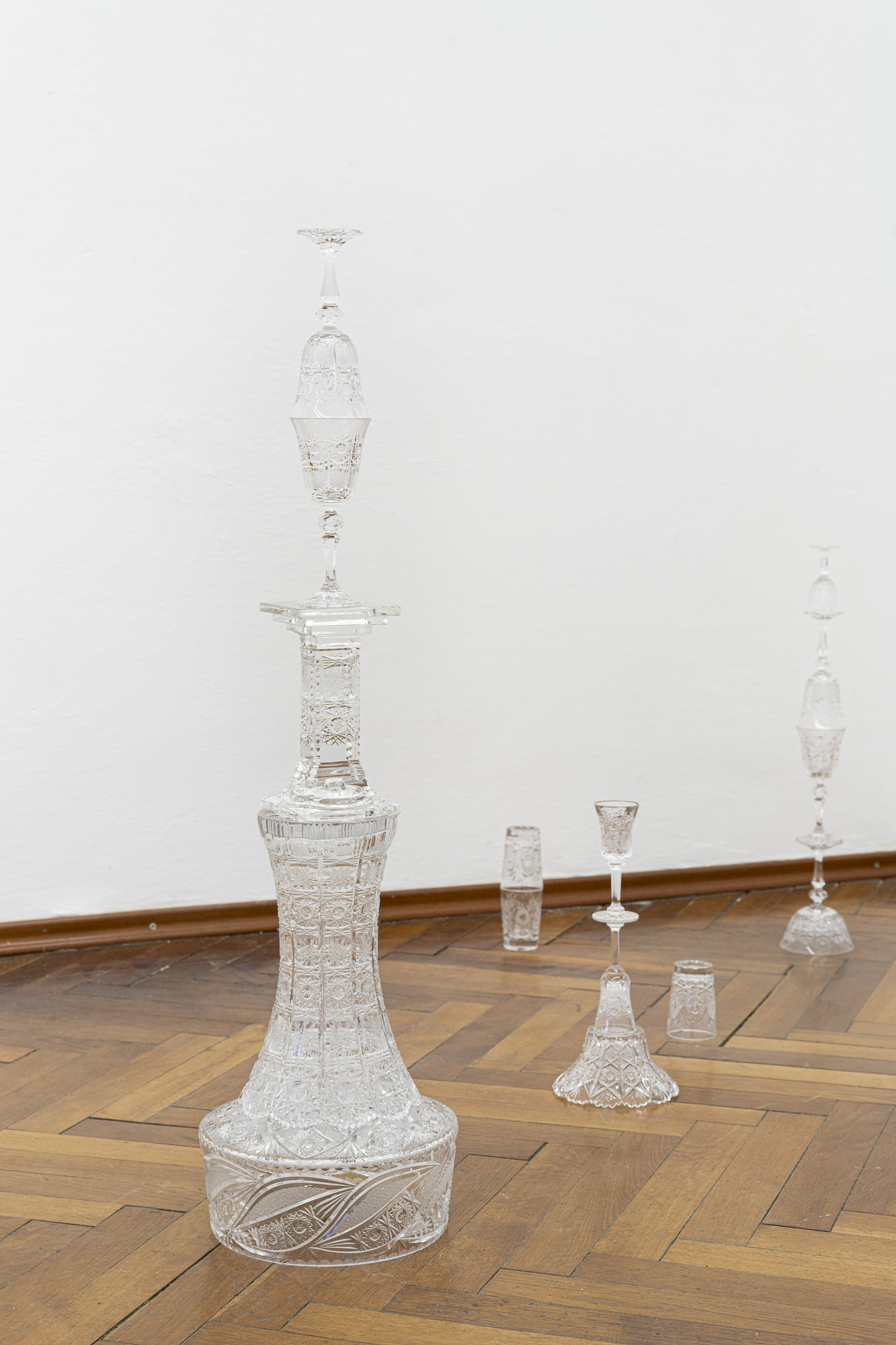
Fragile. Photo Denisa Horváthová
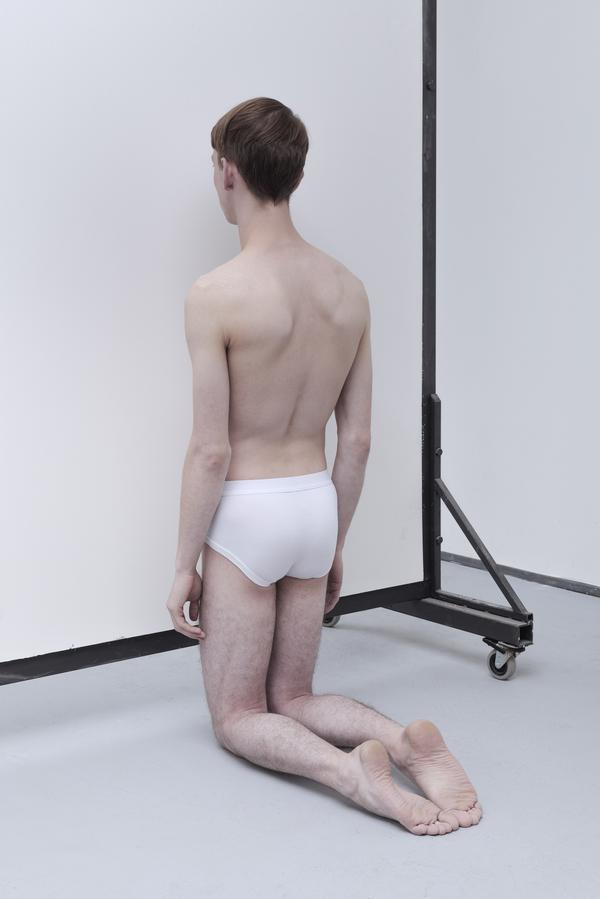
In the Name. Photo Marek Wurfl
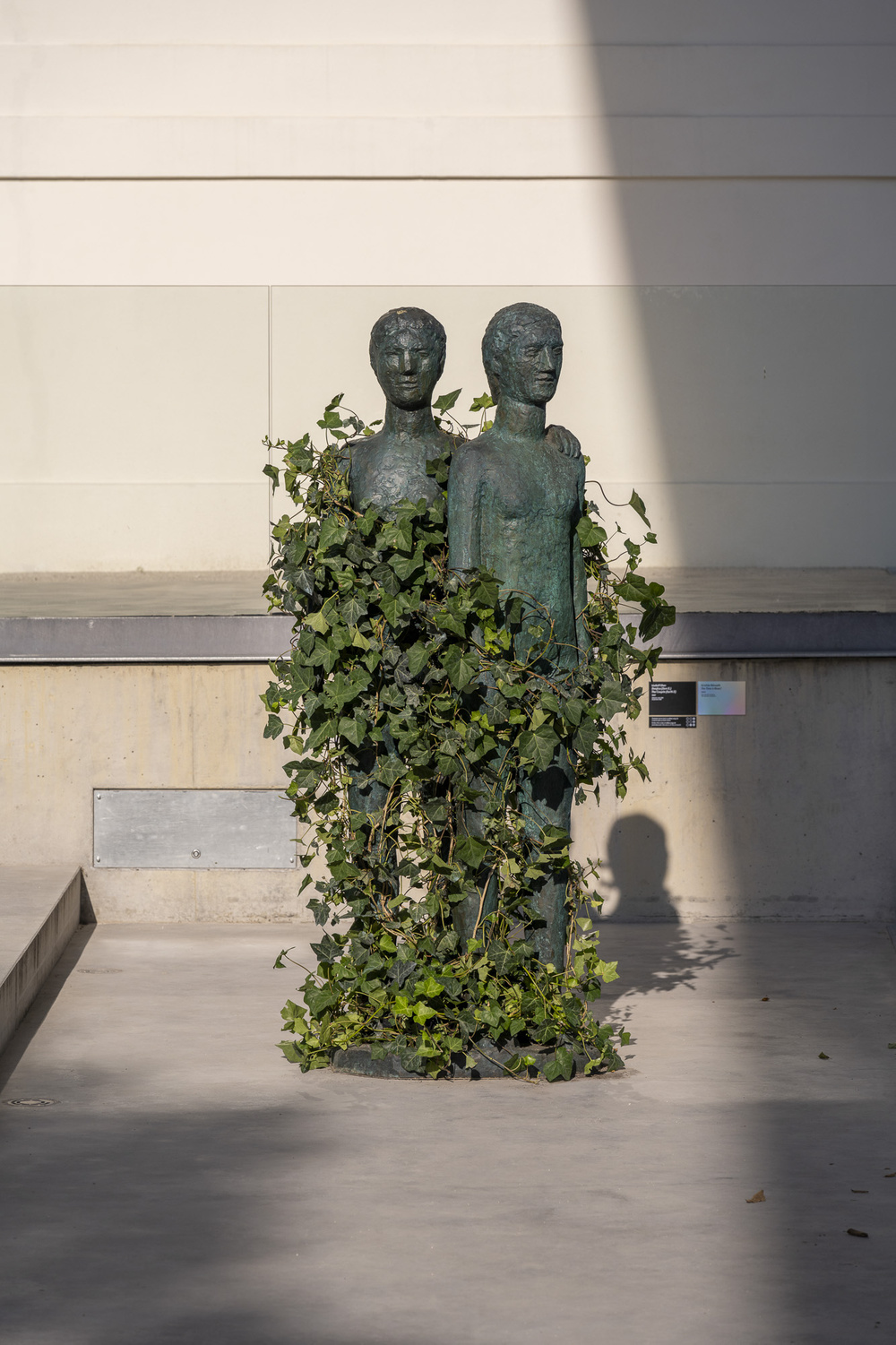
The Time is Now. Photo Adam Šakovy
MH: You were born in Slovakia, but now live and work in Brussels. How has relocation shaped your personal and artistic identity?
KN: My identity hasn’t changed dramatically, since Brussels is not so far from Slovakia. I still travel back frequently for exhibitions and activities. That said, Brussels is an inspiring city with strong contemporary art institutions, and they do influence me indirectly.
MH: And what about queer identity? Do you notice differences between Slovakia and Belgium?
KN: The difference is in acceptance. Belgium is far more tolerant, with modern legislation that places queer people on equal footing. Queer life here is an ordinary part of society. In Slovakia, it is often still treated as an anomaly, especially with the current political climate. We have made some progress, but it remains insufficient both socially and legally.
This gap between lived equality and institutional neglect explains why religion looms so large in Németh’s practice. Works such as The Children of Jan Mokso (2020), which confronted the sexual abuse of his mother and cousin by a Catholic priest, or The Bars (2009), which recorded his own confession with a priest who refused him absolution, expose how deeply entangled Catholic power is with queer vulnerability. His installations often deploy candles, columns, or fragments of church interiors not as blunt symbols, but as subtle stage props in dramas of power and resistance.
MH: Many of your works deal with the relationship between queer identity and the Church. What attracts you to this tension?
KN: Slovakia is strongly Catholic, despite claiming to be secular. The Church has enormous influence on both society and politics, often blocking legislation that would protect queer people. When an institution has such power over our lives, it deserves serious scrutiny. My approach is critical, but not destructive. I want to create space for dialogue.
MH: Do you see this critique as a kind of spiritual practice in itself?
KN: Not really spiritual. More critical, but in a constructive sense. Even the Church changes slowly; look at statements from Pope Francis. If its behavior is problematic, I feel it is important to point it out, so there is a chance for improvement.
There is a striking honesty to this stance. Németh does not set out to destroy, but to expose contradictions and leave room for change. That balance is mirrored in Warm Greetings (2021), where melted communion candles are piled in tangled masses. They seem both sacred relics and burnt-out ruins, critiquing the pressures of religious conformity while acknowledging their strange beauty. Or in Monument of Possible Fall (2019), a slightly off-axis column in a synagogue installation suggests instability, whether of the Church, of democracy, or of ecosystems collapsing under their own weight. His works sit in the space between faith and doubt, reverence and protest.
MH: How do viewers, especially believers or queer audiences, respond to your projects?
KN: Reactions are mixed, but never indifferent. One of the most moving responses came from Evangelical pastor Anna Polcková, who invited me to exhibit critical works inside her parish. That openness touched me deeply. It showed me how faith institutions could respond to critique: not by closing doors, but by opening them.
MH: Has your own relationship to belief shifted over time?
KN: Yes. For years, I searched for a path to God. Eventually, I decided I am an atheist. But I do not see it as permanent; it could change. Right now, this is my position.
As we spoke, it was impossible to ignore the violence of recent years. The terrorist attack in Bratislava in 2022, in which two queer people were murdered, remains a wound in Slovak society. Németh’s Prayer for a Better Future (2023) confronted this directly, bringing together 14 years of his work alongside Slovak painters Bazovský and Mednyánszky. It asked whether art can push society beyond denial, beyond silence.
MH: Do you feel Slovak society has shifted at all on queer rights since then?
KN: After the attack, there was solidarity, but it faded quickly. With the new government, things have worsened, especially with the Minister of Culture being openly hostile to queer identities. But I am surprised by the strength of resistance from the artistic community. That gives me some hope.
This sense of fragility and resistance, of being simultaneously vulnerable and unyielding, is the red thread through Németh’s work. From crystal glasses balanced on each other’s edges, to resin-encased flowers that fade beneath their surface, to confessional recordings behind church bars, his art returns again and again to the question of what survives.
And always, it is queer life at stake. Not as a token, not as an identity reduced to slogans, but as lived reality: fragile, stigmatized, resilient, still here.
“Nothing is covered up that will not be revealed,” reads the Gospel of Luke. In Németh’s hands, this scripture is not a promise from the Church but a challenge to the Church: silences will break, whispers will be heard.
To walk through his exhibitions is to feel this tension directly: the fragility of objects, the weight of absence, the beauty of resistance. Kristián Németh reminds us that fragility is not weakness, but a condition of being alive, and that queerness, in all its precariousness, carries within it the seeds of renewal.
In his words, “There is no other time but now.”