
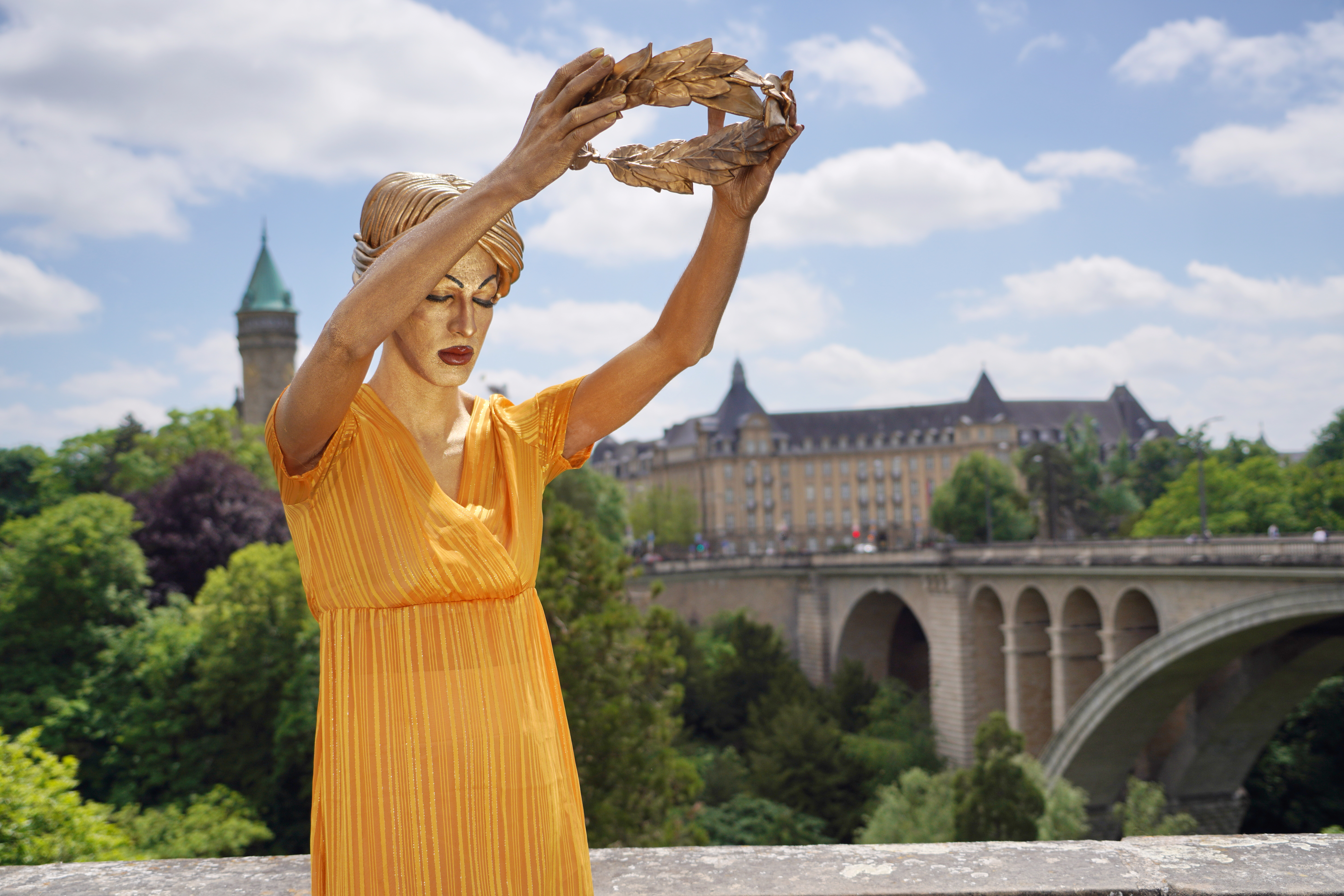
photos Alex Loos – model Wendy Vine
“Can drag be considered a form of translation?” This question was the starting point of a project that took me to Toronto last June, where the Canadian Association for Translation Studies was organizing an unconference (in French, they called it “conférence collaborative”). The goal was to go beyond the traditional conference format in order to foster meaningful discussions. It was the perfect forum for out-of-the-box proposals, and I used this opportunity to introduce the Gëlle Fra to scholars from all around the world.
But before we get there, let me introduce myself. My artistic name is Wendy Vine (‘cause she’s divine!), and out of drag I go by Manu. I have been living in Luxembourg since 2021. I am a translator, a translation researcher (with a PhD from the University of Tartu, in Estonia) and a drag queen. The question above arose organically from the intersection of these three identities, which give me a unique perspective on drag and translation.
I understand drag as a mosaic of many art forms: make-up and wig artistry, fashion, comedy, dancing, singing, burlesque, clowning, storytelling, political performance and so many more. In drag, these art forms converge and interact in interesting ways that could perhaps be described as translation. Indeed, my idea of translation goes beyond verbal communication. For example, written text can be translated into an image or a musical piece. In translation studies, we term this intersemiotic translation (translation across different sign systems).
In order to explore the apparent link between drag and translation, I decided to create a drag look that was explicitly a translation. From a translation studies perspective, this could be considered a process of transcreation or creative translation. From a drag perspective, the goal was to find a clear reference and to “drag it up”. But what exactly? I remembered the poem “Once I got a postcard from the Fiji Islands”, written by Estonian poet, philosopher and translator Jaan Kaplinski — himself a man of many identities —, which explores exoticness and foreignness, among other themes. More specifically, the lines in this excerpt came to mind:
Once I got a postcard from the Fiji Islands
with a picture of sugar cane harvest. Then I realized
that nothing at all is exotic in itself.
[…]
Far-off lands and foreign peoples are a dream,
a dreaming with open eyes
somebody does not wake from.
Kaplinski, Jaan (1987). The Wandering Border. Copper Canyon Press. Translated from Estonian by Jaan Kaplinski, Riina Tamm and Sam Hamill. The full poem can also be read on the following website: https://estlit.ee/person/66/poems/94.
Like the Fiji Islands in Kaplinski’s poem, Estonia is a small country that many people do not have a clear image of. Still, vague impressions of “an idyllic archipelago in the middle of the Pacific” or “a cold post-Soviet country” exist. What about Luxembourg? Can Luxembourg be exotic in a different cultural context? How is Luxembourg perceived by “foreign people” in “far-off lands”? I decided to create a batch of postcards of Luxembourg and to fly across the pond to explore these questions, as well as the question of whether drag can be considered a form of translation.
And who would you find in a postcard of Luxembourg if not the Gëlle Fra? A symbol of freedom and icon of Luxembourg, the choice was obvious (sorry, Melusina, maybe next time!). I contacted Alex Loos, a fantastic photographer who often collaborates with Rosa Lëtzebuerg, and we arranged a photoshoot. To bring my fantasy to life, I bought a custom-made golden wig from Allemaal Tejater, which became the most expensive part of the look. The cheapest was the dress — only one euro on Vinted (to offset the cost of the wig, and because I believe that drag should be sustainable!). Covering myself in gold was easier than expected, but scrubbing it off? Several days later, I still found flecks behind my ears…
Can Luxembourg be exotic in a different cultural context? How is Luxembourg perceived by “foreign people” in “far-off lands”?

The photoshoot was a lot of fun. Passers-by constantly stopped me for pictures, common when you’re in drag, even more so when you’re glowing from head to toe. Aurora Jimeno and Guy Loos, our dear assistants, made sure that everything ran smoothly. First, Alex took some pictures at the lookout point across from the Casino, with the Spuerkeess building behind us, the Pont Adolphe to our left and the actual Gëlle Fra to our right. Then we took the stairs down to the Parc de la Pétrusse, where we shot a picnic. Seeing the Gëlle Fra chilling out and reading The ABC of EU Law was probably not on your bingo card for 2025 — well, it wasn’t on mine either!
The next step was designing the materials: the postcards, but also a poster to explain the concept behind them. There, I referenced one of the key figures in queer academia: Judith Butler. The text below reflects on the “original gender” that drag imitates.
Drag is sometimes (mis)understood as a parodic imitation of an original gender. However, according to Butler (1990), the relation between the “imitation” and the “original” is a complicated one. Drag does not necessarily constitute a gender parody of an original, but rather a parody of the notion of an original gender identity. Drag, Butler claims, “reveals that the original identity after which gender fashions itself is an imitation without an origin” (p. 138). Drag denaturalizes, displaces and recontextualizes gender meanings.
Butler, Judith (1990). Gender Trouble: Feminism and the Subversion of Identity. Routledge.
Seeing the Gëlle Fra chilling out and reading The ABC of EU Law was probably not on your bingo card for 2025 — well, it wasn’t on mine either!
At the unconference, which took place from 2 to 4 June at George Brown College in Toronto, I encouraged attendants to read the poster, take a postcard, read Kaplinski’s poem and share their thoughts. The conversations were highly stimulating, and I gained some new insights into drag and translation. For instance, a scholar remarked how drag exposes the absurdity of gender norms by taking them to the maximum level. Another scholar observed that this was not only an example of intersemiotic translation or transcreation, but also a form of performance translation, a concept that opened a new possible avenue for future research.
In regard to Luxembourg, I found it amusing to ask people to guess what the Spuerkeess building was. The best answer was that it looked like “the castle of the monarch of Luxembourg. A king? A prince? A duke?”. When I revealed that the building wasn’t a castle at all, it was suggested that the Spuerkeess building was “doing drag as a castle” (a brilliant thought!). Somebody pointed out that the original Gëlle Fra could be considered a translation herself. Indeed, she could be said to have multiple “sources”: she was reportedly inspired by a real person, but also by the Greek goddess Nike (and presumably, there were other aesthetic influences).
As “obvious” as my creative choices for the postcard were, I noticed how the picture of the Gëlle Fra against the Spuerkeess building could evoke or even reinforce certain idealized images that many North Americans hold of Western Europe: elegance, refinement, sophistication, opulence, and ultimately, wealth. From a post-colonial perspective, I am not sure that this can be called exoticization, but if we want to use this term, it is clear that Luxembourg is not exoticized in the same way that non-Western countries are. It is also worth asking: is this just how Luxembourg is seen, or also how Luxembourg wants to be seen? These thoughts about national images sparked a fascinating conversation about the way that Canada portrays itself to the world (beautiful unspoiled nature, Canadians being overly nice and polite…), which does not necessarily match the complex realities of the country.
This project is a love letter to the country that has welcomed me, but it also feels like a political statement.
Ultimately, all these discussions helped me realize that this project had translated not just the Gëlle Fra, but Luxembourg City, and to some extent, the country itself. To borrow Butler’s terms, my Gëlle Fra did not only recontextualize gender meanings, but also meanings of national identity. Luxembourg is a country where I am a migrant, not a national. At the same time, migrants are an integral part of Luxembourg’s national identity. As a member of Luxembourg’s migrant and queer communities, it was an honour to “become” the Gëlle Fra and to represent Luxembourg abroad as her. This project is a love letter to the country that has welcomed me, but it also feels like a political statement. The Gëlle Fra is for everyone, and the feeling of belonging that she instils in the people of Luxembourg — locals and foreigners alike, queer and not queer — is a shared experience with the potential to unite us all.
