Joy, frustration, hope: three emotions that reign after the publication of the updated Plan d’action national pour la promotion des droits des personnes LGBTIQ+. What lies behind these mixed emotions— and how does the government intend to address them?
Joy on Stage, Frustration Behind the Scenes
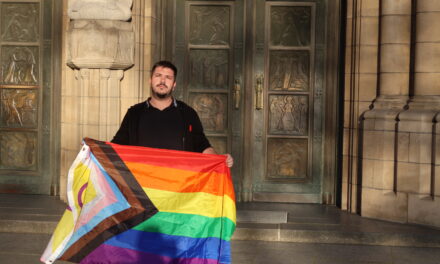
At Luxembourg’s Pride 2025, rainbow flags waved in the July breeze, as political leaders smiled benevolently from the stage. Just days later, the Ministry of Diversity and Equality (MEGA) unveiled the updated version of the Plan d’action national pour la promotion des droits des personnes LGBTIQ+ (PAN LGBTIQ+ 2025/PAN).
Months on, frustration among LGBTIQA+ and human rights organizations runs deep.
Off to a Bad Start
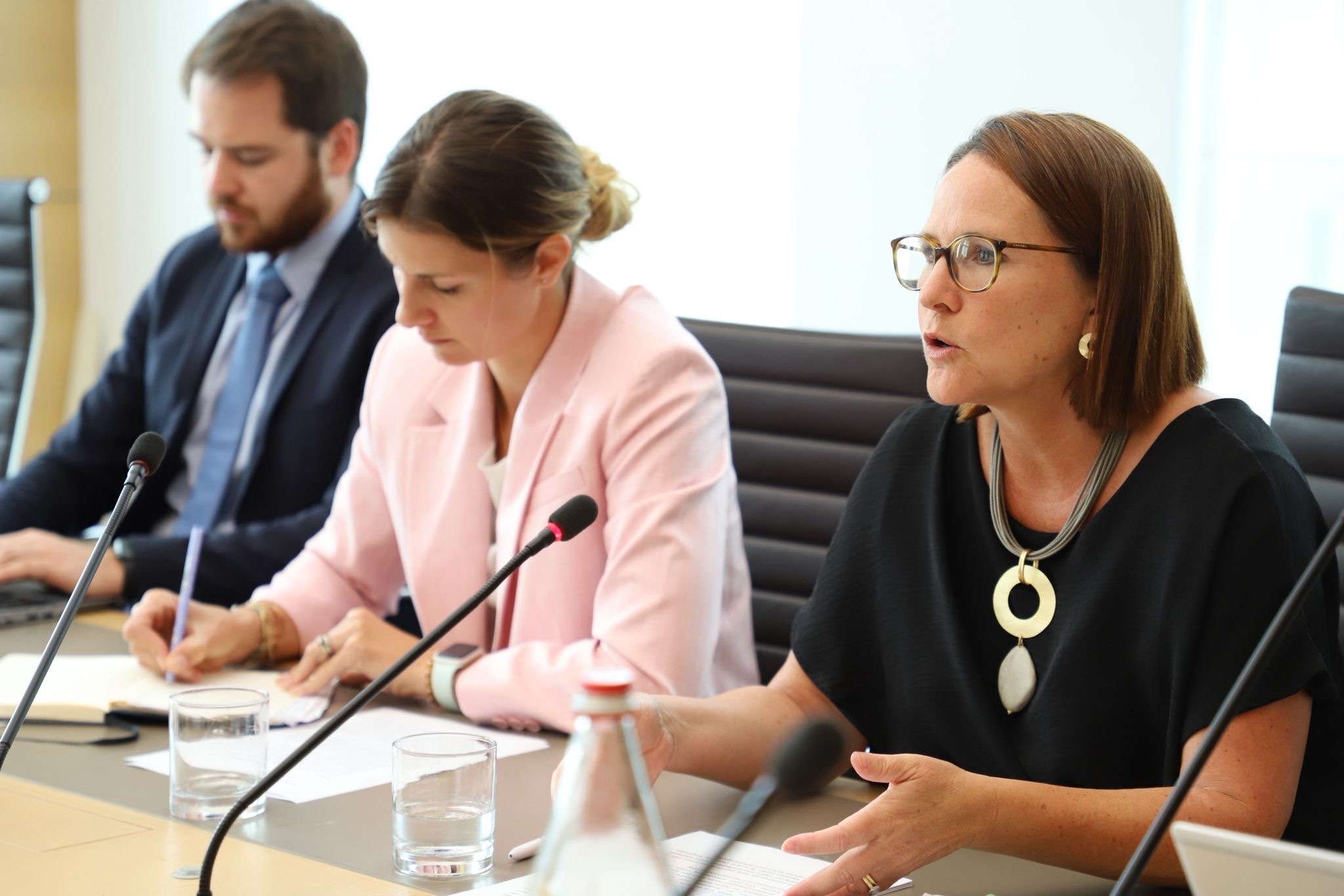
After the evaluation of the PAN LGBTIQ+ 2018 by the University of Luxembourg, it was clear to all those involved that there was a need for more transparency in the implementation of the measures and for a closer cooperation with civil society. Equality Minister Yuriko Backes (DP) responded by establishing an inter-ministerial committee to oversee – among other things – the implementation of the PAN LGBTIQ+. She also pledged involving LGBTIQA+ experts with drafting the updated PAN.
In this context, the first Colloque LGBTIQ+ took place in Kirchberg in March 2025. The conference was aimed at organizations, associations and institutions. A commendable initiative? Yes, said Andy Maar, board member of the LGBTIQA+ advocacy group Rosa Lëtzebuerg, with a few caveats: “First, the date was uncertain, then the invitation wasn’t clear, at least to us. We only learned a few days before the event that all our members were welcome. Since the ‘colloque’ took place on a weekday, that made things difficult to arrange”
Fellow board member, Laurent Boquet, present during the conversation, agreed.
In the end, 120 participants responded to MEGA’s call, but time and logistical constraints prevented the attendees from taking full advantage of all the scheduled workshops. Their conclusions were presented in a final session to the comité interministériel LGBTIQ+ élargi, which was given seven days to comment upon.
“Today’s event serves, among other things, to engage in consultation with civil society,” said Romaine Boever, then Commissioner for the Equality of LGBTIQ+ People at MEGA during the Colloque, “even if we cannot adopt every suggestion one-to-one.” She was right – on many levels.
“During the conference, several experts also warned against publishing the PAN in midsummer: They argued that there wouldn’t be enough time to analyze the document, especially since the publication was supposed to be released during Pride season – an intense period of the year for LGBTIQA+ associations. The government stuck nonetheless to its initial schedule”, stated Maar.
Boquet showed what this entails with an example: “We tried to meet up with Martine Deprez, the Minister of Health and Social Security, before the publication of the PAN. We requested an urgent meeting because we wanted to make sure that our key demands would be taken into account. Unfortunately, the meeting happened only afterwards – without many of our health-related requests being included.” To make matters worse, the meeting took place without the minister. She was represented by staff.
Many needs and demands have not been integrated with the necessary clarity and commitment.
What the Civil Society Thinks
Criticism of the PAN did not take long to surface. By mid-September, Rosa Lëtzebuerg, Intersex & Transgender Luxembourg (ITGL) and the Consultative Human Rights Organization (CCDH) had all commented publicly on the new PAN.
“Many needs and demands have not been integrated with the necessary clarity and commitment,” the CCDH stated. For example, “instead of a concrete bill introducing a ‘neutral’ option in identity documents for non-binary people, the PAN merely mentioned a new legal analysis. The proposed measures about the automatic recognition of parentage ties between same-sex parents and their child born of medically assisted reproduction (MAR) or surrogacy remain vague as well.” The PAN and the coalition agreement only stated that such recognition would be possible by both partners, with the goal of submitting a bill in 2027.
The common denominator of the criticisms, however, is another one. Everyone seemed to suggest that the PAN missed two priorities, both of which had already been flagged at the Colloque in March: ending the pathologization of trans and non-binary people by adapting the statutes of the Caisse nationale de santé (CNS), and banning non-essential surgical operations on children born with variations in sex characteristics.
What is the PAN LGBTIQ+?
The acronym stands for Plan d’action national pour la promotion des droits des personnes LGBTIQ+ (PAN LGBTIQ+/PAN). The first PAN LGBTIQ+ was presented in 2018 by the then government (DP, Déi Gréng, LSAP) after discussions dating back to 2015. The goal: to consider the concerns of LGBTIQ+ people in all areas and to pursue an appropriate political approach. Corinne Cahen (DP), former Minister for Family Affairs, Integration and the Greater Region, was responsible for the coordination at the time. With the change of government in 2023, the file moved to the Ministry of Equality and Diversity (MEGA) under Yuriko Backes (DP).
The PAN LGBTIQ+ 2018 was evaluated by the University of Luxembourg in 2022/2023 and the results were published in April 2024. The researchers found that although 59 percent of the 93 actions had been fully implemented by then, more than half of them had already been adapted in 2018 or even before the publication of the PAN. Yuriko Backes reacted to the results by establishing an interministerial committee to apply the PAN.
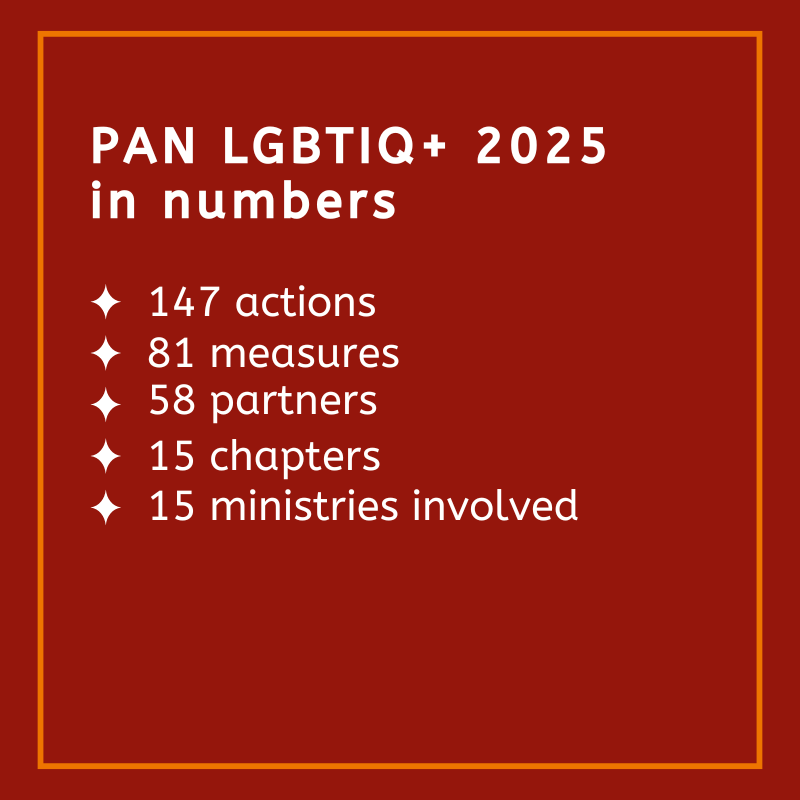
The current coalition agreement (2023-2028) stipulates the update of the action plan. In July, these words were followed by deeds and the current government (DP/CSV) presented a new version – the PAN LGBTIQ+ 2025. The eight existing chapters (Education, Work, Health, Family, Integration, Trans Rights, Intersex Rights, Discrimination) have been supplemented by seven further thematic priorities (local affairs, culture, sport, civic engagement, research, foreign and European policy, communication). A PDF version is available online at gouvernement.lu.
Trans Rights
While the revision of the CNS statutes was explicitly mentioned in the PAN LGBTIQ+ of 2018 (page 42), this demand was missing in the new version. When asked by queer.lu, the Ministry of Health and Social Security pointed instead to another measure: “Commit to the respect and enhanced protection of non-binary gender identities” (page 58). By 2026, the government said it wants to analyze the legal framework for gender-affirming surgeries and hormone treatments in other EU countries. An interministerial group would evaluate Luxembourg’s procedures and adapt them. It is unknown what the real outcome will be. Even though the situation of trans and non-binary individuals has been known for years and has been sharply criticized by organizations like ITGL.
“To be eligible for transitional medical measures (hormone treatment and surgery), trans and non-binary people must submit a psychiatric report for hormone treatment and another for surgery,” ITGL explained. “Most people do not need to see a psychiatrist, as they do not have a mental illness. The interviews often serve not as a support function but as a control function, and have been experienced by many as humiliating or aggressive. They have no medical basis.”
According to ITGL, this procedure complicates the access to medical care and therefore violates the right to self-determination and constitutes an infringement of Luxembourg’s Constitution (art.13: “Everyone has the right to their physical and mental integrity”). It contravenes international standards such as those of the World Health Organization (WHO) and the World Professional Association for Transgender Health (WPATH). “Both clearly establish that health care for trans people should be administered without pathologization, based on self-determination and informed consent.”
What About the Children?
The keywords ‘self-determination’ and ‘informed consent’ lead to the second measure that, to the astonishment of all the aforementioned organizations, has disappeared from the PAN: the ban on non-essential operations on children with variations in sex characteristics. In 2022, Corinne Cahen (DP), former coordinator of the PAN LGBTIQ+, had called the ban a priority in an interview with the weekly newspaper Woxx. At the time, it was anchored in both the PAN (page 48) and the 2018-2023 coalition agreement.
But already in 2023, a parliamentary question by MP Octavie Modert (CSV) to the Ministry of Health, Justice and Family Affairs revealed that the decision on a draft law had been postponed; as the responsible interministerial working group could not agree on a general ban. Today, there was no longer any talk of a ban – whether blanket or partial.
For ITGL and the CCDH, Luxembourg was once again in breach of international recommendations — from the UN, the European Commission against Racism and Intolerance (ECRI), ILGA-Europe and others. Local organizations such as the Ombuds Committee for the Rights of the Child or the CCDH are joining in. “The prohibition of these interventions must imperatively be an integral part of child protection and respect for human rights”, the CCDH stressed, calling on the government to “legislate without delay”.
Instead, the government offered to form a new working group, arguing that the issue was too “complex” and required input from many actors. ITGL countered: “This analysis already exists for Malta, France and Germany. New working groups should not be used as a substitute for State action or as a way to delay necessary measures.”
In numerous cases, there are best practices from abroad that Luxembourg could use as a guide. We have discussed certain topics for years: the establishment of a new working group will not bring any new insights.
Working Groups as an All-Purpose Weapon
The creation of working groups ran like a red thread through the action plan. If you search for “groupe de travail” in the PDF, you will land 16 hits. Search for “projet de loi” (bill), only six.
The Ministries of Health, Justice and Equality defended their approach, arguing that the topics were complex and required broad consultations. “A bill can also be initiated by a working group,” MEGA noted.
Maar, however, saw it differently and seemed to confirm ITGL’s fears: “We saw this more as an evasive manoeuvre to delay decisions. In numerous cases, there are best practices from abroad that Luxembourg could use as a guide. We have discussed certain topics for years: the establishment of a new working group will not bring any new insights.” The CCDH drew a similar conclusion, calling the updated PAN a “missed opportunity and a worrying decline in human rights”.
Were Political Conflicts to Blame?
Was it all a sign of political friction between the coalition partners DP and CSV? Both parties generally supported LGBTQIA+ rights; both opposed the petition to remove LGBTQIA+ content from schools. Yet their election programs revealed differences that now came to the surface.
Surrogacy was the clearest example. In its 2023 election program, the CSV resolutely opposed legalization, while the DP was open to it under non-commercial conditions. Who eventually prevailed? The CSV, because both the PAN (page 44) and the current coalition agreement (page 99), stated that surrogacy would not be allowed in Luxembourg.
Even so, Boquet refused to blame the CSV alone: “ The problem was rather that not every ministry recognized the importance of LGBTIQA+ rights or had the necessary resources to implement them.”
MEGA, for its part, emphasized that the updated PAN was coordinated by the interministerial committee and reviewed by all ministries before publication. “In the end, it was a document supported by the entire government. It is therefore understandable that not every demand of civil society was reflected.”
The PAN has to be understood as an open document without an end date.
What Now?
Despite the criticism, civil society also acknowledged progress. Even ITGL highlighted what it was particularly pleased about: the prohibition of conversion practices in a bill, the planned introduction of the possibility of the ‘neutral’ qualification for non-binary people in their identity documents, the removal of the mention of sex in documents where it is not relevant, and the finalization of the IMS guide “Inclusion of transgender people in the workplace” by enclosing legal information on the use of the chosen first name before the official change in the civil registry.
Rosa Lëtzebuerg praised “the promotion of remembrance culture for LGBTIQA+ victims of the Second World War, as well as the introduction of labels to identify businesses as safe spaces for LGBTIQA+ people.”
The focus of the criticism was rather on individual demands that have been on the table for years. It’s about the idea that working groups must negotiate old problems and known solutions with an uncertain outcome.
MEGA, nevertheless, sounded confident in its support of the interministerial committee, which will have to submit an annual report to the government council, which in turn could pressure ministries to act.
At Pride, civil society waved rainbow flags. Now, MEGA raised another banner: a white banner, asking for patience. Whether the PAN was a bold move or a missed opportunity would depend less on the wording of the document than the government’s willingness to act, and MEGA insists it is an open document without an enddate, in other words, “it can still be adjusted in the coming months and years.”