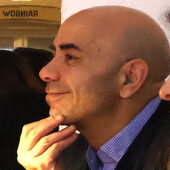
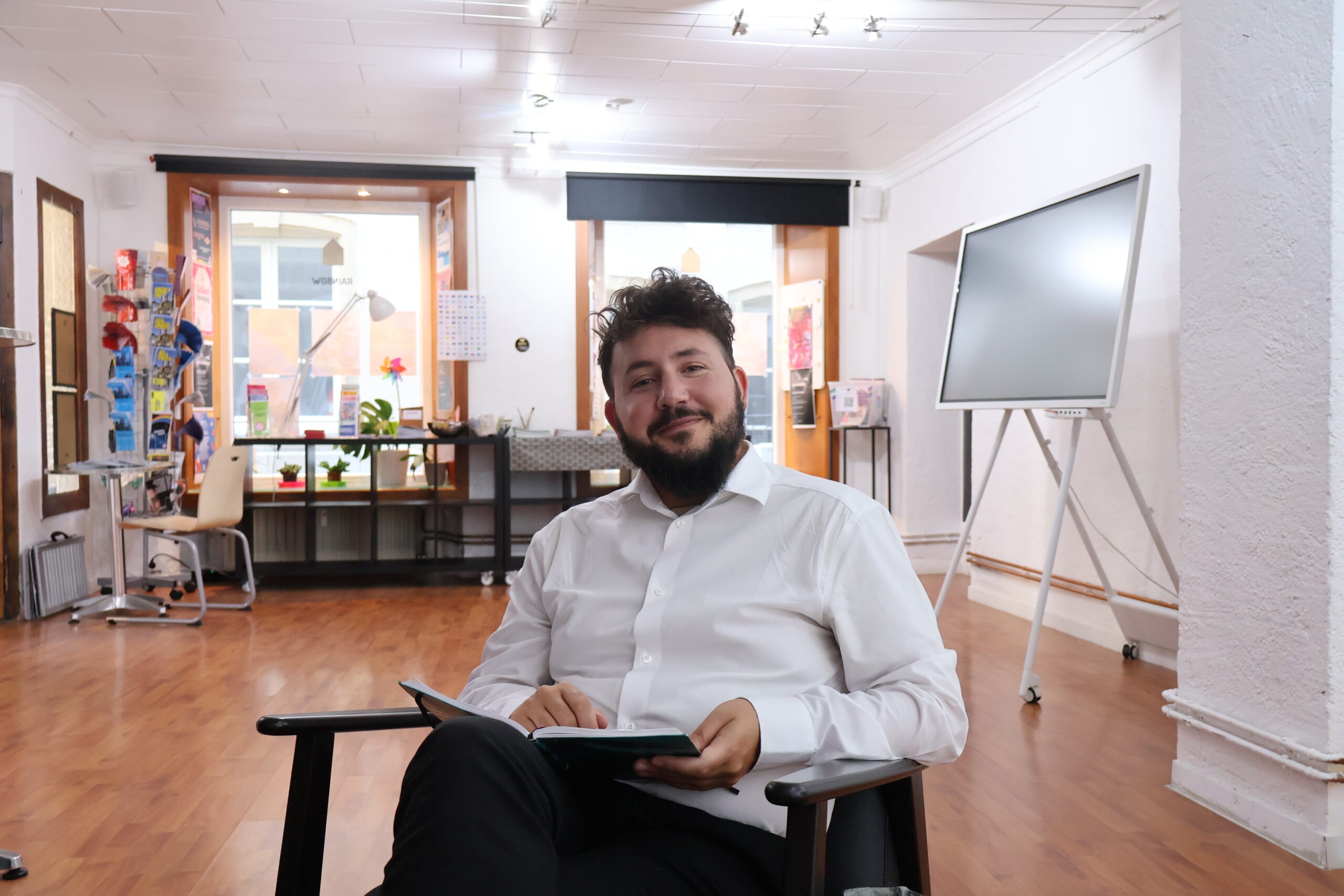
In early July, in the days leading up to Luxembourg Pride, queer.lu sat down with Frankfurter Marco Linguri. He had been invited to speak at a roundtable discussion on the place of faith in the queer community and take part in a queer interfaith celebration.
Marco is not only a trans man, he is also an Imam and co-founder of a queer Muslim community in Germany.
queer.lu: A warm welcome to you. How should we introduce you? As Marco, or Imam Marco? Or Imam Linguri?
Marco Linguri: My friends just call me Marco. But I also chose an Arabic name—Yasin—during my transition. I usually don’t go by “Imam Linguri” or any title like that. I’m not into showing off titles. Just like I wouldn’t ask people to call me “Master of Arts” even though I have that degree.
Gotcha.
That’s probably because I’m very much not German.
Would you like to share some information about your background—both cultural and spiritual—we’d love to hear how your journey led you to Islam.
My mother is German, and my father is Turkish. He comes from a minority that speaks Munja, a kind of Greek dialect. My family faced persecution in Turkey for being part of that community and had to flee the country.
What’s interesting is that although my family wasn’t Muslim, we experienced anti-Muslim racism in Germany simply for being Turkish. So, it was like a double layer of discrimination. I grew up hearing stories about persecution and escape, and it shaped my worldview as a child.
But I never associated religion with that persecution. My family might have had an easier life in Turkey if they’d been Muslim—but they weren’t. I’m the first in my family to convert. And for me, Islam didn’t feel like a conversion—it felt like a confirmation of what I already believed.
I never understood the concept of the Trinity or Jesus as the Son of God. It just didn’t make sense to me. When I read the Quran, it was like finding a language for beliefs I already held. Kind of like my gender transition—I always knew who I was, but didn’t have the words to express it.
Being surrounded by people who remind me that I am whole.
How old were you when you first read the Quran?
I think I was in my twenties. I’m 35 now, so it must’ve been 10 to 15 years ago. A friend used to tell me stories, and when I asked where they came from, she said, “From the Quran.” So, I read it—and I just knew I was Muslim.
Do you identify with a specific school or branch of Islam?
I simply say I am Muslim.
Islam is a community-oriented religion. Social bonds are central, so did you go to mosques or take part in collective worship, or was it more of a solitary journey at first?
It was very personal and solitary at first. I’m autistic—I like being on my own. I read the Quran by myself, taught myself how to pray, and kept my faith to myself. Later on, I decided to study Islam academically, as I had with sociolinguistics. I started a Bachelor’s in Islamic Theology.
In Arabic, there’s no real difference between faith and religion—it’s all Deen. But when people claim to have the one true version of Islam, I step back. I don’t like authorities. The Quran says we shouldn’t take religious leaders as gods besides God, and I take that seriously.
All those paths are valid.
How would you define faith?
Faith is a light. A light we all carry inside. Some call it God, some call it the universe, some see it as inner peace. I believe all of those interpretations are valid. My way of expressing it is through Islam.
Why Islam in particular?
Because it makes the most sense to me.
Do you think everyone can have access to or perceive that light?
Absolutely. Some people find religious frameworks that resonate with them. Others create their own ways. I believe all those paths are valid.
What about doubt? Do you experience it, and do you cope with it?
Constantly. Doubt is essential. If you don’t question your beliefs, you can’t feel them deeply. You need both your heart and your brain. If your mind finds no answers, your heart can’t rest.
So, doubt is a practice in itself?
Yes. You should challenge yourself. Ask, “Is God there?” and seek the answers. Sometimes, you find them in nature—like bees dancing in figure-eights around flowers. That joy and beauty prove something to me.
Would you kindly define what God is for you?
Since there is nothing greater than God, we must be within Him. The universe is part of God. I feel Him especially when I’m struggling—when I lie on my prayer mat, eyes closed, and still see light. That’s Him. He’s within, around, everywhere.
Empathy isn’t automatic—it requires work.
Let’s go back to the community. Are you part of one?
Yes. Last year, a queer Turkish Muslim friend and I founded a collective. We wanted to create a spiritual space for inclusive Muslims. It’s not small, and I’m very proud of it.
We don’t have leaders. Even though I’m an imam, my voice carries no more weight than anyone else’s. We vote on everything. New members must be approved by both the group and the individual themselves.
Have you received external reactions?
Not really. We’re intentionally private—no Instagram or social media. But we’ve spoken at Pride events and shared talks online. Feedback has been positive.
How do you navigate racism within queer communities?
It’s a big issue. Queer spaces are often very white, especially in cities like Berlin. Some people see us as intruders—Muslim, racialized, different.
People assume that being marginalized means you understand all forms of oppression. But that’s not true. TERFs exist. Empathy isn’t automatic—it requires work.
And how do you stay resilient in the face of far-right politics and growing hate?
I’m scared, honestly. The far right is growing. But I won’t live in fear. We still have time to act, organize, and resist.
Faith and community help. Our Friday prayers are online. Someone leads the prayer, someone else gives a khutbah. We reflect, discuss, and grow.
Sometimes people make it to our meetings exhausted, depleted. But by the end of our sessions, almost always someone would say, “I feel more energy now than when I came.” That means the space is working.
I won’t live in fear.
What about language barriers—especially Arabic in religious practice?
I always translate anything I say in Arabic – into German, English, whatever language is needed. I think it’s essential that people understand what they’re hearing.
I also encourage people to read multiple translations of the Quran. You get a more complete picture. Translation is interpretation, after all. And we have community members who speak Arabic fluently and help us all understand better.
What are people in your community mostly after? What brings them to the safe space you helped set up?
Many are looking for connection—for community, for healing, for peace. Some are exploring their identities, trying to find a language for experiences that have no name. We talk about decolonizing queerness, finding Islamic frameworks for gender and sexuality. We’re not inventing something new—we’re reclaiming something old.
Do you see yourself more as a spiritual leader or a religious one?
Both, maybe. I’m an imam—I earned that title. I trained with Ludovic-Mohamed Zahed in Marseille. It took two years, a thesis, and a lot of reflection. But more than anything, I see myself as a person of faith. Titles don’t matter much. Connection does.
Last question—what gives you joy right now?
Community. Knowing God loves me. Feeling that I belong. Being surrounded by people who remind me that I am whole.
And helping others believe that too.