Last October, Ahmed Gul, cover photographer of queer.lu issue 5, and I , traveled to the French city of Calais to report on asylum seekers. What began as a press visit unfolded in an opinion piece on precarity on European soil, the emboldening of anti-migration forces, and the need for queer-feminist solidarity.
Two days before Ahmed and I set out for the Northern French coast, a notification popped up on our phones. It was Méryl Sotty, communications manager at Doctors without Borders (Médecins sans Frontières/ MSF) France. We had been in contact with her prior to our 3-day press trip to Calais. Her message read:
We’ll ask you Ahmed not to show your camera from the beginning of the visit. […] Calais is a very complex context. There have recently been some attacks from UK far-right activists, who were violent with migrants and filmed them, so the presence of a camera can generate fears and tensions.
Neither Ahmed nor I had known of this beforehand. We mentally prepared.
After forty-eight hours and a lively car journey through Belgium and France, we arrived in Calais. We had no appointments and used the afternoon to explore the city. The beach town felt different from what the news made me expect. Calais seemed like a typical summer resort in autumn—preparing for hibernation, while banners and posters lingered as reminders of the last “summer holiday attraction” and “beach programs”. Few people on the streets carried out their routines without much urgency. On the town hall facade, the gold-plated inscription “Liberté, Égalité, Fraternité” gleamed in full view.
Calais—the situation on the ground
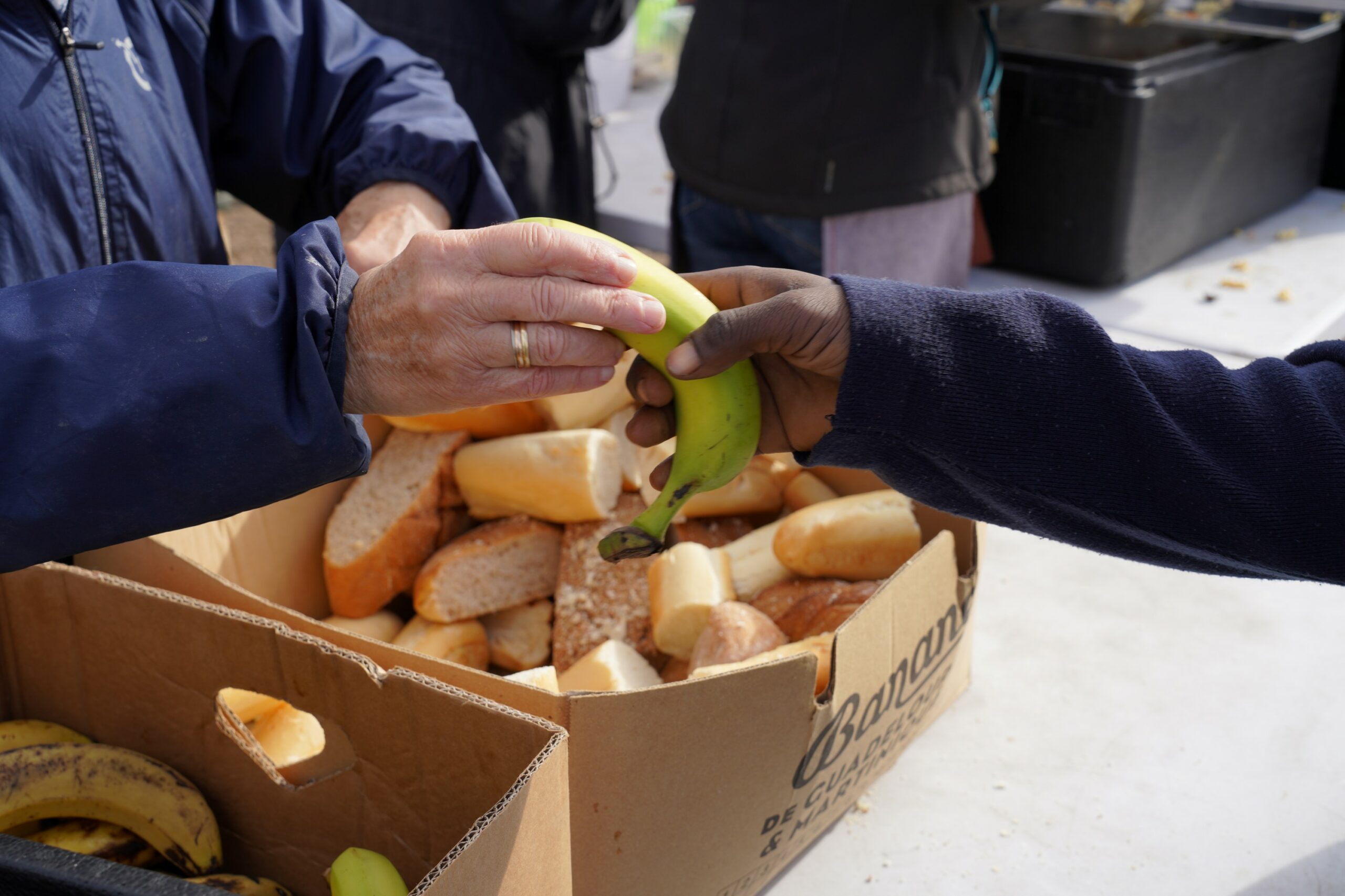
After a good night’s sleep at a local B&B, we met up with Méryl just five minutes away from the city center. We stood in front of the sole day-center for people on the move in the larger region. We were invited to accompany the MSF team during their shift. The day-center is run primarily by volunteers of Secours Catholique and opens its doors every business day from 12:00 until 17:00. Around 500 people come daily to get some rest, information on boat safety, a shower, warm food, charge their phones and get medical and psychological check-ups. Elise Houard, MSF nurse, and Amira Babakar, MSF intercultural mediator, greeted us with smiles. As we spoke, the day-center slowly filled.
During our talk, Elise explained the main dangers faced by people attempting to cross to the United Kingdom. In order to avoid police interception, some asylum seekers are crossing from places that are further south of the northern French coast. Departures now occur as far as Le Touquet, which is approximately 40 km from Calais. This significantly lengthens their journey, often by several hours, and increases the risks at sea.
Before boarding, traffickers sometimes require people to wait for hours in chest-deep seawater for their boat to arrive. Many suffer severe burns caused by fuel mixing with saltwater that pool in the middle of the overcrowded boats. The number of people per vessel has surged, with up to fifty-four individuals now packed onto small dinghy boats. Most of the time, these boats are supposed to carry only up to 40 people, are inflatable and of structurally poor quality. For example, the floors of the boat often give way to the sea, plunging people into the water. In some cases, people have been crushed to death on board. According to the Missing Migrant Project, at least 85 people died on the Mainland European-UK border in 2024, including 16 children.
We walked through the day-center. A volunteer reminded us to be mindful when talking to people onsite. Some have just returned from a failed attempt to cross the waters, others had spent the night in makeshift camps, without sleep.
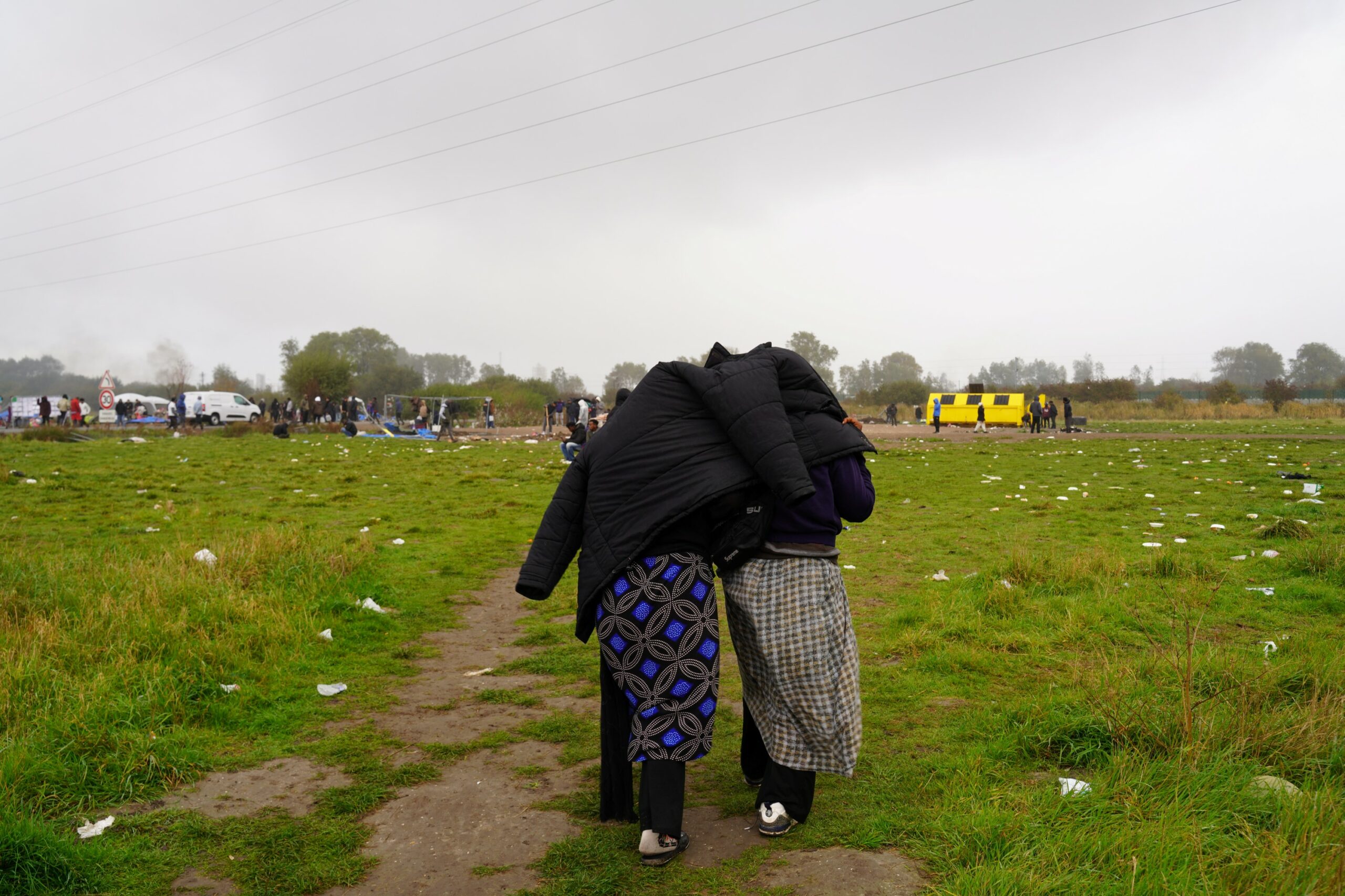
We spoke to some people who described their ongoing struggles in Europe. We hear of people who had just been evicted by the police from a camp. According to the Human Rights Observer NGO, 642 people were evicted in Calais and nearby Grande-Synthe in October 2025. Most often, people are left onsite without assistance—tents and personal belongings are frequently confiscated or destroyed.
We also met a Kurdish family with three children under the age of ten. They had been travelling for several months and had arrived in Calais the day before. They had slept the previous night at a bus stop. Ahmed helped with translations as they were being told that the current infrastructures only offer them one night in a shelter. The following day, they would be back on their own again. The family thanked Ahmed and the volunteer.
A volunteer pointed towards the entrance gate of the day-center. “That’s where, a few weeks ago, British far-right ‘activists’ stood filming people,” they said, shaking their head. Ahmed’s camera stayed mostly in his backpack that day. We would hear more about these activists soon.
At 17:00, the center closed its doors. Ahmed and I decided to take a break at the beach in Calais. The weather was clear. We could glance over the waves of the Channel and see the peaks of the British shore—only 33 kilometres away. I took a deep breath. According to the UK government, from September 2024 until September 2025, around 46,000 people arrived in the United Kingdom on small make-shift boats and around 5,000 via other routes, including hidden in trucks or shipping containers.
The reasons why people expose themselves to these dangers of crossing the English Channel are manifold. Some people try to reunite with their partners or family members, as family reunifications were halted in the UK in September 2025. Others got their asylum application in an EU-country refused, after an often traumatic and dangerous journey, and now have the last hope of applying outside the EU-synchronized system in the UK. The latter has also been confirmed for people who got rejected in Luxembourg, as reported by Lëtzebuerger Journal. The reasons might be diverse, but applying for asylum is a human right—and currently, “legal” and safe ways to seek asylum in the UK have become nearly non-existent, as stated by MSF.
My second night’s sleep was restless.
Anti-migration forces are organizing
The following day, Ahmed and I went separate ways. I spent the day at a day-center for unaccompanied minors run by MSF. Ahmed went to the neighboring city of Dunkerque. His observations are reflected in the photo series accompanying this piece.
Similar to the day-center, the center for minors provides access to healthcare, food, electricity, and a safe space to rest throughout the day. MSF project coordinator in Calais, Sarah Gallitre, explained: “we would love not to have to do this. But if we don’t, there is no one else”.
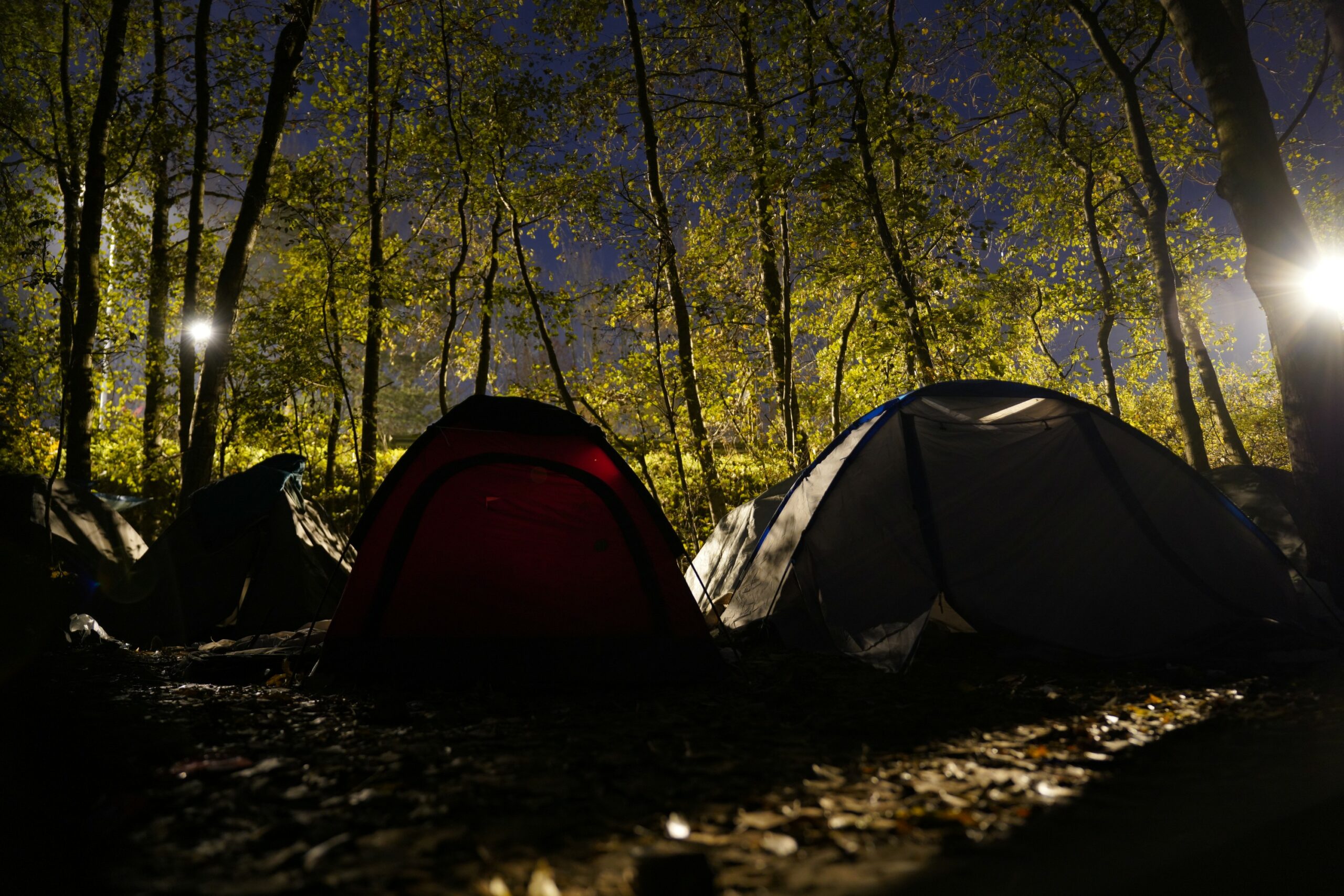
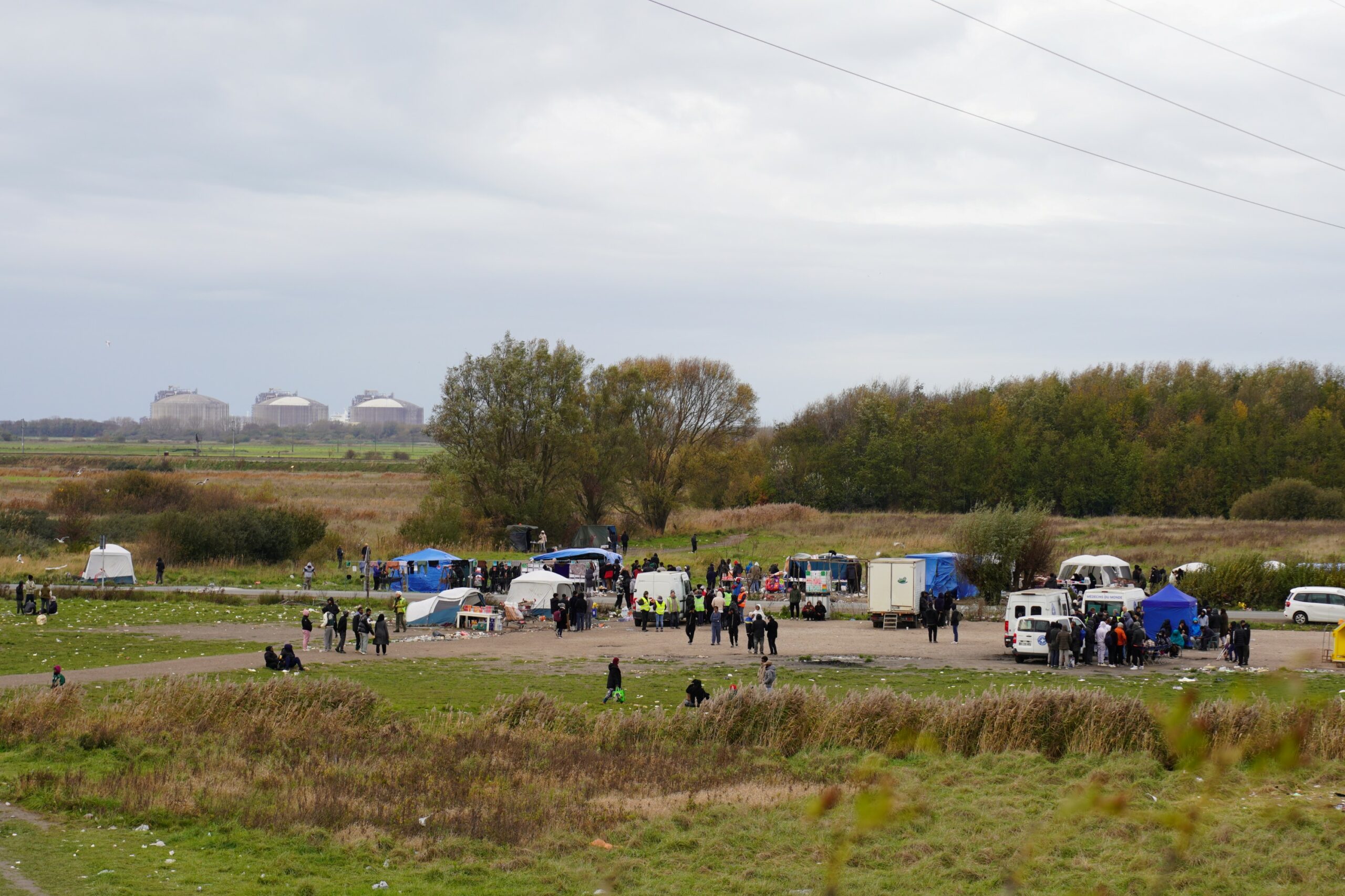
The local government does not visit people in makeshift camps to provide help—most humanitarian aid relies on volunteers and the civil society. NGOs distribute food and tents at makeshift camps to ensure people’s survival. Since MSF started its work in Calais two and half years ago, the municipality has never replied to their request to meet and discuss the situation on the ground.
These camps are particularly risky for minors and single women. While people adapt to circumstances—at the camp in Dunkerque, Ahmed witnessed traditional Kurdish food being cooked, laughter could be heard, and a community was formed, the reality cannot be sugarcoated. The camps are also sites of dire precariousness, without hygiene facilities, at times of sexualised violence and even threats to life, as confirmed by MSF.
The local governments showcase their own priorities through actions. Meadows close to the city center of Calais are filled with large stones (see page 35), making it impossible to pitch a tent. Closer to Dunkerque, the municipality erected new stone walls and wire fences over the past two months to complicate movements, as documented by Ahmed, who visited the area again in November. The question poses itself as what these infrastructures aim to solve.
At the center for unaccompanied minors, the issue of the British far-right ‘activists’ resurfaced. While no one at MSF had witnessed this themselves, videos have circulated of Brits going to camps in Calais, waking people up in the middle of night and urging them not to go to the UK—videos, among others, by Raise the Colours. The British group openly publishes their travels to the French coast on Instagram and explains that they are “looking for migrant boats to DESTROY!” While patrolling French beaches, they look for asylum seekers and try to deter them from boarding boats. Raise the Colours works with crowdfunding, and some of their videos have over 100,000 views and thousands of comments on Instagram. The movement seems to be young, with its first video posted on Instagram in September 2025.
In an introductory video on their website, the group displays a flag inscribed with “Rip Charlie Kirk”, referring to the American political commentator murdered in September 2025. Kirk was known for his xenophobia—as well as his explicit transphobia, queerphobia, racism and misogyny. In a video posted in October, a member of Raise the Colours mocked an anti-far-right protester for wearing what he described as “transgender clothes, referring to the protester’s androgynous outfit. The ideological overlaps are clear.
A queer-feminist stance needed
During Ahmed’s follow-up trip to the region in November, he encountered the same Kurdish family at a makeshift camp close to Dunkerque. The children immediately recognized him, and reacted with excitement. The father took longer. He looked exhausted
While many asylum seekers live in extreme precarity, hostility towards them continues to grow. This is not only accepted, but too often legitimised through policy—we see the signs in how our governments act on migration, and the overwhelming praise a group like Raise the Colours gets in their comment section. Even conservative cis-gay and feminist movements, like Collectif Éros and Collectif Némésis, have joined the xenophobic choir.
As queer-feminist people, we need to stand up to this.
The imagined divide between queers, women and migrants only obscures shared vulnerabilities under systems of exclusion and control. We have an obligation to act—potentially through a coalition outside of identity labels, but still with empathetic honesty of who is most at risk at a given point in time.
While tactics to divert are and will remain manifold, this is not about discussing cultural differences or integration challenges; neither is it about the reasons why someone is on European soil; nor about partisanship. We either uphold civil order and dignity or disregard it. People should have the right to safely and—let’s be utopian—comfortably exercise their human rights and apply for refuge.
Who we vote for, who we give our ‘views’ and ‘likes’ to, who we politically support—or defend during family dinner, it all has an impact. Just as much as if we invest our time into activism, support refugee voices, and sign petitions. Let’s be clear, if some can be stripped of their human rights, then no one is safe.
|
The Photographer: |