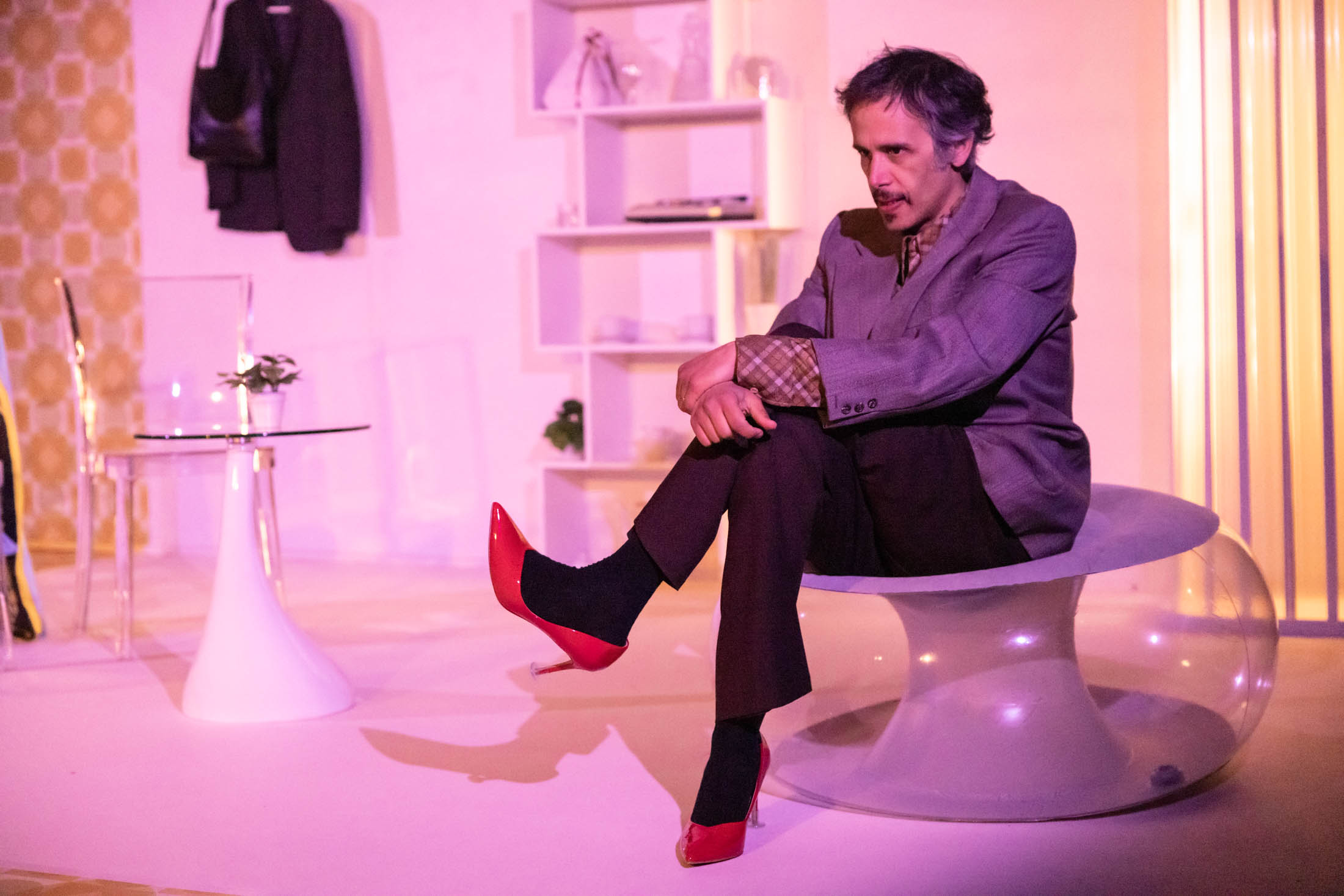
There is hardly anything worse than losing your own child. Especially when it is your own fault. Fabère, a father and detective, was unable to accept the “coming out” of his trans daughter, Lara. She took her own life as a result. Now he mourns her and wears her high heels to literally step into the shoes of the other.
Queer people are well aware that trans people have historically often, if not always, been portrayed as ‘the other’ in all forms of media. That is why I would like to approach this review of Tullio Forgiarini’s play Le Retour de Lucienne Jourdain (2022 Hydre Éditions) a little differently. It is important to note that although the author is a cis man, Lara is the only explicitly mentioned trans character that I have come across in my research as a third-year doctoral student in Luxembourg studies. That is why it is all the more important to write publicly about grief and trans identity in a magazine such as queer.lu.
I would like to write this review in such a way that it critically examines the trope of the dead trans character, who exists solely for the further development of the protagonist. All the more so because we never actually see the eighteen-year-old Lara. Solange (Lara’s mother / Fabère’s wife) and Fabère only talk about her, so narratologically she seems to serve only one purpose: the expression of suicidal grief towards the patriarch (here Fabère). I would like to ponder the following question: How can a man distance himself from patriarchy? Whether cis or trans? The text thrives on this trope, which poses a number of problems. Here, it is important to address a meta-level for cis men who have seen the play or read the text, and a purely text-based level for Fabère as a cis man within the play.
It is important to emphasise here that a male-socialised person can very well renounce patriarchal ideas. This happens on the meta-level of the play, which thus serves as a cautionary tale. The message is ‘don’t be like Fabère’, and the protagonist, Lucienne, makes this very clear later on. On the purely text-based level with Fabère, there is no warning, but rather an invitation to his own execution. For a better understanding, we need a detailed insight into the lives of Fabère, Lara and Lucienne.
Let’s start with the father and daughter.
Fabère takes his cue from his daughter Lara and tries to distance himself from patriarchy. In other words, a cis man is taking his cue from a trans woman. The question then is… how? How does he listen to her? How does she change him? What does the path she has left behind look like? His approach is to run away.
Fabère may be walking around in his dead daughter’s shoes, but he still has a lot to understand. He runs away from the consequences of his patriarchal thinking, precisely because of his shame and grief. Lucienne, the retired woman he interviews during the play, makes him aware of this. Fabère investigates several murder cases and Lucienne is connected to all of them: her husband, a car salesman and a young hotel worker who moonlighted as a gigolo. What he doesn’t know at first is that she killed all three of them, which becomes increasingly obvious as the play progresses.
Fabère slowly but surely realises this too. Nevertheless, he does not pursue the investigation any further. He understands that she feels no guilt for the murders. After all, her husband had oppressed her virtually her entire life and deprived her of all joy, the car salesman wanted to take advantage of her, and the young, fit man at the hotel was disgusted by her older, sagging body. She also expresses irritation towards Fabère.

Lucienne ran away from patriarchy, fled, until her last option was to run directly into the patriarch. In other words, murder. Until she was in her 60s, she refused to admit how manipulative and cruel her husband was to her. She was forced to become the nice, nodding, Christian housewife. She existed for him, not for herself. She was his shadow, and after about 40 years of marriage, the barrel suddenly overflowed.
In Lucienne’s rage, Fabère recognises not only the justification for the murders, but also the flip side of his shame. Duality lives on in Forgiarini’s work. Whether oppressor or oppressed, patriarchy ultimately leads to one of two extremes: the tragic death of a loved one followed by shame and grief, or a rage so deep that only by taking the life of the oppressor can a sense of purpose be regained. Either one uses violence to liberate oneself, or one uses violence to maintain oppression. In both cases, the action is a direct, forced and even inevitable consequence.
Lucienne’s situation explains the other side of Fabère’s motives for rejecting his daughter Lara’s identity. So now we come back to the original question: how can a man distance himself from patriarchy?
The first approach to answering the question remains running away. In Lara’s case, this question is somewhat more complex, since as a trans woman she opposed the patriarchal ideal of the man. Doctors imposed masculinity and manliness on her at birth because she was born with a penis. However, this should not determine what she is or what she cannot be. The socialisation that goes hand in hand with the gender assigned to her at birth does not keep her from her identity. She confronted the question of identity courageously and came out to her family. This meant she had to face Fabère, the master of the house.
However, the consequences were too great, so she ultimately had to run away. One way to interpret her suicide is that Lara hid from her father, the patriarch. Symbolically speaking, her character is the exact opposite of Lucienne’s. At the same time, it is important to remember that times are different for cis women like Lucienne than for trans women like Lara. Above all, Lucienne had more opportunities to defend herself as an adult. And she had been carrying around decades of deep-seated anger. Lara, on the other hand, was extremely dependent on her family as a young adult, lived with her parents, and her mother’s support was not enough to keep her alive. Accordingly, her decision to take her own life must also be interpreted differently than Lucienne’s choice of violence.
Nevertheless, deeply negative voices could perceive Lara’s suicide as a kind of cowardice. After all, she ran away from her responsibility for herself and her father, and that is definite. This corresponds to a common media portrayal of suicide as an ‘easy way out’. However, there is another side to suicide, and I believe with all my heart that this is also the correct way to interpret Lara’s death: suicide is the only death one can choose for oneself, among other things for political reasons. Suicide can and, in Lara’s case, should be interpreted as a political act. She denied her father access to herself and her life because he rejected her as his daughter, as his own flesh and blood. She made it clear to him in the most direct way possible what it means to be a patriarch: to oppress minorities until they run out of strength to keep going… neither in the fight against patriarchy nor in their flight from the patriarch.
Now Fabère is running away. Not only from what he has done to Lara, but also from the patriarch within himself. And he is walking in his daughter’s shoes, her high heels. Thus, his daughter’s suicide represents a new beginning for him in his relationship with his masculinity. What does it mean to be a man? In the contemporary image of masculinity, it is not very manly to walk around in high heels. But for Fabère, in the absence of his daughter, it is the only way to find out how she might have felt. So he leaves part of his masculinity behind in order to get to know Lara better. A first step, albeit a tiny one, towards renewed self-exploration.
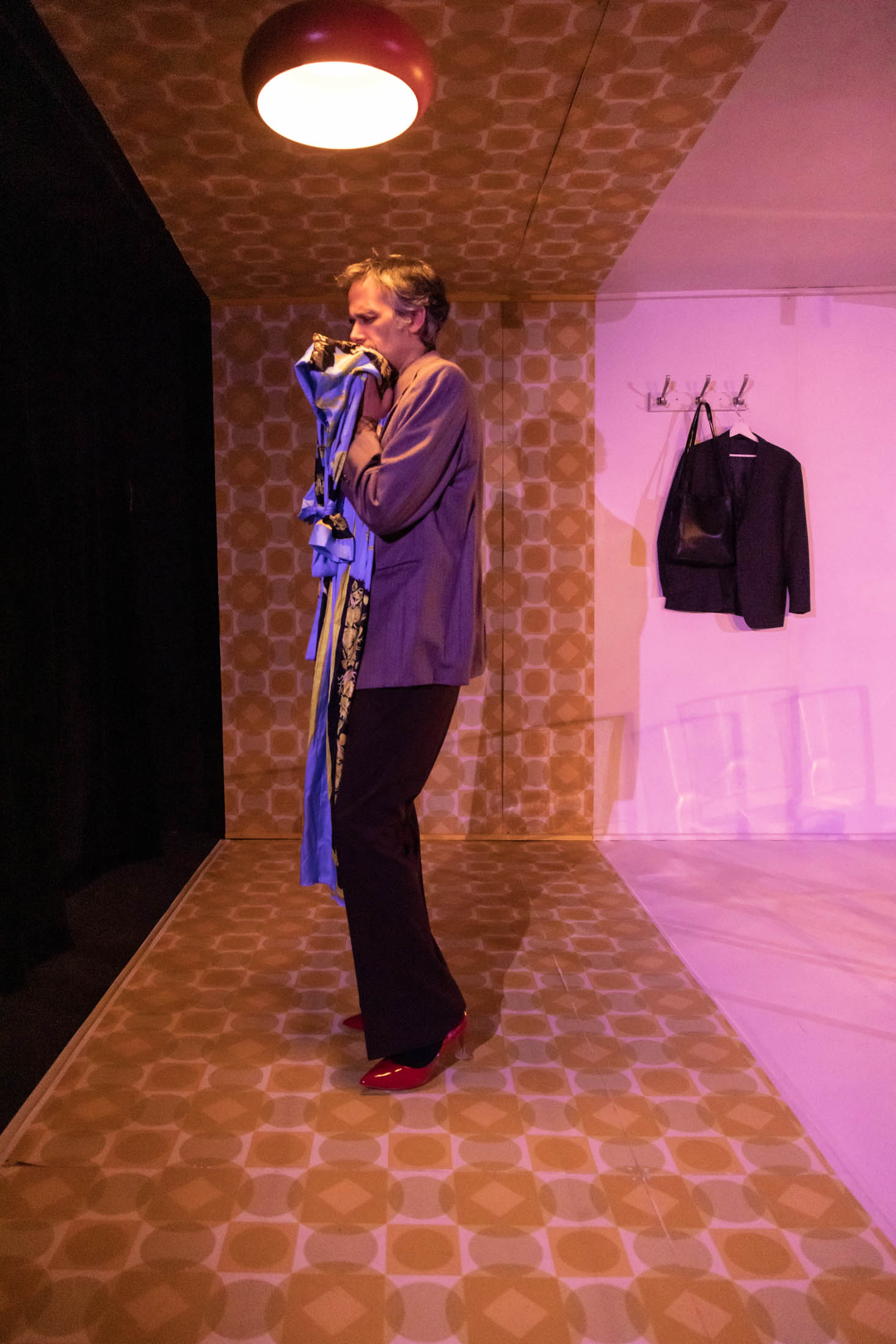
However, he does not begin to feel like her. After all, Fabère is not trans. But he does notice how exhausting it is to walk in these shoes. On a practical level, but also, for example, in Lucienne’s reaction to his appearance. Her door was open, he took one of her dresses and dances, in high heels, with the dress as his dance partner. In this scene, one notices Fabère’s desire for something different, something less restrictive than the patriarchal gender roles he is expected to conform to. Lucienne catches him in the act. She no longer likes the dress, she says he can keep it. He feels somewhat ashamed that she saw him like that, but she doesn’t let on. One could even say that she is almost indifferent, or rather, that she is glad to finally get rid of the dress. This is exactly how Fabère should have behaved towards his daughter. And this brings us to Fabère’s own queer identity.
His rejection of his daughter also contains self-rejection. Fabère, who likes the shoes and the dress, embraces femininity. Thanks to Lucienne’s help and kindness, he distances himself more and more from internalised patriarchy as the play progresses. Fabère begins to understand that he can retain his identity as a man but slowly and surely shed patriarchal ideas, that whether one presents oneself as feminine or masculine, one remains a man.
At one point in the play, Lucienne realises that the detective is actually getting in her way. However, she does not simply kill him, but recognises that Fabère is on a daring path of self-discovery and critical introspection. He is no longer quite running away, but also not quite running towards. He is slowly but surely feeling his way towards what gender identities actually are and how fluid they can be. It is also in this sense that Fabère must go further. Away from patriarchy and into grief. At the same time, he runs towards authenticity and learns to know himself and his daughter a little better. This also happens in grief. Because it always hurts to take off your old shoes and put on new ones. Yes, it is always difficult to leave the old self behind and accept a new self.
However, at the end of the play there is a radical turnaround, which is already hinted at in individual passages throughout the work.
Fabère tells Lucienne that his daughter took her own life because of him. Now she rejects him and demands that he hang himself. Lucienne’s anger is understandable here too; Fabère, one feels, deserves it. After all, he drove Lara to her death. Lucienne’s motto is: what you do to me (or my loved ones), I will do to you. Here, an important feminist connection between cis women and trans individuals is explicitly portrayed. This advocates for queer feminism. From a narratological perspective, Lucienne’s anger is ultimately a plea for radical empathy towards Lara and trans individuals who have suffered the same fate as her. On a purely textual basis, therefore, only part of the play presents the problem that Fabère wants to change and improve himself, but only after the death of his daughter, which addresses the trope of the dead trans character itself. Lucienne’s demand that he take his own life and her refusal to continue offering him help represent an interesting narratological shift. Through Lucienne’s rejection of Fabère, the narrative itself rejects his development. He is alone with his problem and has to deal with it on his own, so the play ends at this point. Lucienne also believed that he could not be saved, which is why she suggested suicide.
However, how effective is Lucienne’s approach to Fabère? The play reaches its climax when it comes to the question of empathy. Fabère does not want to continue living in a patriarchal and restrictive world. He wants to be as free as Lucienne. He wants to run away with her and not lock her up because of the murders. He would rather die than be left alone by her. Now Lucienne leaves him alone and Fabère can no longer run: neither from himself, nor from his responsibility, nor into a new world. He now finds himself in a situation that can be compared to Lara’s. And the only option left to him, according to Lucienne, is suicide. Lucienne has revealed the truth to him: Fabère is not putting on Lara’s shoes to learn more about her, but to find forgiveness. Lucienne has forced Fabère into Lara’s situation and shown him what she really felt at the end of her life. Now he sits there and asks himself the question: should I do it or not? That’s where the play ends.
I firmly and deeply believe that Fabère should not kill himself, as he has a responsibility to bear. If he takes his own life, he would be taking ‘the easy way out’. His suicide would not be a political act, but a cowardly one. So I can understand Lucienne’s method in Fabère’s case, even if I don’t find it productive. On a meta-level, I believe Fabère’s character should be interpreted as follows: yes, it is possible for a man to change and distance himself from patriarchy. However, one should not expect forgiveness from those one has oppressed.
images of Lucienne Jourdain
by Bohumil Kostohryz