Historically Queer: How queer are old fairy tales?
ONCE UPON a time, there was a not-quite-so-young gentleman of a distinguished family, named Joël. His thirst for knowledge was almost insatiable. As he wrote regularly for this magazine, one day he asked himself the following question: How much queerness can be found in the old fairy tales of the Brothers Grimm or Hans Christian Andersen? Is there queer behaviour in Jean de la Fontaine’s fables? To quench his thirst for knowledge, he set off over seven mountains (the seven dwarfs live right next door) to pay a visit to the national fairy-tale expert Tatta Tom, alias Tom Hecker. He immersed himself in a world that has everything to offer, from A for atrocity to Z for zombie.
Trigger warning: violence, including sexualised violence and the abuse of power.
🎙️ Interview with Tatta Tom
The interview is available as a podcast.
The Brothers Grimm
The Brothers Grimm did not actually invent the stories themselves, but rather collected and wrote down folk tales. These are stories from a bygone era when blood flowed in torrents; self-mutilation and being burned in ovens were common occurrences. The original tales have very little in common with the child-friendly, sanitised versions found in today’s Disney films.
It is therefore not surprising that the best-known fairy tales, such as Snow White, have often served as pornographic templates. As early as the 1970s, there was an animated version titled ‘Snow White and the Seven Perverts’ (1973) by David Grant. Little Red Riding Hood and Sleeping Beauty have also been popular sources for pornographic variations time and again.
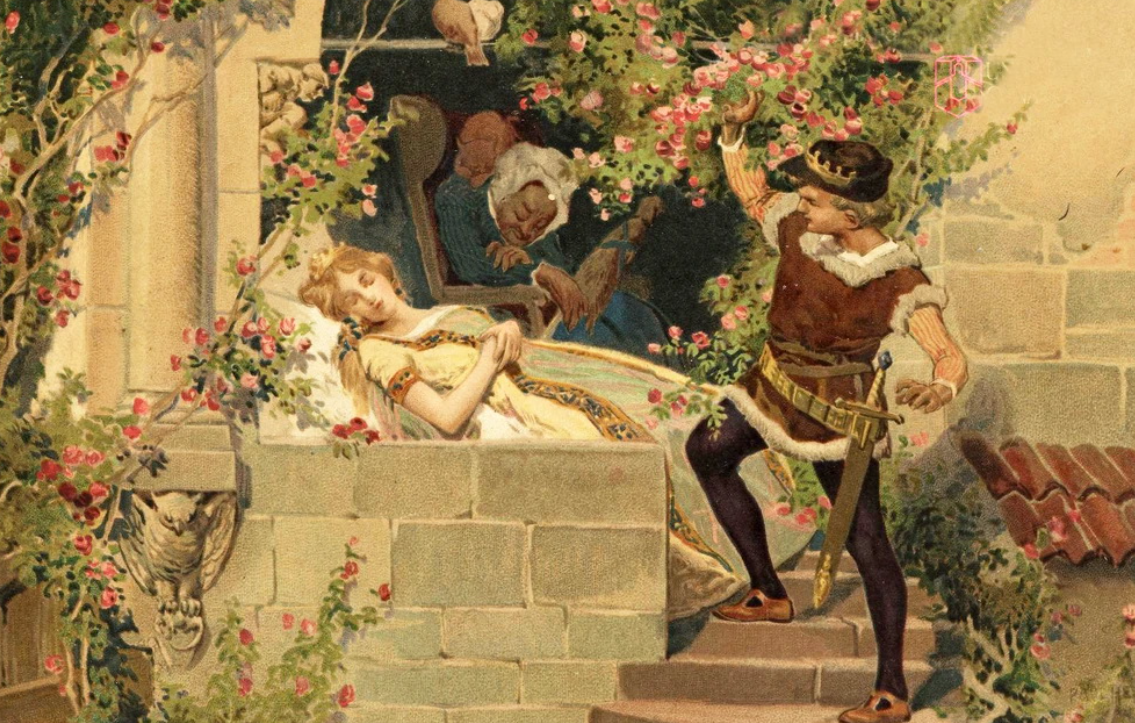
Incidentally, the original story of Sleeping Beauty has a completely different ending. The prince does not kiss the princess awake, but falls in love with her, gives free rein to his lust and has sex with her. The princess then, still asleep, gives birth to twins, one of whom sucks the poison of the thorns from the mother’s finger, and Sleeping Beauty finally awakens. Just the thought of waking from a hundred-year slumber only to find oneself saddled with two brats and a sex-crazed husband is the worst nightmare! And if they haven’t died, the prince is still raping her to this day!
I digress…
In the Grimm’s Fairy Tales – that is, the roughly 200 stories that Jacob and Wilhelm Grimm collected and published in the 19th century – there are no explicitly queer characters or stories according to today’s understanding of LGBTIQ+.
They were written at a time when these topics were taboo or criminalised. However, there is a deep brotherly love between Jacob and Wilhelm themselves, which is evident from their correspondence. Jacob once wrote to Wilhelm:
Dear Wilhelm,
Let us never part, and if one were to be sent elsewhere, the other would have to resign immediately.
We are now so used to this companionship that even the mere thought of separation could sadden me to death. I cannot tell you how it delights me that you are coming so soon. I have felt very lonely of late. It is strange, really, that I, who used to enjoy being alone so much, now cannot bear to be without you at all. I thank you warmly for your lovely letter and everything you write in it. I am convinced that, if we stay together, we shall yet accomplish much that is worthwhile. Farewell, my dear brother, and come soon. Yours affectionately,
Jacob
If that isn’t true love, then I don’t know what is!
Some of their fairy tales, however, do lend themselves to queer readings, however, if one pays attention to gender roles, bodies, identity and relationships. Allerleirauh is one such case. A princess disguises herself in a cloak made of animal skins, flees from her father and lives incognito as a kitchen maid. Her identity is concealed by her clothing, which allows for an interpretation involving cross-dressing. In two other tales, The Twelve Brothers and The Six Swans, women take on traditionally male roles, fighting and rescuing others. These fairy tales depict women who must overcome great challenges and tests of courage and who act against normative role assignments. A deep sisterly love is found in Snow-White and Rose-Red. Two sisters live secluded in the forest with their mother and experience an adventure with a bear (an enchanted prince), who can be read as a threat. The strong, self-chosen sisterly bond takes precedence over the romantic relationship. This is even clearer in the fairy tale of Iron John. A wild man is captured, then released, and raises a prince in the forest. The close relationship between the ‘wild man’ and the prince can be understood as a queer mentorship or an unconventional father figure.
Hans-Christian Andersen
Unlike the Brothers Grimm, Andersen wrote all of his stories himself. In today’s fairy-tale books, the tales of the Grimms and Andersen are often intermingled, as they share similar themes, featuring fairies, witches and talking animals. Andersen himself was most likely bisexual, albeit on a purely platonic level.
The Little Mermaid was written by Andersen shortly after he had been spurned by a man. In a letter to him, he wrote:
“I long for you as I would for a beautiful Calabrian girl.”
Yet the man in question distanced himself and married a woman. Andersen never married in his lifetime. This rejection is reflected in The Little Mermaid. The mermaid lives ‘between two worlds’, neither quite fish nor human. She falls in love, but is not allowed to live out her feelings openly – like many queer people in Andersen’s time. Her self-sacrifice, her inability to speak, and her tragic end mirror experiences of queer invisibility and self-denial.
The story The Ugly Duckling is one of Andersen’s best-known fairy tales and tells of a young, supposedly ugly duckling who is mocked and ostracised by others – until he finally discovers that he is in fact a beautiful swan. This can very well be read as a coming-out story, relating to both sexual and gender identity.
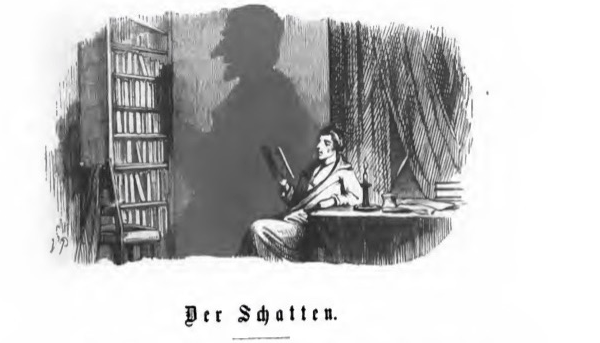
Most people can relate to the fairy tale The Shadow. A scholar loses his shadow. It takes on a life of its own, becoming rich and powerful, whilst the scholar falls into poverty. In the end, the shadow has him killed. The relationship between the man and his shadow can be read as a representation of inner turmoil. Control over one’s own identity, or the loss thereof, is something that queer people understand well. One can also view the shadow symbolically as a socially accepted façade.
Jean de la Fontaine
Jean de la Fontaine wrote his fables in 17th-century France. Queer identities or sexualities in the modern sense could not be openly depicted at that time. Morality, court culture and censorship were too restrictive. That is why there are no clear queer characters or relationships in the fables either.
These fables are only loosely comparable to fairy tales. They are more akin to satire, with a moral ending, and the animals and their peculiarities are partly based on real people and partly on well-known personalities. De la Fontaine had to be extremely careful to ensure that no one recognised themselves in the stories, as he would otherwise have been buried under a flood of defamation suits.
Taking this a step further, one might discover queer behaviour on an implicit level. Many of the animals act ‘against their nature’. Lions are weak or manipulative, foxes fail in their cunning schemes, and donkeys become moral authorities. From a queer perspective, this could be read as a challenge to the natural order, though admittedly, that is quite a stretch.
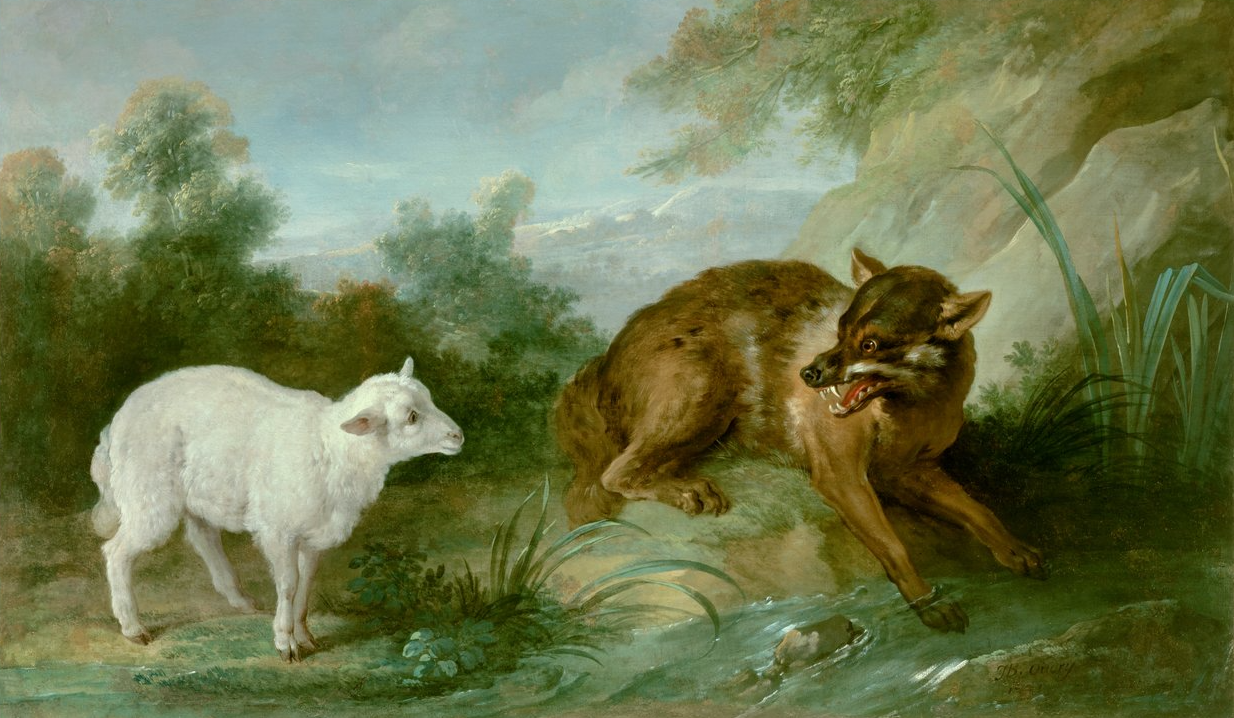
Let’s try an example: ‘Le Loup et l’Agneau’ (The Wolf and the Lamb). The wolf seeks every possible pretext to eat the lamb. All the lamb’s rational arguments are rejected by the wolf. The moral:
‘La raison du plus fort est toujours la meilleure.’
(The reasoning of the stronger always prevails.)
Read in the traditional sense, it is a critique of arbitrary rule and a warning against placing false trust in a superior power. Viewed through a queer lens, however, the lamb represents social groups that must justify their existence, even though they harm no one. The lamb argues, explains and defends itself – a scenario that should be very familiar to queer people in a normative society.
When the gentleman of distinguished standing had completed his work, he laid down the quill, which had become quite blunt from so much writing, exhausted but happy. He sent for a messenger, who hurried as fast as he could to the editorial office of queer.lu and handed over the finished manuscript.
And if he hasn’t died, he’s still writing today.
Images: Sleeping Beauty by Paul Hey, year unknown. — Le loup et l’agneau by Jean Baptiste Oudry, 1751. — Illustration by Eduard Kretzschmar for “The Shadow” in H.-C. Andersen, “Fairy Tales and Stories”, 1873.