Queer people in Luxembourg and the rest of the world are currently not in the best position. Not only do not all basic human rights apply to queer people in any country in the world – in many places, new achievements are being called into question or dismantled. Not only in the US under the Trump administration, but also in Hungary, Bulgaria and the UK – and there is no guarantee that this anti-queer wave will stop at Luxembourg.
Last summer, we saw how quickly our entire existence can be framed as a threat, and how many people signed a petition to ban us completely from all educational materials. Luckily, this hateful petition did not come from a particularly organized political sphere, was poorly worded and the petitioner did not cut a particularly good figure during the debate in parliament. What would it have looked like if, for example, a political party had run a proper campaign?
At least the defense worked well: Press releases, personal statements on social media, ditorials by journalists, protest actions and much more showed the public that we will not put up with this, that we will fight for our rights – and in the end, these actions certainly also helped ensured that more than 10,000 people signed the “counter-petition”. This is certainly a success and a good example of how the defense of queer rights works. But we should actually be going on the offensive, and there is still a lot of room for improvement here, especially in Luxembourg. For example, a European citizens’ initiative calling for a ban on conversion “therapies” only received 2,236 signatures in Luxembourg. Don’t worry, the petition has reached the required one million signatures – mainly thanks to the last-minute efforts of our French comrades.
For those who believe that we have already achieved everything, I recommend taking a look at the “Rainbow Map” of the International Lesbian, Gay, Bisexual, Trans and Intersex Association (Ilga), which focuses exclusively on the implementation of fundamental human rights. Luxembourg has slipped from a former top position to tenth place. This is not because rights have been revoked in this country – but simply because other countries have made more progress. Initiatives such as the support for a queer cultural center like the Rainbow Center are, of course, not taken into account by the Ilga report, but laws that improve the rights of queer people have not been passed in recent years. A look abroad also shows how quickly these very rights can be revoked or restricted. A future in which the CSV, for example, discovers that it is very easy to create a populist mood at the expense of trans people is not very far off in Luxembourg either.
I would also like to emphasize at this point that it is pointless to play the “but I’m not like them” card against right-wing extremists and fascists. On the one hand, queerphobes will always find a way to brand us as outlandish and perverted, on the other hand, such behavior also throws all our queer siblings who cannot or do not want to adapt to a cis-heteronormative way of life under the proverbial bus. It is no coincidence at all that the pseudo-argumentation and agitation that can be heard against our trans siblings these days is exactly the same as that used against gays and lesbians a few decades ago. It always refers to all of us. And by “everyone” I mean: really everyone, regardless of whether they dance in fetish gear at a Pride event every weekend from the end of May to August or are part of a “completely normal” nuclear rainbow family. People who pursue anti-queer politics don’t care how conformist (or not) we are.
We have no choice but to go on the offensive.
So we have no choice but to go on the offensive. Otherwise, we must fend off attack after attack and continue to wait for all the fundamental human rights that apply to cis-hetero people to finally, mercifully, apply to us. But it’s not just about ticking off a checklist of legislative measures, this fight is also about gaining at least a degree of cultural hegemony and disrupting the current status quo. We have tried “asking nicely” long enough – and we simply can no longer rely on the majority in society to graciously grant us the rights we are entitled to. We need to become more radical in our demands, and probably also in our forms of protest, in other words we need to tackle the root of the problems.
In my opinion, the best way to do this is to come out of the defensive, to be loud and courageous in putting forward our own demands. As a community, we know best what these are anyway, and we shouldn’t hold back. A large-scale campaign to abolish the mention of the “gender“” in official documents would probably not be immediately successful, but it would shift the discussion from “Oh no, drag queens are reading fairy tales!” to “How useful is it to categorize people by gender?”. The discourse can gradually be changed in this way.
There are many ways to initiate social discussions and bring about change that build on each other and are not mutually exclusive. On the contrary: successful protest movements thrive on the fact that the most diverse forms of activism intertwine and are carried out in parallel. It always starts with what many of us have been doing for years (or decades): Informing, educating, talking – again and again. It’s tedious, but every good, honest conversation you have will have an impact. Of course, this doesn’t mean that you should accept or even tolerate everything. Drawing boundaries is just as important! Those who shy away from a direct conversation can, of course, become active in the media, for example by writing an article or letter to the editor, recording a podcast or posting on social media. However, the latter is becoming increasingly difficult because some of the major commercial platforms actively suppress queer content and do nothing to combat hate speech.
Perhaps it makes more sense to try out a truly boring but effective method: Writing emails to members of parliament. If you don’t get a reply after a week, you can also call their office or party headquarters and ask (politely) if they don’t care that healthcare for trans people is rather poor and that there is still no ban on surgeries on intersex children. Or whether they really intend to wait until conversion “therapies” are advertised in Luxembourg before they consider banning them. It is particularly effective to write to the MPs in the “right” commissions and those from your own constituency.
In Luxembourg, it would theoretically be possible to submit a legislative proposal, a so-called “Proposition motivée aux fins de légiférer” (PML), directly to Parliament. In order for this to be discussed (!) in a plenary session, 12,500 eligible voters must sign it. This would certainly require a large-scale campaign, without any guarantee that the law would pass. However, drafting a text that “simply” puts all of ILGA’s missing demands into a law, for example, might not be the worst idea to initiate a discussion about the fact that LGBTIQA people in Luxembourg are still being denied essential human rights. However, a broad-based campaign, led by a queer NGO that uses its connections to the rest of civil society, could be successful – and make history with the first PML.
We should turn our backs on rainbow capitalism
In 2015, Ireland held a referendum on whether same-sex marriage should be legalised. Since a constitutional amendment was needed to clarify this issue, a referendum was required. LGBTIQA activists therefore had to conduct a campaign, which was successful (62 percent of votes in favor). Can you imagine going door to door and asking people to grant you the same rights? As bad an idea as it is to have a majority vote on the rights of a minority, it is positive that Irish queers managed to push through same-sex marriage ten years ago.
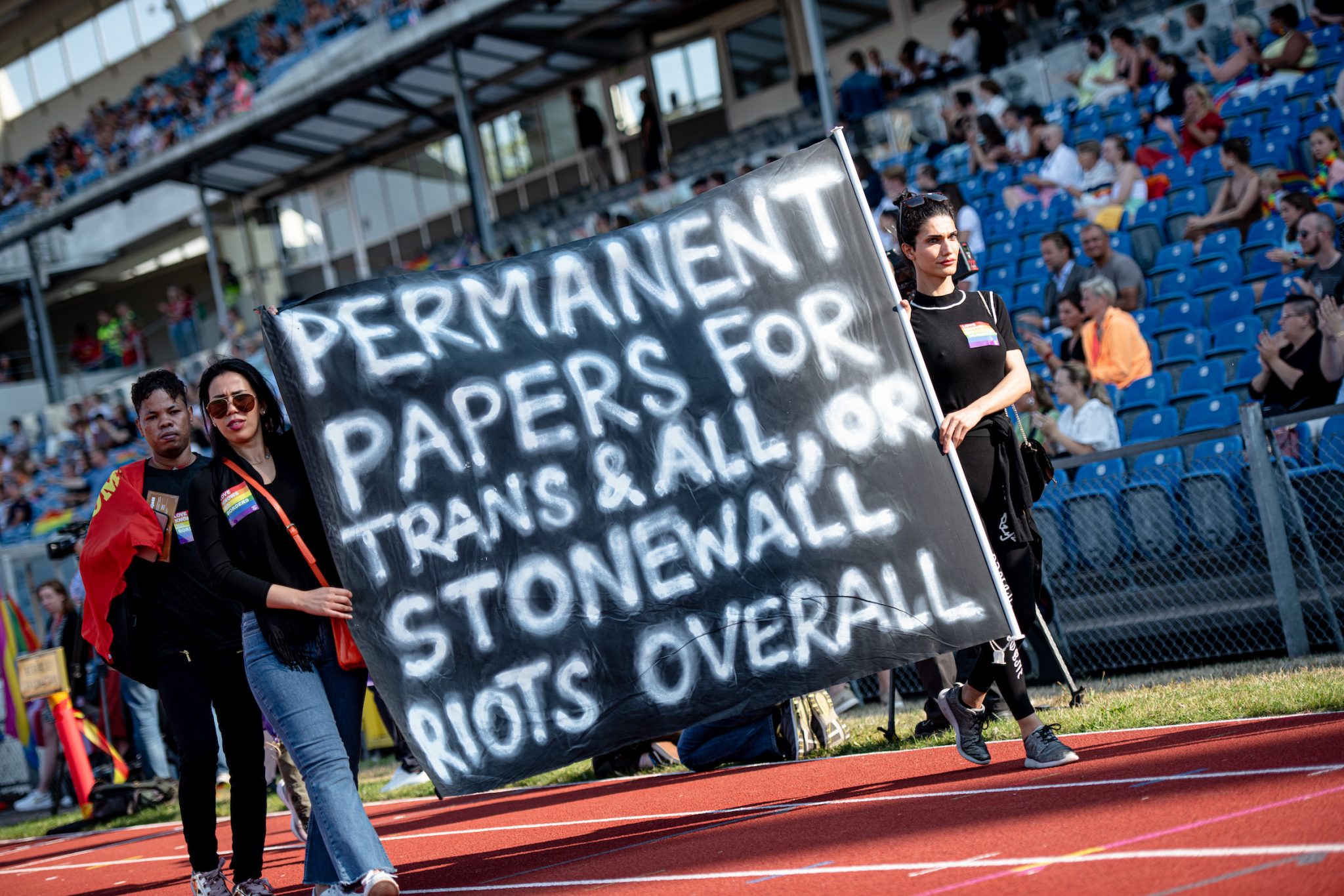
Protest on the streets should also not be neglected. On the one hand, Prides should become much more political again – now that many are pulling out to please the Trump administration, it also shows that the many big companies only “supported” us because they wanted to win us over as potential customers. We should therefore turn our backs on rainbow capitalism – or at least pay no attention to the sponsors. If they don’t want to support our messages, we don’t need them either. Protests can also be organized outside of the summer months. Other, more creative forms of protest such as “die-ins” or protest choirs can also attract attention. Symbolic occupations, such as those carried out by the organization “trans kids deserve better” in the UK, attract a lot of media attention and can help to shift the discourse in the right direction.
Regardless of the forms of action used, it is crucial to seek alliances – historically, there have always been links between queer people and labor movements or trade unions. When trade unions in Luxembourg demonstrate for a fair pension system, LGBTIQA people – who are often affected by poverty in old age – should not be absent. We should also pay closer attention to multiple discrimination and fight tendencies such as racism and ableism within our community and beyond. Solidarity can be very powerful, and battles are easier to win together.
Ultimately, the form political activism takes is (almost) irrelevant and also a matter of personal preference. The most important thing is to be loud, hopeful and confident. We should not just fight back, but demand respect (not “just” tolerance!) and our human rights.