In late summer 2022, I met Rari on the set of a video shoot in Berlin. Over the course of three days, we bonded, and I was immediately fascinated by this Romanian-born, Portugal-raised artist who, at the time, was living with some of my friends in Berlin.
Rari is a graphic designer, filmmaker, writer, and actress who has called Luxembourg home for the past two years—part of a new wave of talent shaping the Grand Duchy’s creative industry and emerging queer subcultures. We spoke over video call on a Monday morning, as she awaited news on a funding pitch for her latest project.
Rodrigo: What is this project you’re working on?
Rari: It’s a short film, my third short, it’s still playing with the concept and idea of gender, but from another perspective, it’s about a lepidopterist, I don’t know if you know what that is?
No.
It’s someone who studies and preserves butterflies and moths. And It’s about a night out between this guy and a trans woman, and how he navigates his sexuality through that encounter.
But it also raises questions about attraction. I don’t believe attraction is always associated with gender. Because we are not attracted to someone’s genitals—but by what their vibe and energy is. And I’m trying to explore that, including the shame this character feels about what his desire means to him.
I have experiences with men—especially in the queer community, where the attraction is clearly there, but as soon as I say I’m trans, something in their brain switches off. It’s not necessarily that the desire disappears; but it suddenly feels “wrong” to them. As if they should only be attracted to someone “male”. But they were not drawn to me because I’m male—you’re attracted because of the vibe and feeling I give you.
You’ve explored this in previous works. Is this your way to continue your own exploration? Is this another step in your own journey?
Yeah, exactly. I’ve learned that when it comes to attraction and sexuality, I’m very fluid. I always assumed that I was mostly drawn to male-presenting people, but over the last few months I realized I don’t really care about gender when it comes to who I’m attracted to.
Sexually, I’m still more attracted to male bodies, but that’s often about pleasure, not necessarily emotional attraction.
It’s interesting how sometimes we assume things are a certain way, then realise they aren’t.
Exactly, and it makes me question things like, ‘oh now that I’m on this journey to become a woman, what does that mean?’ I’m not even trying to get answers anymore, right now I’m allowing myself to flow instead of just settling into something fixed.
Throughout my life as a queer person and through the labels I’ve used, I’ve always tried to settle. Feels nice sometimes, but also limiting to me. I feel like I just want the openness of exploring, in terms of sexuality. When it comes to my gender, I know that I’m trans. With my sexuality, I prefer the openness of the word queer. It gives me room to explore. And be open to what is out there and the experiences I can have.
That must be very liberating.
Yes, for sure.
Did Berlin and Lisbon’s queer scenes shape that process ? And how does Luxembourg compare?
When I moved to Berlin at 19, I finally stopped exploring that side of me in hiding. That city pushed me to confront my identity. I also had a lover who had just started their transition—they opened a huge door for me.
We were not together for very long, but we stayed friends because of how rewarding that connection was.
Then I stepped back for a while until I moved to Lisbon in 2023, during a harsh breakup. And its queer nightlife honestly shaped me more than Berlin’s. It really opened so many doors when it comes to my identity and being more accepting of the fact that I identify as a woman.
Was it difficult to rebuild queer hubs once you moved to Luxembourg?
In the beginning, yes. The first few months were a bit hard. I struggled to find a community. I was used to the Berlin and Lisbon bubbles. Visibility and exposure there are just so much bigger than here.
But then I explored nightlife here, beyond Letzboys—I’m sorry, I have to throw it out there—and actually found a lot of dolls and queer people. We hang out and stick together.
What breaks my heart is that when I go to queer events, only a few people show up. I’m like, “Where are you, babies? Come out, we’re here.” We’re still missing that community-building feeling, but we’re starting. Baby steps—but it’s a beginning.
Let’z build a community, not Letzboys?
Exactly, thank you.
Luxembourg had mostly had gay bars, not queer venues.
It’s not enough. The issue that we have a gay bar is that we only have a gay bar. We need more community spaces for queer people. It’s so sad that most queer people I hang out with go to Ground. You get associated with something which is stereotyped as shady. But it’s literally the only place where we can be visible and enjoy something we connect with. Letzboys is not necessarily for all queer people. I don’t only listen to Ariana Grande—I love techno and dubstep. We can create those spaces here too, like queer raves.
In a way, Ground being seen as “shady” reminds me of that 1980s idea—the place your parents warned you not to go to, which is always where the community actually is.
Literally. In Lisbon, all the places we went to would be considered “shady” from the outside, but were really not. The queer community was just so big that it was normal. We have the possibility to fund these kinds of places, so what are we doing?
You’ve lived in Romania, Portugal, Germany and now Luxembourg, where do you call home?
Girl, honestly, I really don’t think I have a concept of home when it comes to space, places or locations. For me, home is people I meet, and the connections I make. I think I’m also fluid in that regard. My parents also moved to Germany—so we traveled a lot and I never felt that concept of a fixed home. But if you’re asking where I would feel more connected, I’d say Portugal. Not home, just a deeper connection.
You studied graphic design, then film, you write, and now you act. Is story-telling the common thread?
I’ve enjoyed all of it, but I’ve learned that I really love writing. Yes, it’s storytelling—writing was always there, I just never really found the right form. I used drawing and visuals to express myself before, but now I’m more comfortable with writing, and I love the space it gives me to sit with myself and put whatever I want on paper. I fictionalise experiences and turn them into film ideas. A bit delulu *laughs* but it works.
Speaking of drawing—didn’t you once run an Ariana Grande fan account she interacted with?
Girl *laughs*, what do you wanna know?
Do you still have it?
No, I deleted it. But I kept screenshots of her messages.
You were meant to shine from early on.
That era was tied to a part of my life I lost—my best friend. We ran the account together. Then Ariana unfollowed me at some point because I stopped posting. So I deleted the account. That’s when I learned: “ok girl, you obsess easily—be careful”.
Obsession can be useful in your line of work, though.
In a way, yes. I definitely practiced my drawing skills with her, so I’m grateful.
Music is a big part of your identity, what are you listening to these days?
A lot of Oklou and FKA Twigs, and Ethel Cain. Her story-telling, her narrative world building, I connect deeply with that.
And your coming of age song?
Right now, “American Teenager” by Ethel Cain. I am not American, but it feels like a coming-of-age song to me. I imagine myself in a film—road-tripping, very Bones and All vibes, by Luca Guadagnino, and then that song playing. It’s not glamorizing the new Americana, but criticizing it, like modern coming-of-age films. Romantic with a critical edge.
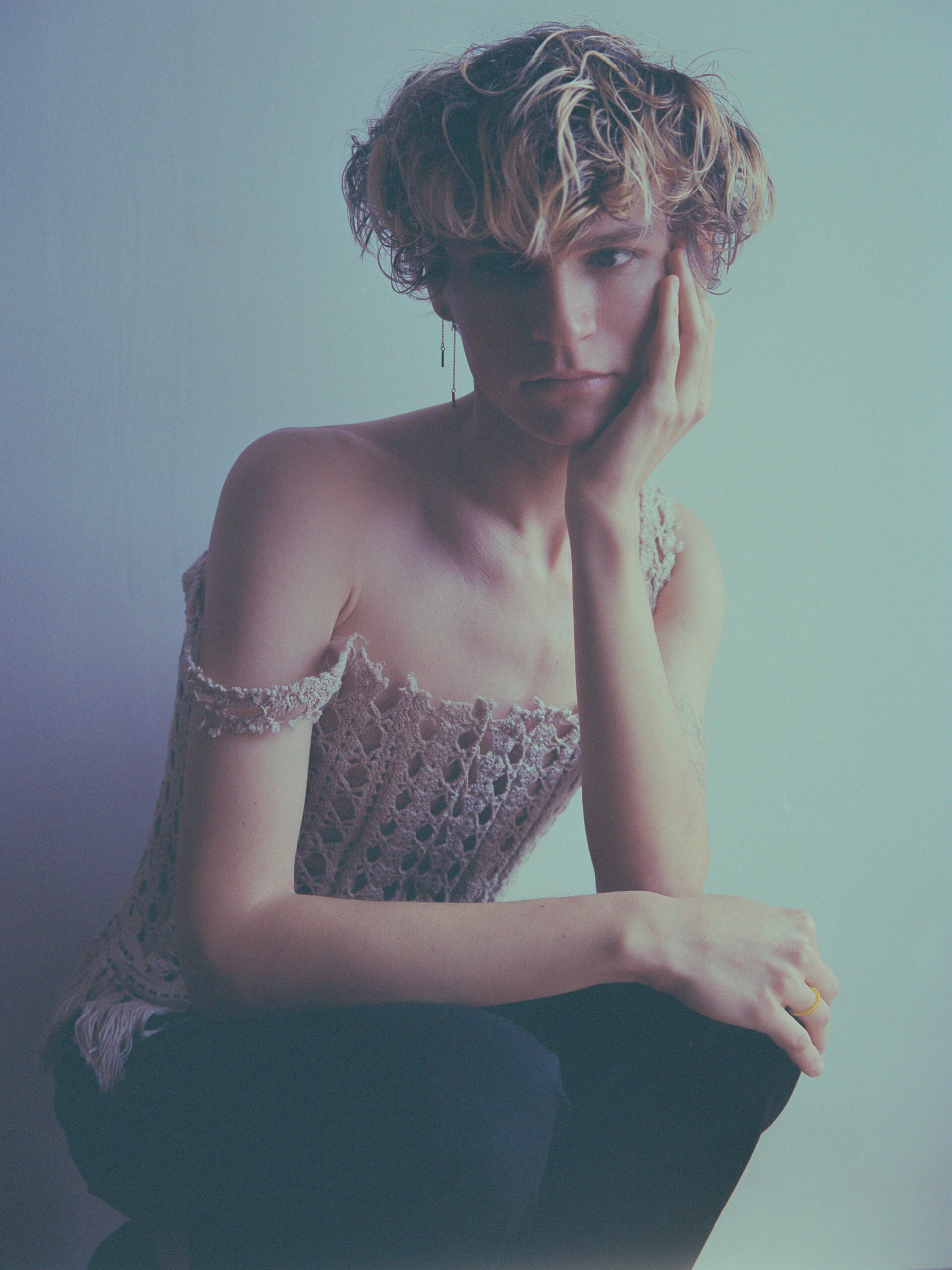
Photos Rita Ruivo and Shade Cumini