Living More Happily with Your Parents
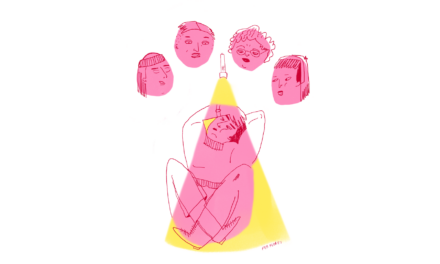
Hello Kelly! My parents are quite open-minded and supportive of me being queer (I live at home, I am in my early 20s). Nevertheless, I experience microaggressions from them and do not really know how to deal with this. I know that they will block when I start explaining to them why their behavior and their opinions hurt me – do you have any tips on how to educate them, or how to make my home more of a safe space for me?
Thank you for your open and honest question! It’s lovely to read that your parents are generally supportive of you. At the same time, unfortunately, that doesn’t automatically mean everything is free from hurtful comments. Many queer people experience this tension in their relationships with family members: care on the one hand – and offhand comments, inappropriate questions or stereotypical assumptions on the other. Especially when the relationship is actually a good one, these situations can feel confusing.
1.What are microaggressions?
Microaggressions are remarks, everyday behaviours and unconscious reactions that are derogatory or discriminatory – often without any so-called malicious intent. ‘Micro’ does not mean they are harmless. It means they are often subtle: offhand comments, jokes or ‘compliments’, strange facial expressions, false assumptions, inflexible behaviour or minor breaches of boundaries. Microaggressions build up, and their constant repetition in everyday life leads to stress and psychological strain. Microaggressions vary depending on the form of discrimination – even those directed at queer people differ. For example:
“You just haven’t met the right person yet” said to asexual or aromantic people.
“Do you have to be so open about it?”, “Maybe it’s just a phase”, “It’s a shame, you’re so pretty” or “You don’t look it at all” when directed at gay, bi or pansexual people.
When directed at trans and/or non-binary people, it’s often the use of the wrong pronouns or names, questions about their bodies, or comments such as “I just can’t get used to it.”
This is often driven by insecurity, shame, ignorance or socially ingrained norms. However, this doesn’t make these remarks harmless, as repeated exposure to them can make one’s own home feel less safe.
2.What can you do for yourself?
I think it’s great that you’ve realised for yourself that you don’t want to – or can’t – have every discussion. Many queer people find themselves in the position of having to explain, justify themselves or respond in a way that’s deemed “educationally valuable”. Pay close attention to where your boundaries lie – after all, only you can set them, and they only work if you can enforce them yourself. You can’t force your parents never to say anything hurtful again. But you can decide how you want to react and which situations you’ll walk away from. Make it as clear as possible what’s okay for you and what isn’t. For example:
“I don’t want to talk about my love life right now.”
“If jokes like that are made, I’ll leave the room.”
“I won’t discuss my identity.”
Also, create (more) small safe spaces for yourself both inside and outside your home. This could be your own room, time on your own, queer friends, online communities or counselling (see info box below). Places where you don’t have to justify yourself. And places where you can also strengthen your relationship with yourself through self-care, hobbies and your own interests. Unfortunately, changes in family dynamics are often a long-term process. That’s why it’s particularly important to look after yourself well.
CIGALE. The LGBTIQ+ Centre offers (psychological) counselling and support for queer people.
Familljen-Center. The Familljen-Center offers counselling on difficult situations within the family or involving the family. It has an explicit focus on queer people, which is why queer individuals are given priority on the waiting list here.
Family counselling (e.g. together with parents) is available, for example, at Pro Familia or the Erzéiungs- a Familljeberodung (Parenting and Family Counselling Service). How well they are familiar with queer issues and microaggressions probably depends on the individual counsellor.
The ITGL Parents’ Group (Intersex & Transgender Luxembourg) offers parents of trans, intersex and non-binary children a safe space to share experiences and receive advice. The meetings take place alternately online and in person. Information about the parents’ group is available on the website of the Support and Information Centre for issues relating to trans, intersex and non-binary topics: www.caitia.de
3.What can you do with your parents?
If you feel that your parents are generally open to learning, it can help not to bring up the topic only when a conflict has already arisen. Many people go on the defensive when they hear: “That was hurtful.” A calm moment often works better than a discussion straight after a boundary has been crossed. Instead of “That was anti-queer”, it might work better to say: “I know you love me. That’s precisely why I want to tell you why some comments affect me.”
You could perhaps try listening to, watching or sharing specific content with them: short Reels, films or TV series, or personal accounts from queer people in podcasts, videos or articles. Sometimes people find it easier to accept things when they hear them from an outside perspective. If your parents use social media, you could forward them content that discusses queer issues in a calm and accessible way. Perhaps there are certain media outlets or creators who appeal to your parents more than an emotional conversation at the kitchen table. Or perhaps there are relatives, friends or other trusted figures who can explain queer issues well and towards whom your parents are less defensive. If the situation is taking its toll on all of you, joint family counselling (see info box) could be helpful in improving communication.
4.What can your parents do for you?
From the way you describe them, your parents don’t seem like people who want to hurt you on purpose. Rather, they seem like people who still have things to learn. Helpful skills include, for example:
- listening without immediately getting defensive;
- acknowledging mistakes;
- actively learning and practising pronouns or terms;
- correcting people when they use inappropriate terms or make comments;
- reacting with curiosity rather than judgement;
- taking responsibility for their own further education.
Speaking of further education: it sounds as though your parents are already familiar with the basics of queer issues. If this is still an issue, one of these resources might be helpful:
- A 3-minute explanatory video on gender and sexual diversity by Dissens (Institute for Education and Research): interventionen.dissens.de/materialien/erklaerfilm.
- A brochure in plain language entitled Woman. Man. And much more, which you can download: undnochvielmehr.com/download.
- For further reading: The graphic novel Queer. A Graphic History by Jules Scheele and Meg-John Barker, published by Icon Books. There are also two further graphic novels on gender and sexuality by the same authors.
Sometimes individual therapy or counselling for parents can be helpful – particularly if they’re struggling with uncertainties, fears or societal expectations that they’ve never questioned. It’s not your job to guide their learning process on your own.
I hope you’ve found one or two tips here that are relevant and useful for your situation!

Kelly