Historically Queer
In this column, we look back on queer history and stories, both through personal anecdotes and historical events.
If you would like to contribute, please contact us: info@queer.lu
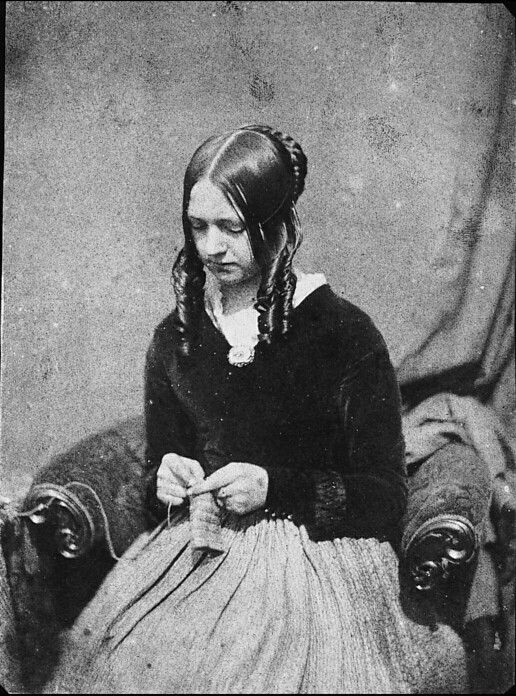
The story of Herculine-Abel Barbin is known to only a few. It is a sad one, and it ended tragically. Herculine-Abel was among the first known people in France whose intersexuality was acknowledged by the state, but not recognised. The consequences of the medical and legal pressure to conform to a single ‘true gender’ proved fatal for Herculine-Abel. Their unfinished autobiography was published after their death by the sexologist François Tardieux, but was soon forgotten. It is thanks to the well-known philosopher Michel Foucault, who republished these memoirs in 1978 as part of his gender studies, that they have been preserved.
I will change gender pronouns throughout the story and not resort to today’s “they/them” in order to better illustrate the fatality that ultimately cost Herculine-Abel their life.
I have suffered much, and I have suffered alone! Alone! Forsaken by everyone! My place was not marked out in this world that shunned me, that had cursed me. Not a living creature was to share in this immense sorrow that seized me when I left my childhood. […] I instinctively drew apart from the world, as if I had already come to understand that I was to live in it as a stranger.
H.-A. Barbin
Frühes Porträt von Christina von Schweden um 1640 (Gemälde eines unbekannten Hofmalers); Projekt Gutenberg.
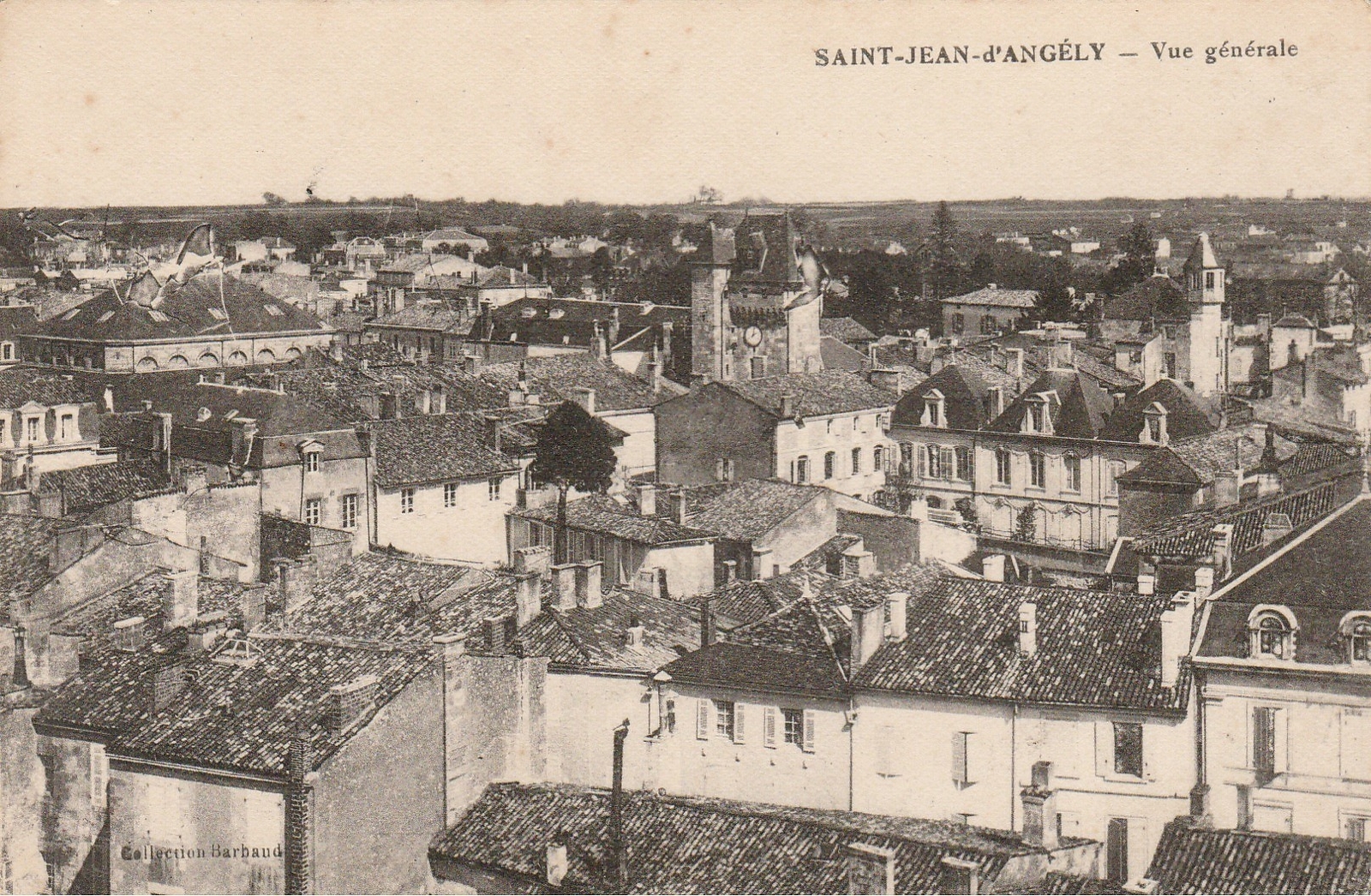
Childhood in St. Jean d’Angély
On 8 November 1838, in St. Jean d’Angély, a small town in the Charente-Maritime department, Mr and Mrs Barbin’s first child was born. She was registered at the registry office as female and given the name Adélaïde Herculine Barbin. Herculine’s father, a simple clog maker, died unexpectedly when she was six years old. In order to survive and not slip completely into poverty, her mother took a job as a maid with a respected, wealthy family in La Rochelle. There she was to take care of a family member who needed full-time care. There was no time left for little Herculine.
She writes about this in her biography:
Her predicament had awakened the interest of some noble-hearted people […] and soon generous offers were made to her by the worthy Mother Superior of the homeless shelter of St. Jean d’Angély. Thanks to the influence of an administrator, a distinguished lawyer of the town, I was admitted there. I was seven years old. On the morning of that day, I was absolutely ignorant of what was going to happen a few hours after I got up; my mother, having taken me out as if we were only going for a walk, led me silently to the house of St. Jean d’Angély, where the worthy Mother Superior was awaiting me.
She was placed in the orphanage wing. A beautiful and carefree time, as she later wrote. She always felt somewhat superior to the other children because she still had a mother who visited her, albeit very rarely, which made the others envy her.
Thanks to a petition from the mother superior, she was then transferred from the homeless shelter to a convent school for girls, where respected families also sent their daughters. She was a diligent student and received a rigorous religious education. There, 10-year-old Herculine formed a close friendship with Lea, who was seven years older. It was a strange – purely platonic – connection that she described as almost like a love affair.
Youth in La Rochelle and Orléon
At the age of 15, she had to leave the convent school and returned to her mother’s care. She moved into the family home in La Rochelle and became the chambermaid of the youngest daughter, Clothilde, who was three years older. Her job was to help her get dressed and undressed in the mornings and evenings. She also read the newspaper and books to the often ill grandfather.
In her memoirs, she describes her feelings toward Clothilde:
I helped her rise in the morning, and that was always early, in the summer as in the winter. Afterward, I dressed her, and we would talk about all possible subjects. If a silence set in, I would innocently start admiring her. The pallor of her skin was incomparable. It was impossible to imagine more graceful contours without being dazzled by them. That is what happened to me. Sometimes I could not refrain from paying her a compliment, which she received with the best grace in the world, without it either surprising her or making her more vain. Changing the subject then, she would inquire about my health…
Herculine often spoke of her fragile health. She frequently complained of feeling unwell and was treated by her family doctor. However, none of the tinctures, pills and diets had any effect. The doctor gave up and said that these were unusual “growth symptoms” and that they would pass with time.
When Clothilde married at the age of 21 and moved out of the house, there was nothing left for Herculine to do. She was encouraged to take up a career in teaching, as she was considered very well-read and mature for her age. She agreed without much enthusiasm.
So, at the age of 17, she entered an École Normale, a convent boarding school located a few hours away in Orléon. She passed the entrance exam with flying colours. She settled in well, but her appearance bothered her. All the other girls developed a rosy complexion and shapely curves, while Herculine remained thin and pale. As a servant, she had had a room to herself, but now she had to sleep in a large dormitory with fifty other girls. She hated it. She developed a fuzz on her upper lip and cheeks, which she secretly cut off with scissors. Her sickly condition caused concern and, on the advice of a doctor, she was put on a strange – and ineffective – diet.
Herculine had a very good friend, Thécla, and they were called the inseparables.
In the summer, studies were held in the garden; we used to sit next to each other, hand in hand, holding the book between us. From time to time my teacher would fix her look upon me at the moment when I would lean toward Thécla to kiss her, sometimes on her brow and-would you believe it of me?-sometimes on her lips.
In several short episodes, she describes feelings that she could not explain to herself. Due to her strict religious upbringing, she had no idea about sexual matters, but had been taught the strictest moral values and did not know how to interpret the changes in her body. But she was sure that something was wrong with her. She describes it as an unknown illness, an inner wasting away.
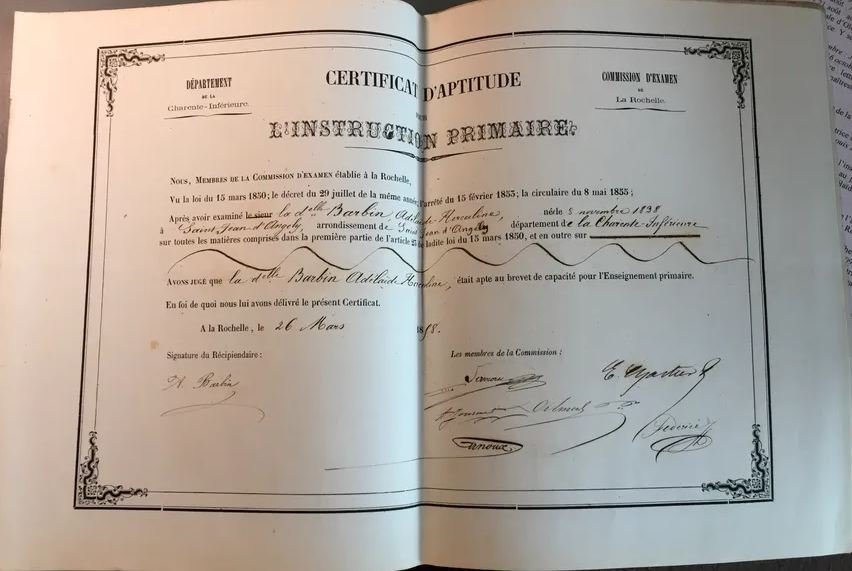
After two years, her training was over and the big final exam was approaching. Her classmates were nervous, but Herculine remained almost indifferent and passed all her exams with top marks. Now it was up to the senior teacher to send her to a school. In the meantime, she stayed with her mother and resumed her duty of reading aloud to the old master of the house.
Teacher at a girls’ boarding school
At the end of the summer, shortly before the start of school, a letter arrived from the head teacher and Herculine took up her first position at a girls’ boarding school in a ‘district town on the edge of the département’. She was warmly welcomed there. The boarding school was run by a family: Mrs P…, who acted as a kind of housemother, and her daughter Sara, who was a teacher. Herculine had been hired to supervise the girls and teach them.
She fell in love with Sara. The two grew closer and began a secret relationship. The mother noticed that something was not quite right, but never said anything and was actually happy that her daughter Sara and Herculine got along so well. However, she was not aware of just how well.
After her first year at school, Herculine was supposed to return to her mother in La Rochelle during the holidays, but before that she attended a gathering of former pupils of the École Normale. Here, for the first time, she had the opportunity to confess to a young priest whom she did not know. She did not feel comfortable confiding in the old abbot who held services at the boarding school. She told him everything: her physical ailments and the immense love she felt for Sara. After two days of consideration, he advised her to withdraw completely from public life and enter a convent to prevent a scandal. Herculine had not expected such a radical response.
She did nothing of the sort. She could not and did not want to. And so, in October, she returned to the boarding school, where Sara was eagerly awaiting her. But in winter, the physical ailments returned and Herculine suffered from unspeakable cramps. After much persuasion from the housemother, she agreed to a medical examination.
At that time, the relationship between a male doctor and a woman was very different from today. The room was bathed in dim light and Herculine lay on a couch under a blanket, where the doctor was only allowed to feel everything with his hands. After the examination, she felt as if she had been raped. The doctor was so shocked by his findings that he was unable to even speak. He prescribed some painkillers and promised to come back, but the mistress of the house forbade him to do so after all the blood-curdling screams from Herculine during the examination.
After this incident, life at the boarding school continued as usual. However, Herculine was aware that her silence and secret love affair with Sara would only make things worse. She could see the predicted scandal looming ever closer. Another year passed, during which tensions grew and Herculine longed for some kind of solution. For example, from the housemother: I have never been able to understand how a woman of her age, of her experience, could preserve such an illusion! Shouldn’t the affection that Sara showed me have opened her eyes? It did not. She was afraid that by showing us the slightest suspicion she would put us on our guard. Poor woman!!!
During the holidays, she returned to her mother in La Rochelle and attended early mass at 5:00 a.m., always held by Monseigneur, Bishop J.-F. Landriot himself. After Mass, one could politely ask him for confession. Herculine told him everything. He remained silent for a long time and asked Herculine to release him from his duty of confidentiality so that he could consult his own doctor. The examination took place the very next day on Monseigneur’s premises. Her mother had accompanied her. She was horrified to learn the whole truth. Monseigneur then asked both of them to come to him and ordered Herculine to return to the boarding school to resign from her position. She remained there for several weeks until a new teacher was found. This was followed by difficult and tearful farewell scenes with Sara and Madame P., who could not quite comprehend what had happened.
From this point on, events unfolded rapidly. Within two weeks, a court order was issued in La Rochelle to change the sex on the birth certificate. So it was all over. According to my civil status, I was henceforth to belong to that half of the human race which is called the stronger sex. I, who had been raised until the age of twenty-one in religious houses, among shy female companions, was going to leave that whole delightful past far behind me, like Achilles, and enter the battle field, armed with my weakness alone and my deep inexperience of people and things.
Herculine became Abel
Abel became the subject of gossip and rumours. The regional newspapers attributed the most adventurous stories to him, portraying him as a Don Juan who had secretly been up to mischief in convents. Sara also became an object of ridicule.
Abel never stopped loving Sara, and the two continued to write to each other for a long time. But he never wrote to Madame P. There is an interesting sentence about this in his memoirs: (…) if I had known how to manage the situation, my future would have been different. Perhaps today, I would be her son-in-law.
Both the prefect of La Rochelle and the bishop protected Abel. Their words carried weight, and so no one dared to step out of line too much, with the exception of the press. However, the prefect advised Abel to leave the area. After some detours, he got a job with the railways in Paris and left La Rochelle for good a month later.
From this point on, the tone of the memoirs changes. It becomes a long philosophical and religious lament, but also an indictment of society, the state, and Herculine-Abel himself. Herculine, who had spent her childhood in the most adverse circumstances but had worked her way up through diligence and discipline, was a respected member of society as a teacher and really only wanted to love and be loved, but now, as Abel, he was met with envy, rejection and ridicule from the people. Even doctors regarded him as a pathological case study of hermaphroditism.
There is little concrete information about his life in Paris, which he initially liked because it gave him anonymity and peace, but he felt very lonely, alone and empty. In one passage, he describes death as a sweet deliverance, suggesting that he was contemplating suicide.
He did not keep his job with the railway for long because his fate became known there and he was once again the subject of wild rumours and stories. He then found a job in financial administration. However, after a few months, he was dismissed due to restructuring.
He describes a job interview for a position as valet to a countess in a small hotel in the Faubourg Saint Honoré as follows:
I found her alone in a vast salon where she was writing. She took my letter, sat down in front of her fire, and asked me several questions, which I had been expecting. I had never been a servant, that was always the insurmountable obstacle. I could very well have said to her, “I have been a lady’s maid.” But how could I answer with such an outrageous remark? However, she passed over this important point. “Here”, the lady said good-naturedly, “you could learn your duties in a short time; but you look weak, delicate to me, and not at all cut out for work of that sort. So I cannot take you on here.” I was sent away. Unfortunately she was telling the truth.
Many job interviews ended in a similar way. The mere fact that he had not been in the military repeatedly closed doors to him. There were often weeks and months when he did not know what he would eat from one day to the next.
He made one last attempt when he tried to sign on as a paymaster on the ship Europa, which was sailing to the United States. In the end, however, he was only hired as a waiter. He accepted the job because he had been promised opportunities for advancement. He never embarked on the long journey.
Abel Barbin died in March 1868 at the age of only 29. He committed suicide by putting his head in the gas stove in his room in the Odéon district.
His memoirs were found next to him, which then found their way to the sexologist Tardieux and were published.
***
What is interesting about the memoirs is that they are written in a noel-like form, as if Abel had always had future readers in mind. Throughout the text, there are repeated foreshadowing sentences such as, ‘If I had known back then what was awaited me…’
After extensive research, I only found a single photo, and even that does not clearly prove that it is really Herculine Abel. One sentence I found on Wikipedia made me angry: ‘These (memoirs) were written alternately in male and female form, suggesting a non-binary identity.’ This assumption is simply wrong! Abel does indeed jump back and forth between genders, which clearly shows a great inner conflict. However, the decision that he became a man from one day to the next was made by those around him, or rather by the court. But he never gave himself the chance to realise whether he was Abel, Herculine, both or neither.
He chose the most terrible of all solutions: suicide.