The vulgate version of the Arthurian romances; Volume 3
Queer Medieval Literature
The older a queer story is, the more it feels like discovering a hidden treasure.
For some years now, I have been making a conscious effort to read at least one or two works of classic literature each year – using the loosest possible definition of “classic”. This usually means one of two things: Early 20th century pulp adventure novels, or random medieval texts connected to the King Arthur mythos.
Queerness in medieval literature is a complicated thing, mostly because their cultural framework was so different from ours. It really is true that the past is a different country, and, like all countries, it has its own ideas about gender and sexuality, as well as its own narrative conventions. You could (and, probably should) do some background research, but there is a lot out there. If you are not a scholar, it is very easy to get lost. The Handbook of Medieval Sexuality (Vern L. Bullough and James A. Brundage), for example, was a very interesting read, but devotes only one chapter to queerness — and none to literature. A better approach is to pick a text first, then dig deeper into its context. For Le Roman de Silence, I found Valerie R. Hotchkiss’ Clothes Make the Man: Female Cross Dressing in Medieval Europe very helpful.
The important thing to know is this: People in the Middle Ages did not understand queerness the way we do. But queer people very much did exist, and they very much did show up in literature. For this article, I’ll share some texts that I am personally familiar with. There are more— especially if we step outside the very small genre that I have so far looked at, or beyond Christian Europe. Understanding the exact way that people at the time related to these stories and characters is a job for specialists. What I can say for sure is that queer readers today do connect with them, and that they are worth remembering as part of our shared cultural heritage.
It is significantly more difficult to argue that nonbinary people are a new thing, when a 13th century text is explicitly questioning gender.
You obviously don’t have to read the original in medieval French. (I tried. Surprisingly understandable—but also, NO). You don’t even need work through literal translations if you don’t enjoy it. Medieval narratives don’t follow modern pacing, and that can trip you up. For many texts, you can find retellings for contemporary readers—even children. Fabien Clavel’s Le Chevalier Silence is short, easy to read, and faithful to the source, with only minor updates to make the story more coherent and acceptable to modern audiences. And if research is not your thing, skip it. You can just read the stories. It’s mostly people whacking each other with swords. You’ll be fine.
All right? On to the list.
“What I can say for sure is that queer readers today do connect with [Medieval stories], and that they are worth remembering as part of our shared cultural heritage.“
Bisclavret (12th century)
A werewolf knight gets stuck in wolf form because his wife and her lover hide the clothes he needs to transform back. He ends up as the King’s pet wolf until the truth comes out. Spoiler alert: it ends with the king kissing the knight on his bed.
The Vulgate Cycle (12th century)
…ish.
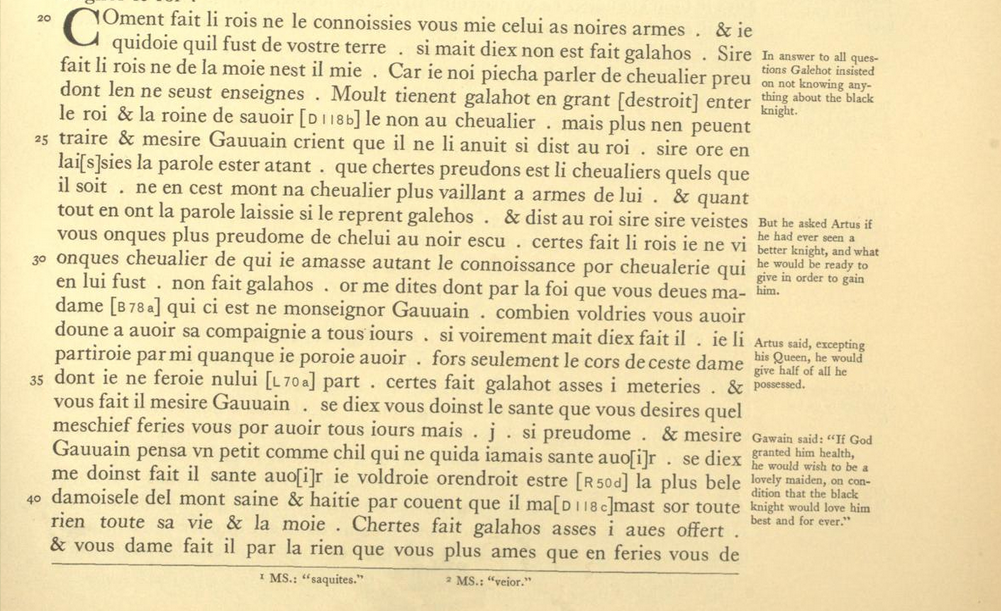
The Vulgate Cycle is a multi-volume epic recounting the entire saga of King Arthur’s court. As such, there is a lot going on in there. I have only read a part of it, and still swear that one day, I will get back and actually read it front to back. I suggest maybe find a better way of doing it than the copy I own – which is in medieval French, with short summaries in the margins in modern English. Interesting way to experience literature, for sure. If you want to try it, the books are on the Internet Archive. The scene we used as an illustration is from “The vulgate version of the Arthurian romances, Volume 3”, page 253 (258 in the document). You can just skip to somewhere around there.
The story, strongly simplified, goes as following:
When Arthur was first out there conquering the British Isles, there was another king doing the same thing, Galehaut, the son of a giant. And he was better at it. He would have won, had it not been for Lancelot convincing him to surrender to Arthur instead (I have seen this particular episode referred to once as “the one time Lancelot won a war by seducing the enemy king”). Galehaut became a close ally of Lancelot, and by association, Arthur, and had all in all quite an important role to play in the earlier days of the legend. Then, because the legend of King Arthur is a tragedy, he died, of a broken heart, when he believed Lancelot to be dead. They are buried together.
Unfortunately, the story also changed with time, and by the 15th century, with Mallory’s Le Morte d’Arthur, Galehaut’s role was significantly reduced. What is important to know, if someone making a modern adaptation actually goes back to the medieval source – and that is a big if! – then what they usually read is La Morte d’Arthur. As a consequence, Galehaut, who died for the love of Lancelot, has been forgotten by the general public.
Le Roman de Silence (13th century)
This French text tells of the knight Silence, born female but raised as a boy. Silence’s gender therefore is slightly complicated to pin down, and the poet explicitly discusses gender norms and nature vs nurture. (Personally, I have settled for he/him pronouns, because through most of the poem, Silence is being referred to as a man.) He has a bunch of adventures, becomes a great knight, wins a war, and is eventually outed by Merlin. At which point he magically transforms into a very pretty girl and gets married, because this is the 13th century, and a debate about gender roles is going to have a different outcome than it would today.
Yde and Olive (13th century)
Is the only one on this list that I haven’t read yet. Like Bisclavret, it is not part of the King Arthur legend. The story is about a young “woman” called Yde, who runs away from home disguised as a man, and eventually ends up married to the daughter of the Emperor of Rome. He is almost caught, but at the last moment, an angel appears and transforms his body into a male one.
Sir Gawain and the Green Knight (14th century)
One of my favourite stories to tell, and also one of my favourite Christmas stories. It follows Sir Gawain, King Arthur’s nephew and one of the best knights of the Round Table, and his confrontation with the mysterious Green Knight, who is going to behead him on New Year’s Day. During his quest, he stays at a castle where the Lord and Lady play a strange game with him that involves him kissing the Lord multiple times. Which he does with enough enthusiasm for the Lord to comment on it. (As the Vulgate scene shows, Gawain has had Very Straight Moments before.)
Of all these stories, Sir Gawain and the Green Knight is the best-known, with several on-screen adaptations. The one you might want to watch is Sire Gauvain et le Chevalier Vert (2014). Or even better: ask me in person sometime. I really do love telling this story.
That’s my list so far. Thank you for sticking with me— I do hope that I sparked your interest. Too often, we dismiss the Middle Ages as nothing but religious and homophobic while talking about queer literature history. They were, but they also produced some good queer stories worth rediscovering.
Also, if you would like to explore more hidden treasures (not all medieval!), I am hosting a monthly book club where everyone is expected to share their favourite reads. Details are on the Rainbow Center’s Facebook page. I would love to see you there!