There is a moment early in Between Then and Now when the art stops being distant and begins to feel like a part of one’s body. At the entrance to Igshaan Adams’ exhibition, visitors are invited to touch textile swatches taken directly from the artist’s studio. Threads, ropes, beads and woven fragments lie on tables and plinths, rough in some places, soft in others. The gesture feels intimate and slightly disarming. Museums usually ask us to keep our distance. Here, the exhibition begins by asking us to feel.
Igshaan Adams: Between Then and Now
Mudam Luxembourg – Musée d’Art Moderne Grand-Duc Jean
10 February — 23 August 2026
Co-organized by The Hepworth Wakefield in collaboration with ARoS Aarhus Kunstmuseum
It is Adams’ first major presentation in Luxembourg. It brings together more than sixty works, including large tapestries, suspended “cloud” sculptures, and a new environment of dance prints created in collaboration with performers. The exhibition unfolds across several rooms, yet it never feels like a simple retrospective. It reads instead as a woven landscape of memory, movement and belonging.
Vue d’exposition Igshaan Adams: Between Then and Now, 10.02.2026 — 23.06.2026, Mudam Luxembourg Musée d’Art Moderne Grand-Duc Jean Photo Marc Domage © Mudam Luxembourg
Born in 1982 in Cape Town, South Africa, and raised in Bonteheuwel, a racially segregated suburb shaped by apartheid, Adams grew up navigating layered and sometimes conflicting identities. That tension quietly informs everything here. He is open about being a gay man raised in a Muslim community, and the difficulty of reconciling sexuality, faith and belonging. This layered identity is not presented as a space of conflict alone, but as a space of negotiation.
The complexity of that experience quietly runs through his material choices and artistic approach. His practice moves between textile, sculpture and performance, but weaving remains at its core. For Adams, weaving is not only a technical process. It is meditative and intuitive. He has spoken about deliberately avoiding formal training in order to work from a place of not knowing. This refusal of mastery is important. It shifts the focus away from perfection and certainty and toward experimentation, intuition and embodied knowledge.
Throughout the exhibition, materials carry stories. Rope, nylon cord, beads, fragments of fabric and found objects are carefully intertwined into dense surfaces and floating structures. In works such as Oorskot and Weerhoud, leftover materials gather like dust in the corners of memory. These pieces feel fragile but also persistent. They suggest that what is discarded or overlooked can still hold meaning. Dust becomes an archive. Residue becomes presence.
The large dance prints, including Residues of Togetherness, extend this idea further. Created with dancers who move across linoleum covered in fresh paint, these works transfer physical gestures directly onto canvas. Footprints, smears and layered marks remain as traces of bodies in motion. They are not illustrations of dance but imprints of lived experience. Each step becomes a record. Each gesture becomes evidence that someone was there.
Time in this exhibition does not unfold in a straight line. There is no clear beginning or end. Instead, the works form a kind of braided timeline. Past and present are interwoven. Personal memory meets collective history. This structure feels especially powerful when viewed through a queer lens. Queer lives rarely follow neat narratives. They are shaped by interruptions, by hidden chapters, by moments that resist public recognition. Adams’ refusal of linear progression mirrors this experience. His work suggests that identity is something layered and ongoing, something stitched together rather than fixed. In interviews, Adams has described how his own queer identity shaped his understanding of visibility and concealment, themes that resonate in works where threads overlap, hide and reveal one another.
In Luxembourg, this parallel feels close to home. The country often presents itself as progressive and open, and in many ways it is. Yet queer lives here, especially for those who are migrants, people of color, or from religious backgrounds, are still negotiated quietly and carefully. Belonging is not always simple. It is woven through family expectations, cultural norms and public visibility. Adams’ layered surfaces echo that negotiation. They remind us that identity is rarely singular. It is built from overlapping histories, compromises and acts of resilience. The exhibition, in my eyes, becomes a mirror, reflecting how queer communities in Luxembourg continue to shape space for themselves, sometimes softly, sometimes visibly, always persistently.
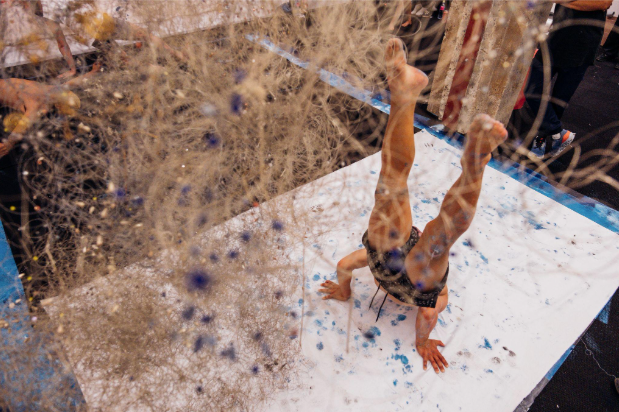
Workshop with Garage Dance Ensemble, Zeitz Museum of Contemporary Art Africa, Cape Town, South Africa, 2022 – Courtesy the artist, Thomas Dane Gallery and blank projects – Photos Lindsey Appolis © Igshaan Adams
There is also a strong sense of collaboration running through the show. Recorded conversations with members of Adams’ studio are available to listen to, and multiple languages flow through the space. The studio appears not as a solitary workshop but as a shared environment. Authorship becomes collective. This openness feels generous. It acknowledges that belonging is not built alone.
The permission to touch lingers as a quiet counterpoint throughout the exhibition. Even in the rooms where contact is no longer allowed, the memory of texture remains in the fingertips. The works begin to feel less like distant objects and more like surfaces that have already been encountered. This shift changes the pace of looking. One becomes aware of the labour inside each knot and bead, of the time embedded in repetition. The exhibition slows the body down. It encourages attention, patience and care. What we carry out of the space is not only an image but a sensation, a reminder that understanding can begin in the skin before it reaches the mind.
Exhibition view Igshaan Adams: Between Then and Now, 10.02.2026 — 23.06.2026, Mudam Luxembourg Musée d’Art Moderne Grand-Duc Jean – Photo Marc Domage © Mudam Luxembourg
Between Then and Now ultimately feels like an exhibition about value. It reclaims humble materials and treats them as sacred. It honours fragility without turning it into weakness. It allows scars and residues to remain visible. In doing so, Adams creates a space where memory is not something to overcome but something to weave into the present.
On view at Mudam Luxembourg until 23 August 2026, this exhibition proposes another way of thinking about time, community and identity. It invites us to step into that space between then and now and to recognise that we, too, are made of layered threads, moving and becoming.