Visiting Europe’s largest LGBTQ+ Archive
On a crisp, sunny day—with that autumn glow you only ever catch in Amsterdam—I headed out to the International Gay/Lesbian Information Center and Archive (IHLIA). Europe’s largest LGBTQ+ Archive sits inside the second largest public library on the continent, and I was intrigued by the idea of spending my afternoon surrounded by books.
I took the metro there—which I admit clashes with the image of Amsterdam as an all-biking paradise. But I dreaded having to cycle fifty minutes in freezing wind. It turned out to be a beautiful trip anyway, sunlight warming my face as I settled into a near-empty metro, a rare luxury in the city.
A few days earlier, I had emailed a staff member from the IHLIA to request access to materials, particularly those related to Luxembourg. After searching their online catalogue under the keyword ‘Luxemburg’, I sent in my list and was lucky to get an appointment that same week.
The walk from the Centraal Station to the Archive follows wide sidewalks along a vast canal, passing the popular floating Chinese restaurant. I spent my nine-minute walk (according to Google Maps) squinting at the water, stubbornly refusing to remove my gaze from the shiny reflections of the sun on the ripples of the canal, caused by the various boats carrying tourists around the city. As much as Amsterdam is known for its tourism and coffeeshops, rarely do people talk about how much the water claims the city as its own, surrounding it at every turn.
Eventually, I reached the Openbare Bibliotheek Amsterdam (OBA), which is impossible to miss in its enormity. I took the moving stairs to the third floor, where IHLIA’s information desk, book collection and exhibition space sit at the far end. Thea, the information service provider I had emailed, greeted me warmly and invited me to sit beside them. They handed the materials I requested: a 1989 issue of the Austrian publication Lesbenrundbrief featuring an article on the Lesbian scene in Luxembourg; a 2020 information brochure from Intersex and Transgender Luxembourg ASBL (ITGL); and, because I couldn’t resist, a second-edition copy of Giovanni’s room—not that it had anything to do with Luxembourg, but just one of my favorite books. The remaining items I requested could only be viewed digitally: a 2022 Luxembourg Pride button, a Rainbow Center button, a 2023 ‘Think Quality!’ condom wrapper, a Schneewittchen poster from Kollektiv Spackelter.
I sat there for half an hour, next to Thea, reading the article “Die gegenwärtige Situation in Luxemburg” from Lesbenrundbrief, travelling back to a time when queer life in Luxembourg was hidden. The hidden and hushed nature of queer identities as they bury themselves in gender roles and banking jobs. I tried to visualize a Luxembourg without the queer joy, resistance, and love, and felt a profound pain but also intense gratitude and pride for how much that is largely no longer the case. queer.lu being a physical testimony of this.
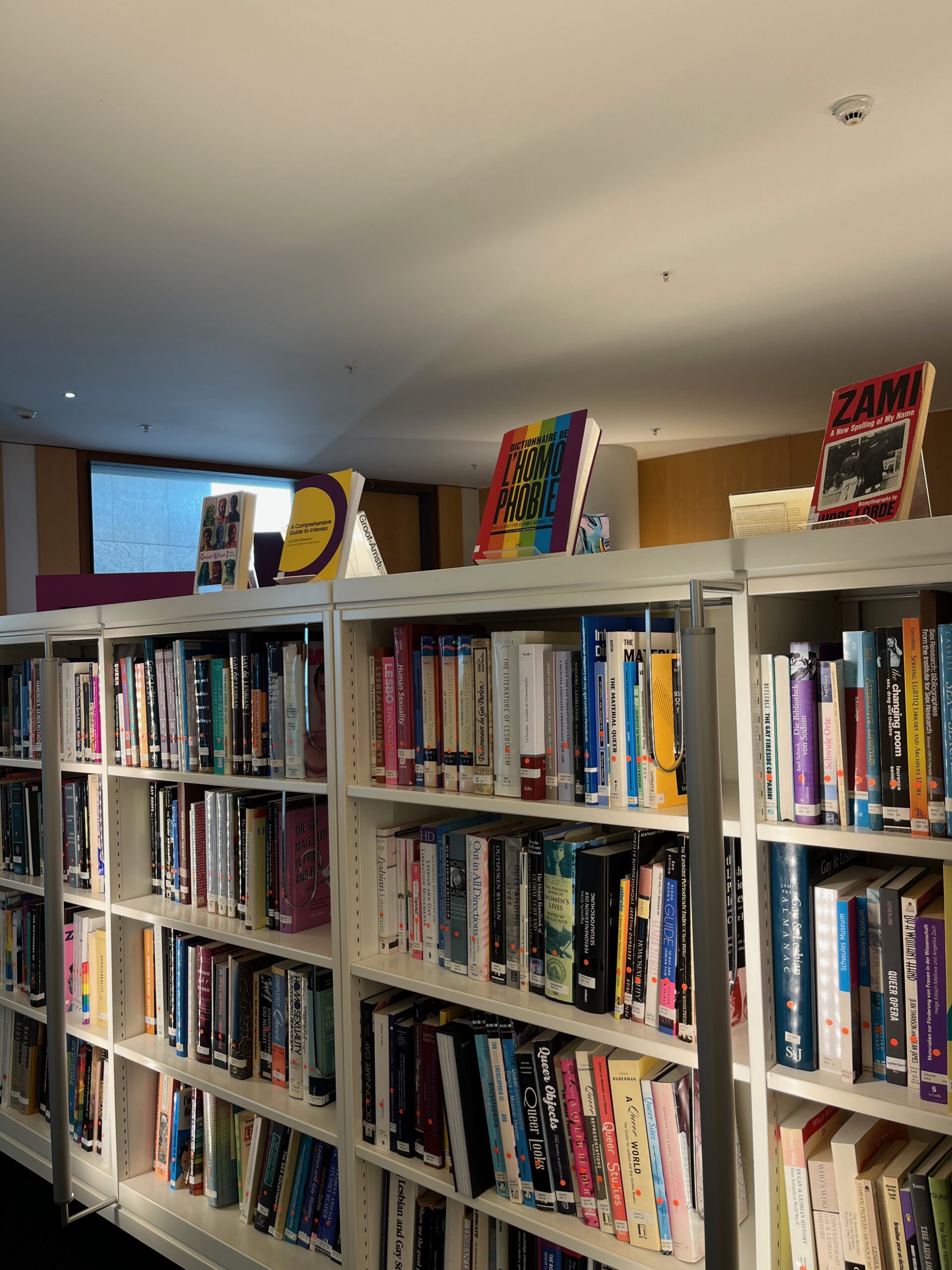
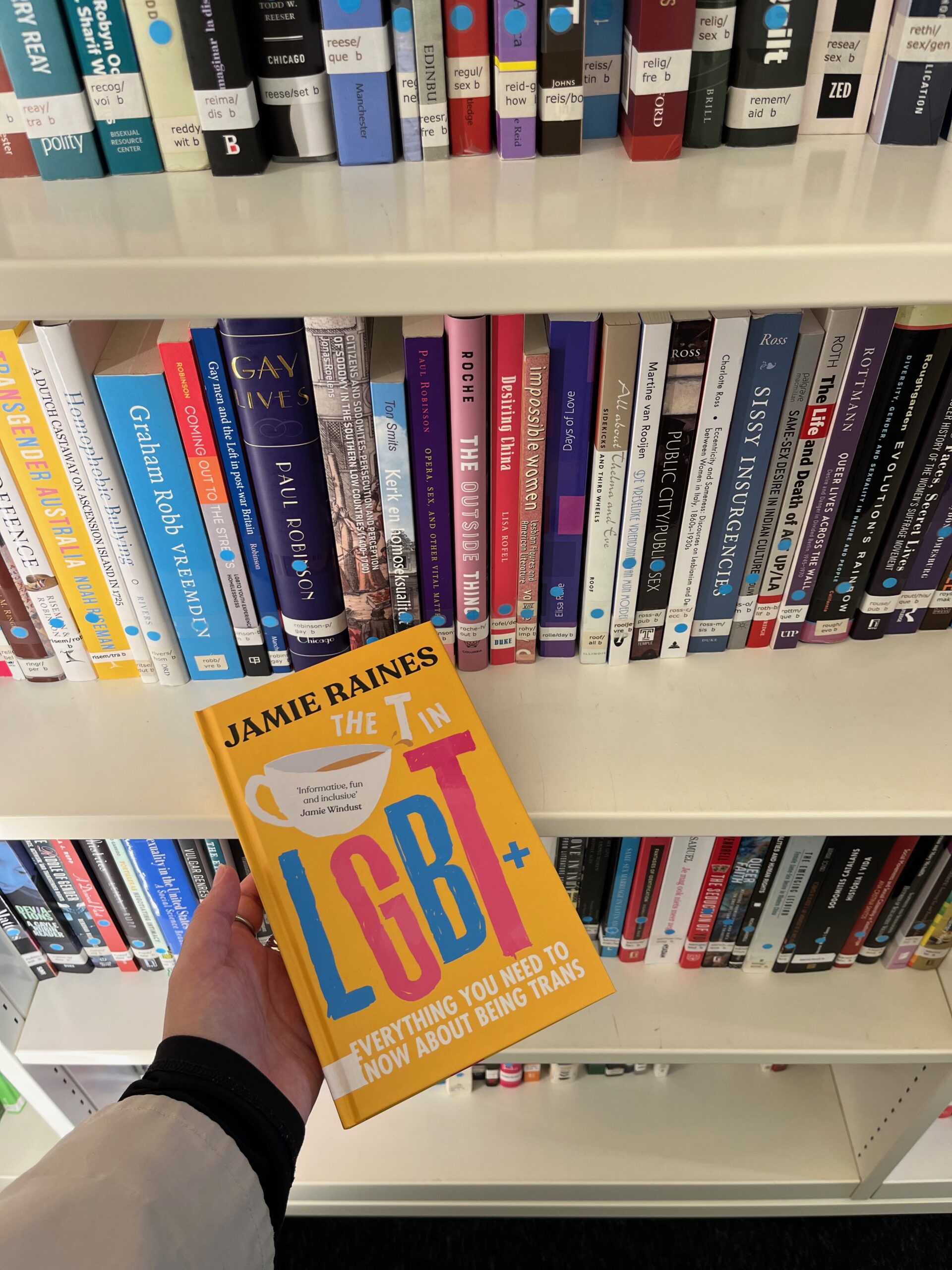
The bookcases opposite the information desk hold IHLIA’s most popular and recent publications. I wandered through them, frustrated only by the preservation rules that forbid borrowing, but grateful I could sit and read onsite. A few titles that caught my eye: Queering Bathrooms by Cavanagh, No Modernism without Lesbians by Souhami, Manifestations of Queerness in Video Games by Pelurson, and The T in LGBT by Raines.
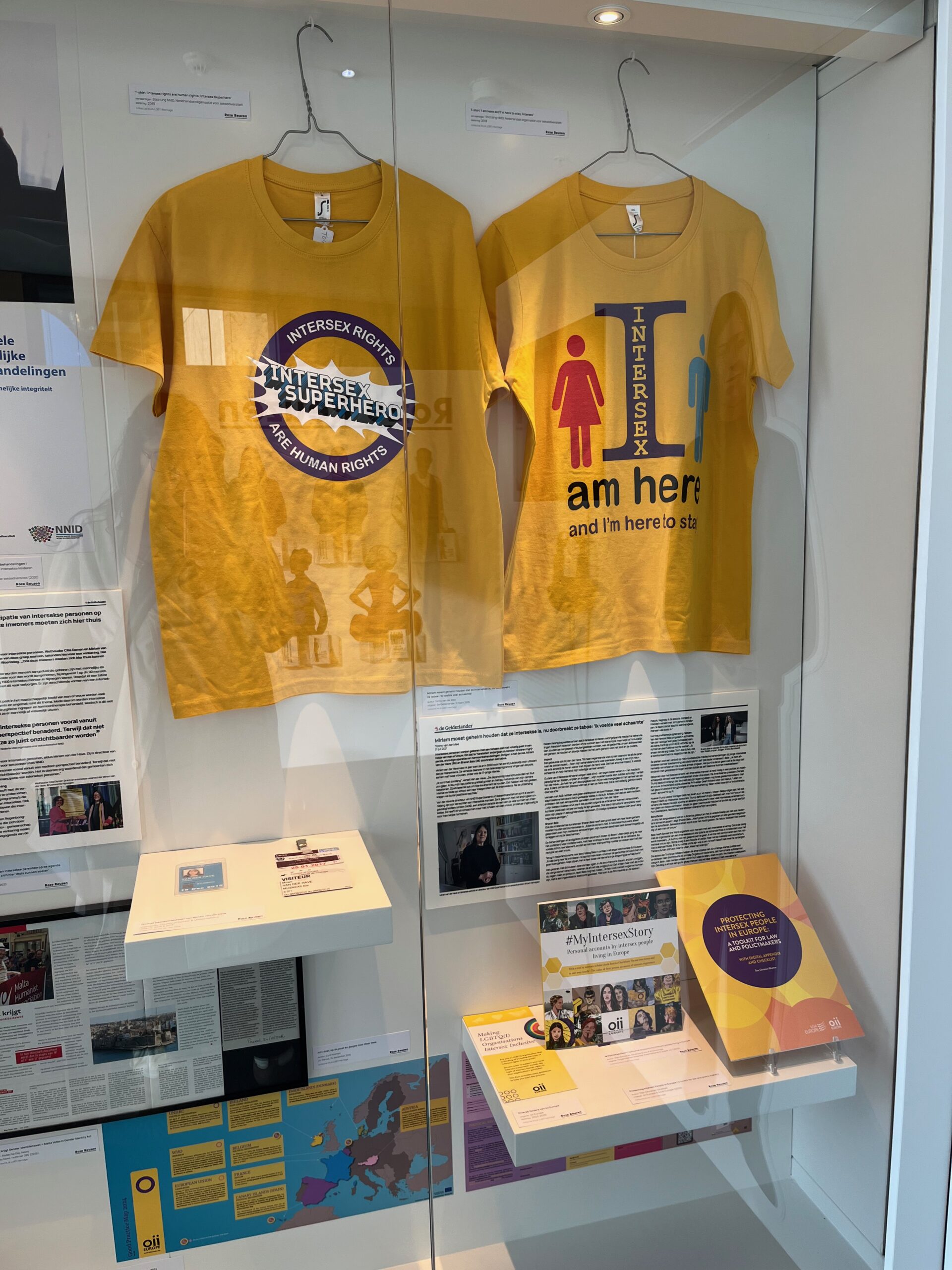
At the last shelf, I strolled into the current exhibition created in collaboration with Roze Reuzen (Pink Giants). Now in its second edition, the podcast—produced by IHLIA, Van Gisteren, Winq magazine and the platform With Pride—highlights Dutch LGBTQ+ activists and their lifelong efforts to give the community a voice. To celebrate this new season, Roze Reuzen and IHLIA selected archival material to trace activists’ paths across decades. Behind glass, I learned from and about Glenn Helberg, Thomas Wormgoor and Miriam van der Have, Ruud Douma (also known as Dolly Bellefleur) and Anne Krul, each shaping the movement in their own way. Works by James Baldwin, Audre Lorde, Strange Fruit Collective, and others, weave the exhibition into a tapestry of intergenerational activism and hope.
All the while, from the windows, Amsterdam canals glittered below. Experiencing this exhibition about queer endurance while bathed in reflected light from water that kept me company all afternoon made this experience even more emotional.
A quote on an open page from I Am Not Your Negro by Baldwin, displayed in one of the glass cases, stayed with me as I left—a perfect summary of what this archive represents, and will continue to represent, for a community still fighting erasure, yet coming back stronger and firmer in its principles and values.
It is the present.
We carry our history with us.
We are our history. James Baldwin · I Am Not Your Negro