Unexpected
political success
in swimming shorts
“Morning! Two sessions at the pool, please.”
A Friday morning like any other. Well, almost. Because actually, my partner and I always go for weight training followed by a swim on Wednesdays. On the way there, we’d already been imagining all the ways things might turn out differently on a Friday: what if Friday is exactly the day when everyone always turns up, and we suddenly find ourselves faced with a crowd that, by sheer luck, we’ve so far been spared on Wednesdays? What if we disrupt the familiar ecosystem and, like intruders from a parallel world, throw the routine off its usual rhythm? Does the turnstile actually know who we are by now, and might it perhaps deny us entry because it’s so confused to encounter us Wednesday regulars on a different day of the week? Then it suddenly dawned on us, to our relief: it’s the Easter holidays in Luxembourg, which means the weekly routine is at least somewhat suspended. And so, after passing through a broken turnstile (which, at least, couldn’t complain), the usual change of clothes and the obligatory pre-swim toilet visit, we found ourselves standing before an almost empty swimming pool and a completely free gym area all to ourselves.
When working out on the machines, I always wear the same outfit I’ll use for swimming afterwards. From what I’ve observed, most of the other visitors do the same, which is hardly surprising given the tropical swimming pool climate that also prevails in the gym area. At most, a few people put on a sports tank top or wear training gloves. Specifically, my outfit consists of a sporty bikini top and a fitted bikini bottom, over which I wear short swim shorts from the women’s section that sit well above the knees and match the top. Personally, I think I look quite athletic in them.
Having finished with the weight training machines, I went, as usual, to shower off the sweat from my body and my clothes (which, from what I’ve observed, a number of visitors unfortunately don’t do) and then headed into the swimming pool. I noticed that a young lifeguard, whom I hadn’t seen before – apparently different people work on Fridays than on Wednesdays, which is my explanation – had been watching me very closely as I walked into the pool. As it was so quiet, however, he didn’t have much choice in terms of swimmers to focus his attention on, so I swam undeterred for ten minutes from one end to the other. To round off the fitness experience, I finally lay down on one of the reasonably comfortable sun loungers and looked around, happy and content. That’s when I spotted the aforementioned swimming instructor, who suddenly headed straight for me. “Excuse me, madam.” I sat up with a start and replied, my heart rate jumping from 60 to 120: “Yeah?” I already had an inkling of what was about to happen. With unmistakable uncertainty in his voice – for this situation was obviously just as awkward for him as it was for me – he pointed out that the swimming shorts I was wearing weren’t allowed. Memories of a bikepacking tour through France immediately came flooding back. Outside every single swimming pool, no matter how small, you’ll find meticulously detailed signs specifying what sort of clothing is permitted – or rather, the thousands of ways in which it’s forbidden to enter the water. In fact, one of the prohibited combinations frequently depicted was my exact swimming outfit, which is why in France I had, at most, dangled my legs into the water from the poolside under supervision – and even that felt like a highly illegal act without wearing skin-tight clothing, which for women is supposed to cover the genital area and nipples with as little fabric as possible.
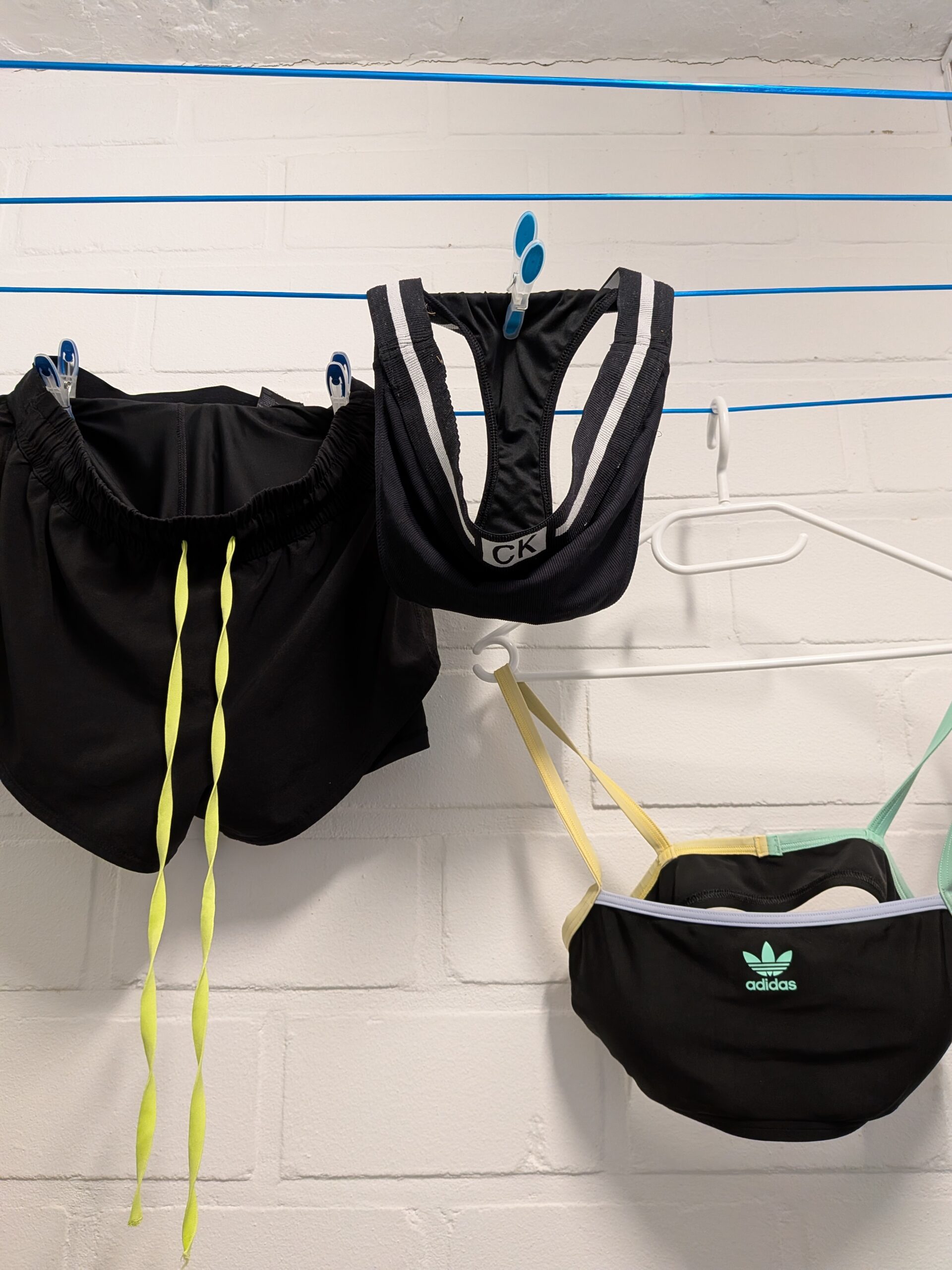
In front of the broken turnstile, however, there was only a single illustration showing a pair of crossed-out trousers reaching below the knees, the only thing missing to complete the cliché was a hibiscus pattern. I certainly don’t wear that sort of thing. So I asked the lifeguard what the problem was with my swimming shorts. He replied, looking even more uncomfortable, that he could clearly see I was definitely wearing swimwear and emphasised that my shorts didn’t have any pockets or anything of the sort. What bothered him, however, was the thin layer of fabric that lay loosely over the skin-tight main part of the shorts. No, it didn’t bother him personally, he just didn’t know how to explain to other bathers my short but slightly loose-fitting shorts were fine, while knee-length trousers made of sturdy material with a hibiscus pattern were a no-go. Surely I must understand that. Perplexed, I acknowledged the remark – which, incidentally, sounded rather like an apology – with an “Er, okay?”, but in the same breath pointed out the lack of clarity regarding the dress code at the entrance. As there was no real reaction, I added that I would simply stop swimming from now on. That seemed to give him pause, so he walked back to his colleagues, even more hunched than before.
Frozen and flooded with emotions, I remained seated on my folded-up deckchair, waiting for my pulse to slow down enough for me to go and have a second shower. Fortunately, my partner had noticed the situation from a distance and came over to ask what had happened and whether I was all right. Relieved by his presence, I began to explain, but was interrupted shortly afterwards by a middle-aged man who turned out to be the head lifeguard, closely followed by the young lifeguard and another colleague whom I’d often spotted on Wednesdays. After a few scrutinising glances at my hip area, a verdict was reached: in my case, we were dealing with a grey area. No one was to blame for this; the instructions came from the very top. Once again, I replied that, if that were the case, I wouldn’t be able to go swimming any more. “Why?” the head lifeguard continued; as a woman, I surely had a huge selection of other stylish swimwear to choose from.
I still can’t quite explain what happened next. It may have had something to do with it being Friday, or with the fact that I’d forgotten to take my ADHD medication that morning. But perhaps an unexpected surge of self-confidence had simply built up inside me, just waiting to burst out at that very moment. In any case, I began to explain that I am a trans woman. Finding myself facing three questioning faces, I went into more detail and explained that I haven’t had any gender-affirming surgery on my genitals and that with certain swimsuits there’s a risk of a bulge showing in my crotch (unless I can be bothered to cover my genital area with waterproof tucking tape before going for a swim, even though I’m allergic to plasters and simply can’t be arsed). The loose-fitting fabric of my swim shorts effectively helps to conceal any visible contours in the genital area, which gives me a huge sense of security. That way, I don’t have to constantly check whether my bikini bottoms have come loose or how far apart I can spread my legs whilst swimming to make sure nothing slips out of place. Without asking any further questions, the head lifeguard, having listened carefully to my explanation, announced that the type of swim shorts I was wearing were now permitted. For all bathers. I was already ready to fire off my next argument and tell him about a cis friend who has large labia and therefore faces similar struggles to mine, but no: my swim shorts are allowed. With immediate effect. And that goes for everyone. Neither the young swimming instructor nor Colleague Number Three – who, on Wednesdays anyway, never seemed to have had a problem with my swimming outfit, or at least never mentioned it to me – had any objections, and they smiled at me and my partner in a conciliatory manner. The crowning moment came when the head lifeguard offered me a conciliatory fist bump, which I returned as if on autopilot, and invited us, as compensation for the inconvenience, to use the sauna area free of charge for as long as we liked – he would even come along beforehand to show us everything.
Whilst I was still in the shower, a fully formed email to the facility was already taking shape in my mind, setting out in writing what had happened and the subsequent decision, and presenting my arguments in detail once again in an informative manner. It begins: “I don’t usually talk to strangers about my genitals when we first meet, and nobody should have to. Today, however, I felt that it might at least set something in motion.” Despite its ultimately positive outcome – which, in my experience, is a clear exception rather than the rule – the situation illustrates just how much arbitrariness and ignorance trans people are exposed to on a daily basis in numerous areas of life. That is why educational materials and training programmes are needed for swimming pool staff that conveys the basic skills for respectful, discrimination-aware approach to trans, intersex and non-binary people – with the aim of reducing uncertainty, to strengthen the confidence of lifeguards in their day-to-day work, and ultimately to ensuring a safe and inclusive space for all pool-goers. This, incidentally, would also benefit endo and cis people and it takes nothing away from anyone. Training plans and draft leaflets are already available. What is missing is financial support and a willingness on the part of Luxembourg’s swimming pools to make use of these training opportunities. So that transmasculine people who have not had top surgery are not questioned about wearing a binder and/or a swimming shirt. So that everyone can use the changing rooms and showers that are right for them. So that everyone can go swimming without fear.
Endo: ‘Endo’ or ‘dyadic’ refers to people who are not intersex, i.e. who do not have variations in their sex characteristics. Their physical characteristics correspond to the standard medical definitions of male or female. These terms are used to make these definitions visible.
Source: caitia.de